

I have written on various aspects of artificial intelligence for the last two weeks. My intention was to move on to do some in-depth analysis on sovereign debt, interest rates and taxation. But that will wait till next month. So much happened this week in the AI world that it almost requires comment. It seems the software that we have been using for decades is not as secure as we thought. Credit problems in the AI space are not going to be contained to just the AI space. It is going to have impacts all throughout the economy and global markets. I guarantee you central banks are paying attention as it is affecting what they have to charge for sovereign debt.
AI is rapidly increasing in power and there is no clear leader as the hyperscalers jockey back and forth over the lead. And China is right on everyone’s heels but with a different “feel.” The impact of artificial intelligence on GDP, especially because of the buildout and capital expenditures, is profound and is likely to become more so. Everything we want to do is going to require more connectivity and more complex systems so that we can seamlessly go on with our day without having to think about the complexity behind us. And the various AI companies, chip manufacturers, robot manufacturers, telecom and bandwidth providers are all working as fast as they can to make our life easier… and at a low, low subscription price.
It’s a lot to cover, so let’s jump in!
When a Credit Default Swap Isn’t about Credit
Just this last week we saw Broadcom's (AVGO) $63 billion Anthropic financing vehicle, Meta's (META) $95 billion stock sale, neoclouds still shut out of credit, SK Hynix memory sold out through 2029, rising GPU rental prices, Google (GOOGL) selling TPUs to OpenAI and Oracle (ORCL) (a TPU is a type of processing unit that competes directly with Nvidia (NVDA)), and a relief rally led by optics. Not to mention the potential trillion-dollar IPOs. Things are moving and changing incredibly fast.
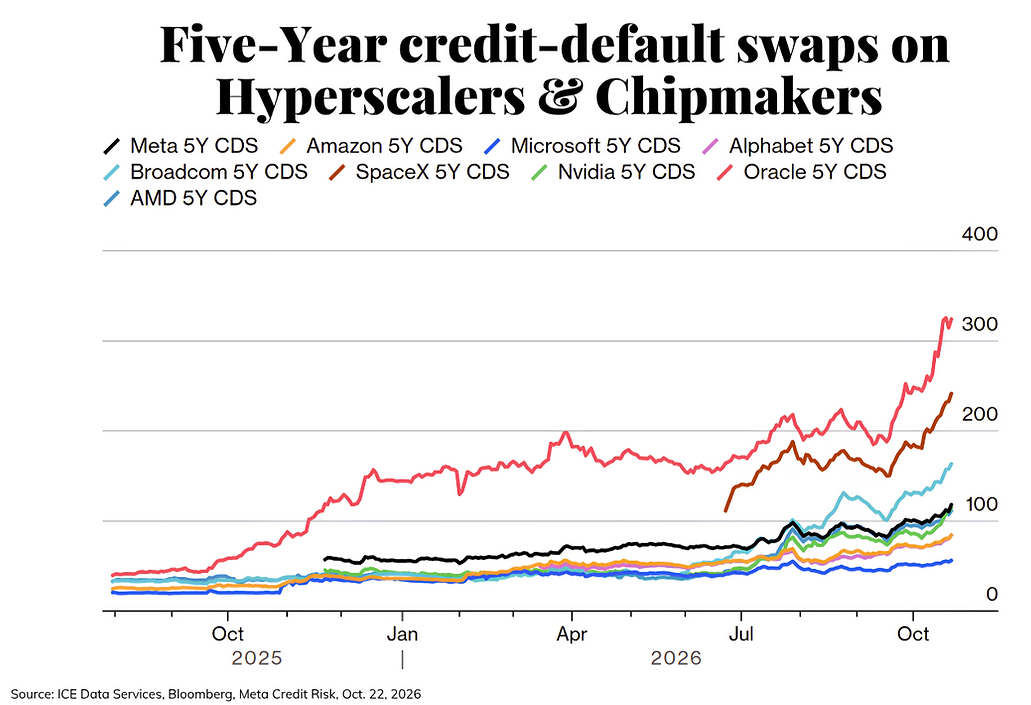
Versions of the chart below have been circulating all week. Why are companies, banks and funds buying credit default swaps (CDS) on companies that they never expect to actually default? Seriously, who in their right mind thinks that Nvidia or Amazon (AMZN) are going to default on their credit? I get the need for CDS on lower quality debt and especially on some of the Neo companies.
Then David Bahnsen’s Dividend Cafe offered not only this chart but an explanation. (Note: I tried to summarize but did a lousy job of it. Let’s just read David’s words. Emphasis mine.)
Are People Getting Scared?
“The cost of insuring against a default in Oracle's debt has skyrocketed in recent months. This suggests a growing concern about the credit risk of Oracle.
“But the volume of protection being bought on all credit default swaps has gone up 5x (500%!!!) in three months. Not only are investors paying more for it, but they are buying more of it, where the ‘it’ is protection against default of debt from companies such as Oracle, SpaceX, Google, Amazon, Meta, Broadcom, and Nvidia. Total corporate CDS volume across the universe is much higher in nine months of 2026 than it was all of 2025.
“But is this a sign of fear and loathing in Las Vegas (see what I did there), or is it just math? AI-affiliated debt issuance was about $100 billion last year - which now feels like someone's lunch money. It has surpassed $466 billion so far this year, with plenty of time still on the clock. It stands to reason that a greater volume of debt issuance rationalizes a greater volume of insurance against that debt.
“But I do not buy the idea that the cost of buying protection on Oracle's debt going up (chart above) or even Meta's and Nvidia's (also higher) is a pure by-product of ‘fear of default.’ I think it is worse than that.
Source: Dividend Cafe
“I am not here to write that there will be no defaults in any of the bonds of any of these issuers, but if you put a gun to my head I would not predict that these senior debt positions will face default (which is an entirely different category than what could happen to their equity). And yet, the increase of default protection is entirely rational as a by-product of liquidity in the marketplace, needed hedging costs, and market technicals. Meta and Nvidia both saw their CDS spreads widen over 100 basis points, and I don't think a single buyer of that protection believes they are ever, ever, ever going to ‘default.’
“Rather, they need the liquidity to buy more. And buying more means taking down the exposure on your books by buying protection. Rinse and repeat.
“And yes, I have seen this movie before.”
(You can subscribe to David Bahnsen’s Dividend Cafe at the link underneath the chart. And also read a much fuller explanation on credit in the AI space.)
A quick comment on Anthropic. They are planning an IPO and we got their disclosure documents. The first scary headlines said that Anthropic lost $80.7 billion in the first half of the year. Find the lifeboats!
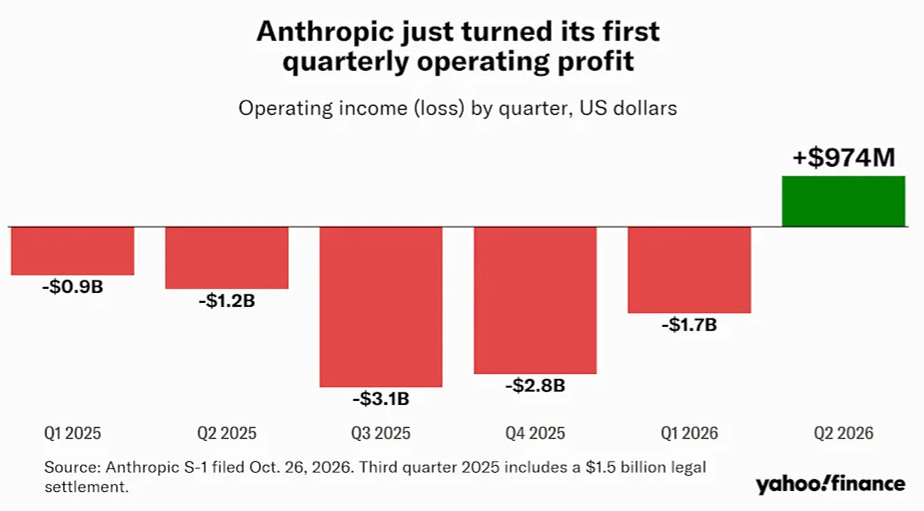
Well, not quite. From Yahoo: “Why the $80.7 billion net loss for the first half? Nearly all of it is accounting. As Anthropic's value climbed, so did the value of convertible notes and similar securities it sold to investors — IOUs that turn into stock. Arcane accounting rules require the company to book that rise in the company’s value as a loss. The charge came to $72.4 billion, and similar paper charges account for the rest.
“No cash left the building for those. Over the full six months, the operating loss was $693 million, because the first quarter's loss outweighed the second quarter's profit [of $974 million].” That is the right trajectory.
Source: Anthropic is losing $80 billion on paper — and just made money where it counts
Security by Obscurity
By now, you have probably heard about how artificial intelligence is finding “exploits” in various important pieces of software that run the Internet. Mind you, they are not creating new ones. These are ones that already exist, and in some (many?) cases the developer knew of them but just figured that nobody could find them. Oops.
There’s a great deal of discussion about how we should deal with this. There are some who want to keep all the information about the exploits private. I am not sure if that is possible. Basically, we now practice something called Security by Obscurity. By that we mean that the exploits are so hard to find that it becomes its own form of security. And as I relate below, that has worked for 30+ years.
I first heard the term security through obscurity used in connection with AI from The Deep View. But it turns out the term has its own Wikipedia page. In security engineering, security through obscurity is the practice of concealing the details or mechanisms of a system to enhance its security.
An early opponent of security through obscurity was the locksmith Alfred Charles Hobbs, who in 1851 demonstrated to the public how state-of-the-art locks could be picked. In response to concerns that exposing security flaws in the design of locks could make them more vulnerable to criminals, he said: “Rogues are very keen in their profession and know already much more than we can teach them.”
That is the situation now in the AI space. The horse is out of the barn and well into the North 40. The rogues have been practicing for 30 years and AI just gives them better tools than simple brute force.
I attended a private cybersecurity conference maybe 10 years ago (time flies). I am simplifying a longer topic for brevity. It turns out that there is a small community of “white hat hackers” who search through Microsoft (MSFT) and Apple (AAPL) software (and other systemically important code) as opposed to the black hat hackers who are trying to be able to steal your data and money and shut your system down for blackmail.
If the white hat hackers find a “backdoor” into the software, depending on what it is, they then contact a broker who agrees to keep their name anonymous, who will contact Microsoft or whoever the target is, and negotiate a payment for the exploit in exchange for a way to fix it. Microsoft gets a fix for a problem in their code they didn’t know existed, and the hacker can make a very comfortable, if boring, living in rural Alabama finding a few exploits a year.
I am not saying we should pity the poor hacker, but he now has serious competition, if they are not in fact using AI to help them find the exploits themselves. In any event, various AI systems are finding those exploits at a much faster rate than the plodding line-by-line hackers. OpenAI and others are trying to work with the developers to give them a head’s up before that information gets into the wild, but last week information about the vulnerability with PHP, which stands for PHP: Hypertext Preprocessor, became public.
PHP is a widely used, open-source, general-purpose scripting language that is especially suited for web development and can be embedded into HTML. It runs on about 70% of the systems worldwide. When I read about it, I called the associate who runs technology for one of the companies I am associated with and asked him about it. He said it is a huge deal, but they solved it the day before. Microsoft was already in the process of fixing it when the news came out.
We are lucky this was basically a nonevent. We have no idea about the next time. The AI developers are all over this, as they understand what is at stake and their own risk.
Mauldin Economics’ own Jacob Shapiro made the following comments:
“It is not hard to see why this is not just an individual issue but a geopolitical one. States exist because they are sovereign, and to paraphrase Max Weber, sovereignty is when the government has a monopoly on the legitimate use of force within a state’s borders. Not just our personal lives but the infrastructure upon which the state depends, even the systems and tools and weapons of coercion and violence that governments have at their disposal to preserve and enforce the rule of law, now live on the internet.
“So, we must extend Weber: Sovereignty also means a monopoly on the control of data within a state’s borders. AI models gift capabilities to everyone from individual hackers to state-backed hacking pools to disrupt or control critical infrastructure and defense. The state enjoyed the freedom of the internet as much as we did, but now the state must control the internet, or else move its critical capabilities and information into a protected sphere that cannot be breached by a bored Russian hacker in his grandmother’s basement on a random Tuesday.
“The CEO of Cloudflare (NET), a global cloud infrastructure and cybersecurity company, noted that the fallout was only just beginning. In his words, ‘The next two years are going to be incredibly fraught with new tools that have infinite patience to go look for vulnerabilities across the internet… it’s going to feel like the sky is falling.’ Cognition CISO Alex Stamos noted on the Big Technology podcast that cybersecurity companies are already so backlogged with urgent fixes and patches from current clients that there is no capacity for immediately responsive help.
“The temptation is to read all of this as a technology story, a bad month to be patched and forgotten. And it is a technology story. But there is also a transcendent political component to this, because Black October is the bill coming due on the digitalization of our lives. At stake in this assault on the digital realm is the sovereignty of the state and the privacy of the individual, and it is not clear that we can save one without sacrificing the other.”
I have had conversations on this very topic. When the founders and major actors in the AI space tell us that we need regulation, I pay attention. But who does the regulation? Who watches the watchers? We only have to go back six years to see what government bureaucracy run amok can do trying to enforce Covid restrictions. How many of us now think that we should have given such broad power to so few people working behind curtains that we never knew existed?
And do we want to give government bureaucrats the ability to throw back the development of AI when we are in a very real race with China? But what happens if we don’t?
This is a very real question because the problems themselves are very real. I’m not going to go into doom scrolling about all the potential problems with AI, but we all know they exist. All it will take is one major blowup, one existential crisis where people die and the demands for “protection” will escalate. Understand, I’m not arguing against regulation of AI, just the character of that regulation and what it does and at what expense to our privacy and our own personal sovereignty. As we will see below, China is right on the heels of US developers of AI. I don’t want to sound too paranoid, but I likely will, as I am uncomfortable in a world where the power of AI is not necessarily in friendly hands and the West does not have the ability to counter it. I am reminded of the old Mad Magazine Spy Versus Spy, which first debuted in 1961. (Yes, I know that dates me.)
Getting regulation on AI right is going to be extremely tricky. We need to make sure that we are advancing at the correct technological pace, but that we, and hopefully China in cooperation with us, are making sure that malicious actors are kept under control. Don’t ask me how to do that because I don’t understand. But I know that it needs to happen.
Keeping Up with the AI Joneses
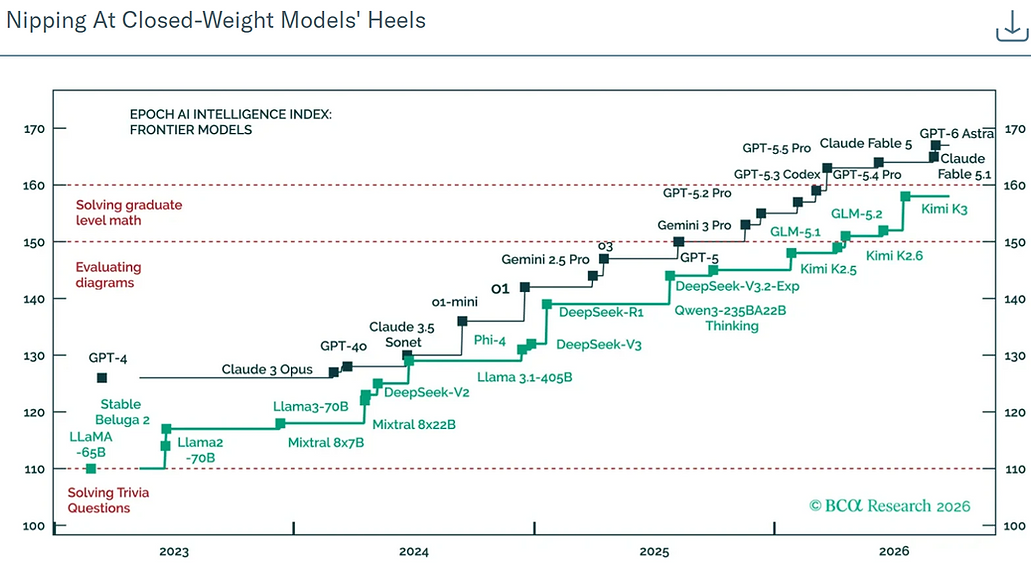
I have been a fan of the Bank Credit Analyst since the late 1980s. I became good friends with the editor Martin Barnes. They do solid institutional research, and I find it very balanced and calming. They courteously sent me a new report on AI and technology. We have all seen this chart before, but this is an update. Basically, it talks about how the computing power of AI is increasing at an ever more rapid pace. Not only is the computing power going from the lower left to the upper right, but each new level is lasting a shorter period of time before it is superseded by the next version, either internal or from competition. No one company maintains a comfortable lead. And the green line is the results of competitive AI in China. Visually, and very roughly, they seemed to be about six months behind the US a few years ago, and now that differential has closed. But OpenAI and Anthropic are changing leads as they introduce new versions. This is a race the US and the West cannot afford to lose. We don’t necessarily have to “win,” but we need to be able to control our own destiny and not be subject to blackmail. Then again, more skeptical minds looking at the costs of capital expansion for AI might ask: Is this a race we can afford to win?
Source: BCA Research
BCA’s new AI-focused researcher, Matt Dyson, observes that AMD (AMD) is beginning to catch up with Nvidia, something I noted last week when I asked, could Nvidia maintain 70% margins? The answer is clearly no. Other chip manufacturers are also moving up the chip power curve. On the other hand, the three main memory chip companies have very little competition and prices have gone through the roof. Apple had a stranglehold on the industry and kept prices on memory chips down. When those chips became necessary for AI, the price for DRAM in just the last year has gone up 400-500%!
There is so much more to cover, but we are at my word limit. Stay tuned…
Comments
Log in or sign up to join the conversation.