


This week the widespread expectation of a good night for Democrats was correct, even understated. I don’t know anyone who expected the kind of brutal shellacking voters handed Republicans. I certainly didn’t.
I try not to write about politics in this letter. I’d rather focus on economics and investments. But this week, politics impacts economics so we need to address it. Let me see if I can express what I think many voters were feeling:
This election was a sad but understandable backlash against all things Republican, which at its base was all things Trump. Voters saw multiple problems with their own eyes: high energy and healthcare prices, inflation, ham-handed deportations, constantly changing and very unpopular tariffs and government seemingly by whim. An expensive and unpopular war where the rules of engagement changed almost weekly, the head-snapping back and forth on Putin and Ukraine, gaslighting the country about Hormuz and peace deals that never happened, none of this portrayed a thoughtful adult in the White House. Appearances matter.
You can’t tell the American people they are enjoying the greatest economy ever when they clearly aren’t. Prior to the great recession, the US economy often grew at 3% or more. Since then, it’s been more like 2%. That’s not recession and not bad, but it is not the greatest economy. It is at best, “muddle through.” And for those in the bottom two-thirds or so, even muddling through is a struggle. They can see it in front of themselves. The K-shaped economy just seems worse if you are in the lower portion.
Attacking fellow Republicans for not agreeing with him 100% of the time and choosing candidates based on loyalty and not on competence was a clear unforced error. RINO (Republican in Name Only) is what this president called Republicans who only agree with him 80% of the time. Reagan called such people “allies.” No wonder many normal Republicans either stayed home or voted for the Democrats.
Let’s not forget aggravating the very coalition that came together to elect you in 2024. Not to mention the odd focus on monuments and ballrooms, etc. Just as all roads lead to Rome, in this election, all roads lead to Trump. He gave the Democrat controlled congressional committees numerous targets for next year.
Now we will see what it means. In particular, we will see what it means for what I consider the top global economic danger: a worldwide, US-led sovereign debt crisis.
As regular readers know, this isn’t a new concern for me. I’ve been warning about it for many years, including this time two years ago. I wrote several letters in late 2024 describing the debt problem and how I hoped new leadership would start addressing it. I said this in my pre-election November 2, 2024 letter:
“I am quite certain about one thing, though. The gargantuan federal debt will get larger still, bringing a global debt crisis ever closer. We are long past the point where even serious spending cuts or revenue increases can avert this. We should still do them, but we now need major restructuring, not possible given whatever the outcome will be in this election. We are on a one-way road to crisis. There’s no turning back.”
I could write that same paragraph today. Nothing has changed, Most of the Western world slouching toward a global sovereign debt crisis, led by the United States. Today we’ll review what happened since that 2024 letter and what the latest political changes could mean.
At 77, I have been through a few large swings back and forth since first voting in 1972 (I voted for McGovern and then Carter.) I am not certain of the way forward, but I am 100% convinced the Republic will survive. This is still the greatest country and the greatest system in the history of the world. Although right now it’s a little bit tarnished.
Debt Be Not Proud
All that being said, nothing that happened this week changes the trajectory of the coming sovereign debt crisis. It is still building up into what will be a monster crisis. And seemingly no one in Congress cares. According to data tracked by AdImpact, just 30 political ads out of the entire 2026 campaign cycle explicitly referenced the national debt or deficit, ranking 52nd among campaign topics and representing a tiny fraction of a percentage point (less than 0.1%) of total ads.
Truly, neither party is about the debt. It’s hard to be confident about this government, but I am confident about one thing. In the next two years the deficit will continue to grow willy-nilly. Democrats ran on expanding access to healthcare and bringing back the temporary increase in Medicaid that was passed in the Covid era. Which reminds us of the Milton Friedman (paraphrased) old line, “There is nothing more permanent than a temporary government program.” The defense budget, while bloated, is going to need attention as we have run through our missiles and arsenal. They have to be replaced. The Social Security trust fund is expected to run out of money in 2032. More below.
All this will lead to increased national debt, and that will be my focus for these letters in the coming weeks.
Enjoying Our Debt
We’ll begin with the big picture. This chart shows debt held by the public (i.e., excluding intragovernmental debt like the Social Security Trust Fund) since 1970. The left axis is a log scale to make the growth rate clearer.
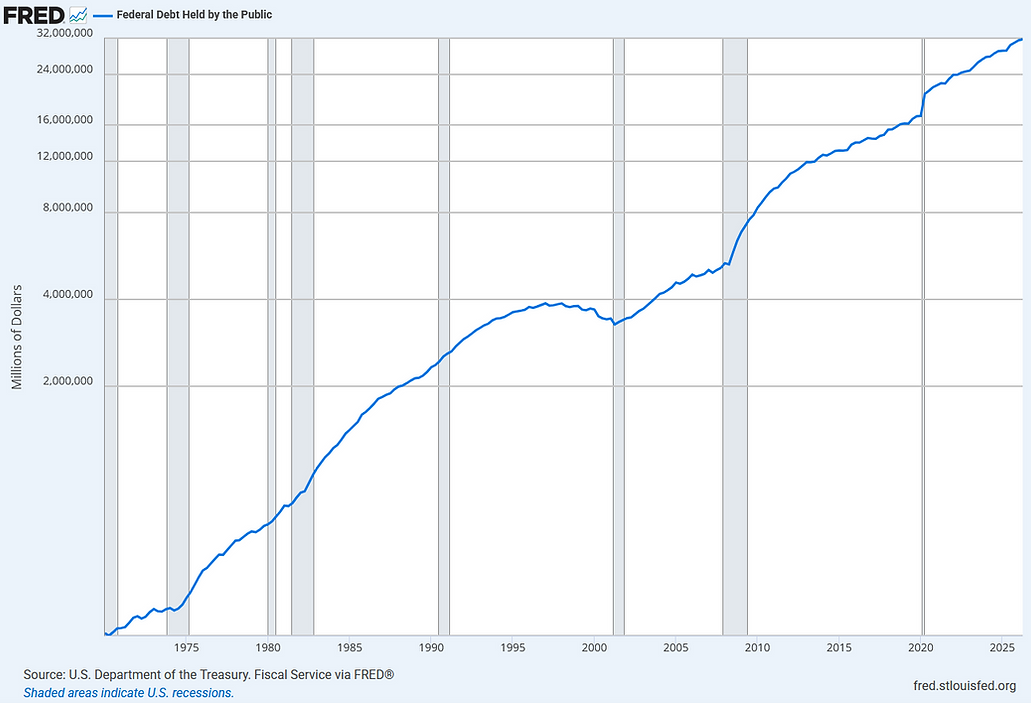
The striking part to me here is how the growth rate has been so steady. The line flattened and (briefly) went lower for a few years around 2000. It also bent upward in the 2008 and 2020 crises. Otherwise, the angle has been pretty consistent for decades. I think that speaks to how much we enjoy our debt – or, more accurately, the things it lets us buy.
Now let’s zoom in on the last five years, also with a log scale.
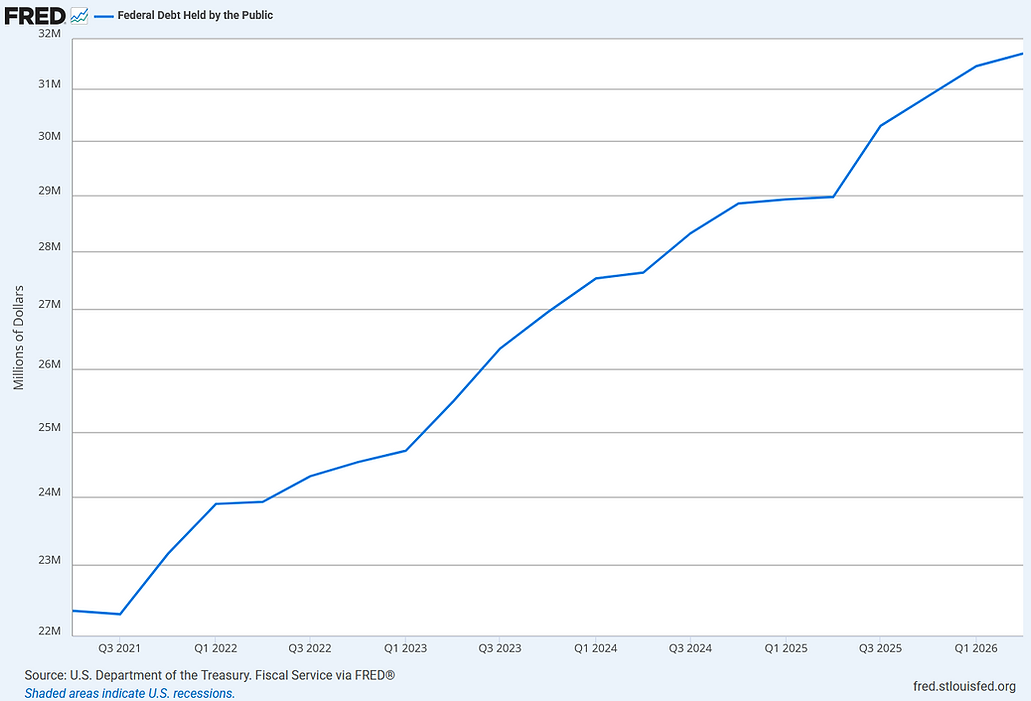
Strip out the bottom scale and this resembles the long-term growth line. In terms of debt accumulation, the Biden and Trump II administrations look a lot like their predecessors.
Comparing administrations is a bit tricky. For one, we are already three months into a fiscal year when a new congress and president take office. They then spend months hammering out whatever they want to change, which often takes effect still later. So, a fair marker is probably the beginning of the next fiscal year.
At the end of Q3 2021, debt held by the public stood at $22.3T. By Q3 2025 it was $30.3T. Four years of Biden/Democratic management added about $2T per year to the debt, on average.
According to Treasury data, debt held by the public stood at $32.4T at the end of Q3 2026. In the first year of Trump/Republican fiscal control, the debt grew $2.1T, a similar pace.
(Quick sidebar: the actual US debt is $40.6 trillion. Most economists don’t include the Social Security trust fund and pension obligations because we technically owe it to ourselves. But eventually those trust funds will have to be spent, which means that we will borrow that money again. It is a distinction that is quite technical and needs a full letter for explanation. Someday…)
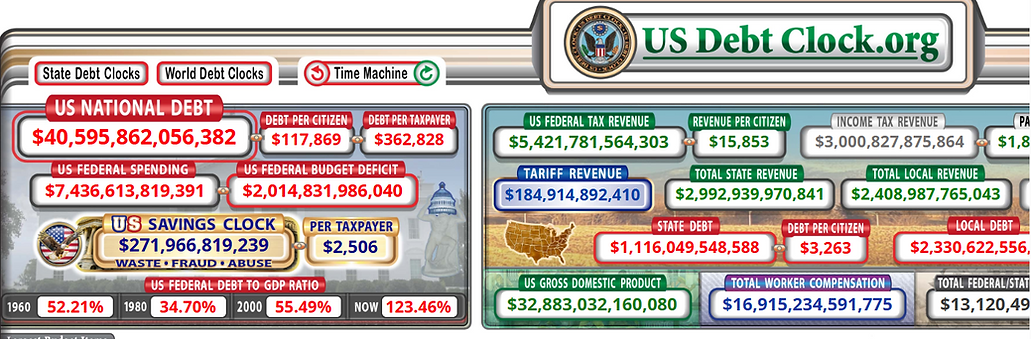
Neither party is seriously interested in reducing the debt. They simply grow it in different ways. That’s been the case for many, many years. And to be fair, this is because politicians of all stripes respond to the incentives before them. Delivering higher benefits and/or lower taxes produces political rewards. Solving far-off future crises doesn’t.
Impossible Bargains
In that 2024 letter I talked about the possibility of a “grand bargain.” Let’s revisit that with some edits to make the point that the more things change, the more things stay the same:
“One of the most frustrating things about this [US debt] topic is the way people think it’s easy to solve. Twenty years ago, maybe so. We were close to a balanced budget and, at least in theory, could have kept that course and began chipping away at the debt. Alas, we didn’t.
“We have now reached a point where all the options are terribly painful. I sometimes compare it to a drug addiction. The first and hardest step is to admit you have a problem. ‘Hi, I’m Uncle Sam. I am a debt addict.’
Due to the nature of the problem, you can’t just go cold turkey. That deficit and debt is so intertwined with so many lives in the US, changing the rules will require a lot of adjustment. People don’t like change that negatively affects them, You have to detox slowly, methodically, and it has to be bipartisan to be accepted.
“When I hear well-meaning people say we can solve the debt by cutting this or that spending, or by raising taxes on the rich, I just ask them to look at the numbers. You can’t do it without producing major side effects. Yes, there are things that would help. We should do them. But make no mistake, they’re just nibbling around the edges.
“As I said, the political incentives all push in the wrong direction. We can’t fix this unless both parties somehow make a grand bargain. As of now, neither seems interested…”
Common Ground?
The big question once Democrats control the House and Senate in January will be how/if they and Trump find ways to work together.
In theory, divided government helps force compromise. Everybody wants to show voters they are “doing something.” The best example is Bill Clinton and Newt Gingrich when Republicans took the House in 1994. They actually managed to reduce spending and stimulate growth in ways that generated more tax revenue. For a brief time, we were on track to balancing the budget and even starting to pay down the debt.
That kind of cooperation may seem unlikely this time, but it’s not impossible. Both sides will have things the other wants. The Democrats won’t have enough votes to pass legislation over Trump’s veto, but they will still have ways to make his life either better or worse. I think it is more likely Trump could simply ignore them and turn his attention to foreign policy, which is where most lame-duck presidents focus in their last term. There he can operate largely without congressional permission. But maybe they’ll find some common ground. Stranger things have happened.
This doesn’t seem to be what markets expect. Initial post-election reactions were for two years of gridlock, leaving tax and spending policy on autopilot at current levels. That may be what happens, but it isn’t something to celebrate. The current course isn’t good. A plane ascending on autopilot will eventually reach an altitude where it can’t fly anymore.
Furthermore, each passing month means more of the existing debt has to be refinanced at higher rates. About one-third of the debt will mature in the next year. If inflation doesn’t settle down, the Fed won’t be able to cut short-term rates and may need to raise them.
We have reached a point where wait-and-see is a terrible choice. It is also the most likely choice. We will again kick the can down the road, waiting to see what happens in 2028. I wrote about this two years ago. It is more true today.
“I have been saying for more than a few years that the more important election will be in 2028. By then, we will be looking at a $45 trillion debt. Interest expense alone will likely consume over 20% of tax revenue. The conversation will be about how to fix Social Security so that it is not drastically cut in a few years.
“I expect a complete about-face from this year, with spending and deficits as the number-one topic [in 2028]. There will be competing visions of how to fix it, but certainly no consensus. Nothing approaching Simpson-Bowles. Forget about Clinton/Gingrich.
“Let me lay down this marker for future discussion. The ultimate importance of 2028 will be the selection of someone to be in charge when the real debt crisis hits a few years later. The debt will not be solved until we have a crisis. Only the return of the bond vigilantes, seemingly rising from the dead, will spur the needed compromises.
“It doesn’t have to be done overnight. We simply have to put ourselves on a realistic glidepath to a balanced budget. There are several ways to do that. If the bond market believes that there is a realistic path, rates will settle down and the world will go on.”
We don’t know what will happen in 2028. We should get some clues soon, though, as presidential contenders in both parties start jockeying for position. Whoever wins will probably be in office when the inevitable debt crisis hits. They will also be in office when the Social Security trust fund runs dry, necessitating payroll tax increases and/or benefit cuts. That won’t be fun, either. I don’t see why anyone would even want the job. But someone has to do it.
A final thought: the economy is doing relatively well. Unemployment is only a few months away from setting a record for being under 5%. We had the lowest initial unemployment claims in 57 years. We are now at 32% year-over-year earnings growth in the S&P for Q3. Job growth this morning at 165,000 jobs is strong. Even with the violent tech selloff, the markets are close to all-time highs. Value stocks are having their day.
While data centers will have some pushback because of the election, most of the 2027 construction has already been funded and approved. Without data center construction the economy would be close if not in a recession. Future AI construction will still happen, but there will be a lot of concessions by the developers to local communities. Not unlike what normal real estate developers do to get their projects approved.
The world isn’t coming to an end, it’s just changing like it always does.


Comments
Log in or sign up to join the conversation.