

Since the 2016 presidential election, bond investors have been on tenterhooks trying to understand the direction of long-term interest rates. Is this the end of the 35-year bull run of falling yields? Will the U.S. government unleash a spending spree and run up greater deficits, leading to higher interest rates? And, is this the beginning of the long-awaited Great Rotation out of bonds and into equities? These are just some of the major issues facing bond managers as they set out their strategy for the year.Let us take a step back and try to put the issues affecting bond investing into some perspective.
The day after the election, the financial markets placed high expectations on Trump’s statements that his policies will stimulate economic growth. Long-term interest rates immediately started their climb. Expectations continue to ride on infrastructure spending and tax cuts to accelerate growth. Much of what Trump promises resides in the world of speculation as to what will actually be achieved in a highly fractious political environment.Notwithstanding, investors have to make decisions on asset allocations and these decisions should be based upon how current conditions will likely impact the economic outlook.
Monetary Restrictions
After the Federal Reserve raised the Fed Funds Rate by another 25 basis points last December, yields on longer-term government bonds actually fell. Since longer-term bond yields are often higher than short-term interest rates, the fall in longer-term bond yields produces a scenario of (yield) curve-flattening. This is a common occurrence before yields fall across the yield curve as bond prices rally. This “tilting” of the yield curve is positive for long-term bonds as it signals that the market anticipates a slowing in growth as a consequence of tightening monetary conditions.
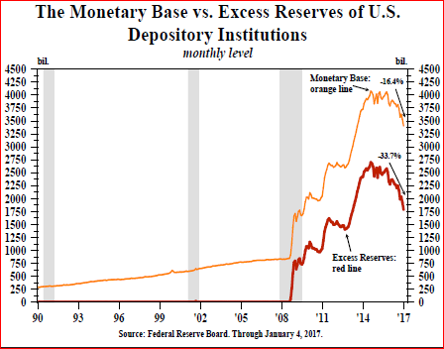
The Fed is well aware of the need to phase out the extremely accommodating monetary policy that was put in place to combat the 2008 financial crisis. Indeed, the Fed has already started to shrink the monetary base (see Chart 1). As my colleague Arthur Donner argues, the shrinking of the monetary base is a sign that monetary policy is tightening and has, in fact, been doing so since 2014.[1]
Chart 1 U.S. Monetary Base
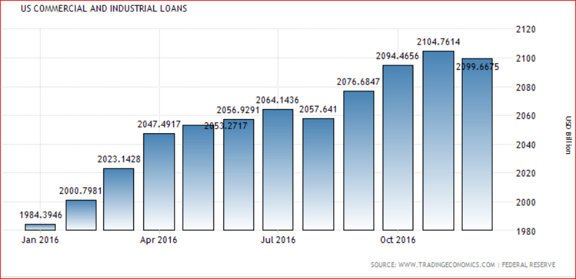
As the monetary base has been shrinking, bank lending has stalled (see Chart 2). Borrowing by the private sector is just holding its own, rather than increasing. (Increased private sector borrowing would be a sign of economic expansion.)The Fed’s tightening policy may be starting to have an effect.
Chart 2
The Fed is making every effort to return to “normalcy” when it comes to short-term rates. However, that would mean raising the Fed Funds Rate in an environment in which economic statistics are mixed at best with secular deflationary forces still working against the justification for higher short-term interest rates.
General Economic Conditions
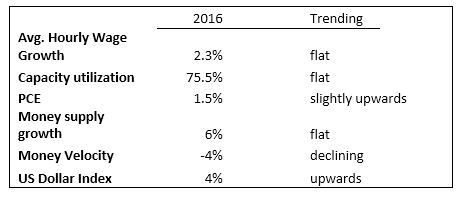
The economic conditions in 2016 will largely continue into 2017 (Table 1). There is no evidence that the wage sector is accelerating. Rather, hourly wages and hours worked likely will stay relatively constant. Capacity utilization has been flat for several years at the 75 per cent level. Even with a possible boost in economic growth, capacity levels will remain low by historical standards. The Fed’s preferred inflation measure—personal consumption expenditure (PCE) --- remains below its target of 2 per cent and will remain there for at least another year. In addition, the money supply (modest increases) and velocity (outright contraction) indicate that nominal income will grow relatively slowly in 2017. Finally, U.S. import prices will fall as the U.S. dollar appreciates in response to future Fed rate hikes.
Table 1 Selected Economic Indicators
Trade Policy is the Huge Wild Card
Proposals to cut the trade deficit by tariffs or import restrictions would have a negative impact on U.S. growth. Initially, there would be a spike in the cost of affected imports. This would be deflationary in the sense that it would reduce aggregate demand. Above all, there is the serious risk of other countries retaliating, resulting in further deflation as barriers to trade become standard policy.
In sum, the combination of monetary tightening and mediocre economic performance suggest that long - term bond yields will decline over the course of the year.
Trade Policy is the Huge Wild Card
Proposals to cut the trade deficit by tariffs or import restrictions would have a negative impact on U.S. growth. Initially, there would be a spike in the cost of affected imports. This would be deflationary in the sense that it would reduce aggregate demand. Above all, there is the serious risk of other countries retaliating, resulting in further deflation as barriers to trade become standard policy.
In sum, the combination of monetary tightening and mediocre economic performance suggest that long - term bond yields will decline over the course of the year.
[1] Despite A Huge Increase In The US Monetary Base, The Money Supply Has Hardly Grown



Comments
Log in or sign up to join the conversation.