


Though oil prices initially gapped higher on the back of weekend news that the Strait of Hormuz had been closed again by Iran, they have since been falling to return to Friday’s levels. This is because the strait hadn’t been fully closed, although ship tracking data pointed to a sharp fall in transits. More to the point, the first round of negotiations between the US and Iran ended and there was “major progress” on Lebanon ceasefire agreement as per Iran’s Abbas Araghchi, Iran’s foreign minister. This comes on the back of a fragile “ceasefire” agreement between Hezbollah and Israel on Friday, even if there was continued strikes in Lebanon at the weekend.
With efforts towards a lasting peace ongoing, we could see some fresh pressure on crude oil prices this week. But the downside could be limited with the bulk of the move already having taken place.
Demand should offset increased supplies
In the short term, the path of least resistance remains to the downside due to the de-escalation of tensions in the Middle East. We have already seen a significant decline in oil prices over the past several days. However, prices are now approaching levels seen before the conflict began.
On WTI futures, oil was trading around $65-67 per barrel before the conflict started, and that is the area where I would expect prices to potentially find support, should we get there. The reason I am a bit doubtful prices will fall all the way there is that we have experienced a substantial supply shortage over the past three months due to disruptions in the Strait of Hormuz. As a result, the supply-demand dynamics for oil have shifted considerably.
That said, markets are forward-looking, and traders are now anticipating the resumption of crude oil flows through the Strait of Hormuz. In addition, releases from strategic petroleum reserves have helped cushion the impact of supply shortages.
Now, with oil prices falling back, many of the inventories that were drawn down during the crisis will need to be replenished. Countries such as China, Japan, and the United States are likely to purchase oil to rebuild those reserves. That buying demand should help establish a floor under prices.
It’s important to note, however, that this demand could be offset by increased supply from producers such as Iran and Venezuela. As a result, the upside for oil prices may remain limited unless we see another major escalation in the Middle East.
Meanwhile, the US dollar could provide some headwind in the near-term. Last week saw the US dollar index break to its highest level since May 2025, at above 101.00. Further short-term gains for the dollar could keep pressure on buck-denominated assets like gold and oil.
Limited downside for oil prices
Overall, I believe there is still room for further downside in oil prices – but don’t expect a crash.
How far oil prices ultimately decline from here will depend entirely on supply and demand dynamics.
From the demand side, there are reasons to expect continued strength. Strategic reserves will need to be replenished, while the U.S. summer driving season should continue to support fuel consumption and keep pressure on inventories of oil products like gasoline. This should offset raised supplies from the OPEC countries and Iran in particular.
WTI technical analysis
WTI futures have been falling for several weeks now, and understandably, prices are becoming a bit oversold.
This raises the potential for some sort of bounce, especially if there are continued or renewed tensions in the Middle East that impact oil supplies through the Strait of Hormuz or other key areas.
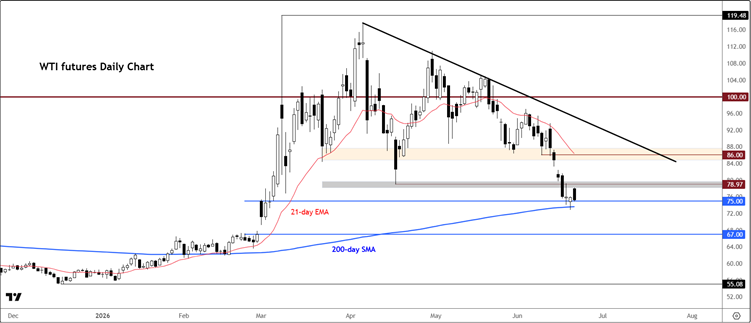
WTI has now reached $75 per barrel, which is a potential support zone, particularly after prices held above this level during the last two trading days of last week.
On Friday, WTI bounced nicely off the 200-day moving average, which comes in at around $73.65. That’s another important level to watch.
Below these levels, we have $70 per barrel, another psychologically important support level, followed by the levels where oil was trading before the conflict began, around $67 per barrel.
On the upside, $78.90 to $79.00 per barrel marks a key short-term resistance area. Prices found support there back in April before eventually breaking through that area last week.
We have now retested this level from below, and so far prices have remained beneath it. That makes the $78.90–$79.00 per barrel zone a very important resistance area to monitor going forward.
A break above that level could trigger a quick move toward the $85–$86 per barrel area.


Comments
Log in or sign up to join the conversation.