


On Wednesday, October 14, fresh U.S. inflation data (CPI and Core CPI) for September will be released. Market consensus forecasts an acceleration in annual inflation from 3.4% to 3.6%. Meanwhile, the monthly growth rate is projected at 0.4%–0.6%. At the same time, regarding core inflation (Core CPI), which excludes volatile food and energy, the market expects relatively modest figures: an annual rate of around 2.4%–2.5%, and a monthly gain slowing from 0.3% to 0.2%.
Chart 1. Headline vs Core CPI YoY
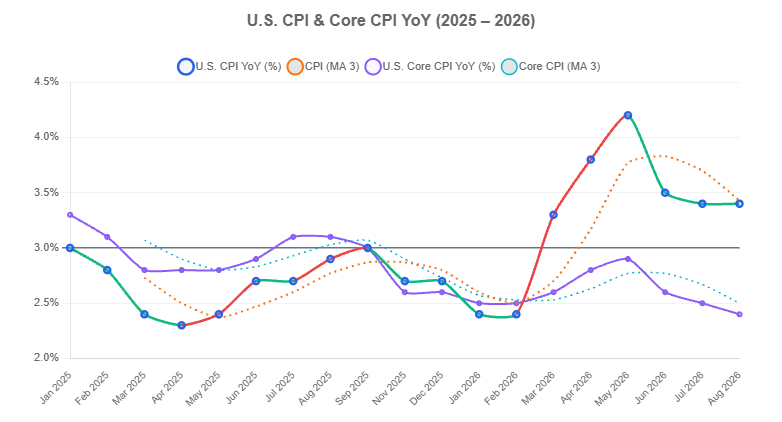
Looking back briefly, we can note that U.S. inflation started rising in February of this year amid the acute phase of the conflict in Iran and surging oil prices. Since then, the headline inflation rate has increased by 1% to 3.4% (in August), while the core inflation rate over the same period actually decreased by 0.1% year-over-year (Chart 1). This is a strong indicator of the state of the U.S. economy, as well as a sign that households and businesses have been able to adapt to potential domestic fuel price spikes. However, this is precisely where the risk of the current situation lies. The spillover of inflation from fuel deeper into the economy onto domestic service components will trigger a reassessment of monetary policy expectations and could lead to increased volatility and a correction in the stock market and the U.S. dollar.
As seen in Chart 1, inflation has been declining from its peak in May (4.1%), and this decrease is mostly driven by the drop in domestic fuel prices within the U.S. In the current tense situation, filled with geopolitical risks, fuel prices have a very strong influence on the inflation figure (Charts 2 and 3). And as can be seen, fuel prices showed another spike in September, which is yet to be reflected in tomorrow's CPI data.
Chart 2. Gasoline Prices vs Headline CPI
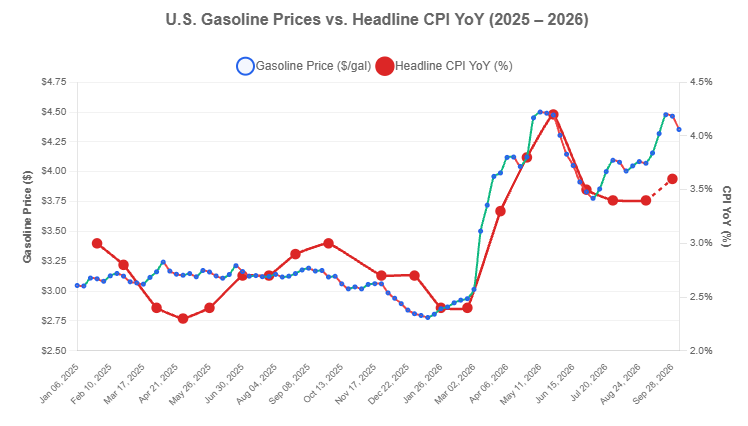
Chart 3. Gasoline Prices 4-Week Average
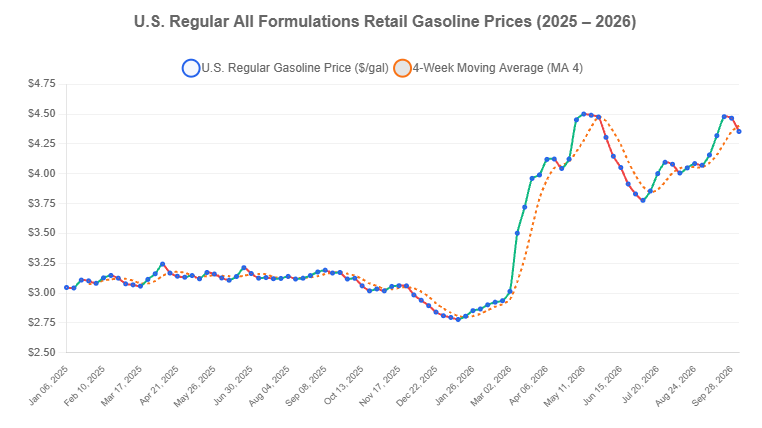
Chart 3 shows that the consensus forecast of 3.6% for annual inflation sort of "falls short" of gasoline prices in terms of pace. With an average gasoline price in May of $4.47 per gallon, inflation stood at 4.2% YoY. In August, with an average gasoline price of $4.05 per gallon, inflation dropped by 0.8% to 3.4%, while in September the average price was $4.35, yet the consensus forecast assumes a rise of only 0.2% to 3.6%. Taking into account structural shifts and overall economic adaptation, the risk still remains that headline CPI could come in above the 3.6% forecast. But this risk is rather anticipated by the market. The bigger risk in the current situation is a potential increase in Core CPI, which nonetheless maintains a general downward trend (Chart 1).
The spring and summer inflation surge demonstrated the structural correlation between CPI and Core CPI (Chart 4). In April-May, the spike in gasoline prices instantly triggered a response in the cost of Transportation Services. With a lag of about a month, this impulse also reached the cost of housing and rent (Shelter). But in the summer, when gasoline prices temporarily dipped, the Transportation Services and Shelter components drifted downward by inertia.
Chart 4. Relationship between Energy, Transportation Services, and Shelter
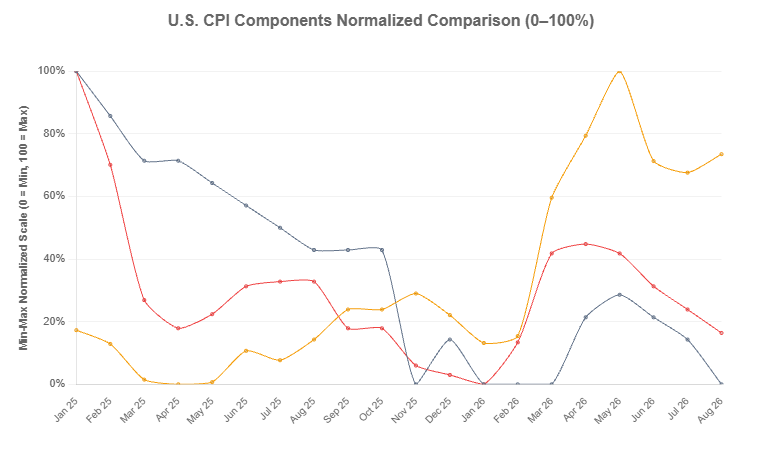
In July and August, the energy component started climbing again following gasoline prices, yet transportation services and rent continued to decline. This brought core inflation down to 2.4% (compared to 2.5% in February and 2.9% in May amid geopolitical shocks). For the Fed, this served as a clear signal: no secondary-cost spiral has unfolded, the economy and households have successfully adapted to fuel price fluctuations over this stretch, and there is no sign of systemic demand overheating.
However, the key question now is whether the lag from September's gasoline price spike will manifest in core components this time. Looking at year-end forecasts, the Fed's official PCE inflation target stands at 3.7% (with core at 3.4%), while the August Philadelphia Fed survey of economists showed a headline CPI consensus of 3.6% (with core at 2.8%). But these forecasts did not yet account for the September fuel surge. Parallel to this, household inflation expectations (according to the University of Michigan) rose to 4.6%–4.7%, and Fed Chair Kevin Warsh alongside the FOMC minutes make it clear that the regulator is ready to maintain a tight policy stance.
The market already expects headline inflation to rise. Therefore, a rise in headline CPI to 3.6% or even slightly higher will not come as a shock in itself. What will actually surprise the market is whether the transmission of the fuel shock into core inflation resumes through the Transportation Services and Shelter items. And here we can highlight two scenarios:
If core inflation remains subdued (Core CPI MoM at 0.2% and below): This will confirm that the inflation increase is strictly narrow and energy-driven. In this case, the market will be convinced that there is no price "stickiness" in domestic services. Fed rate expectations will stabilize, and the U.S. dollar will stop receiving aggressive support, entering a phase of consolidation or moderate softening.
If the Transportation Services and Shelter components return to growth within the report (Core CPI MoM > 0.3%): This will mean that the energy shock has once again begun to seep into core services. Under this scenario, the risks of "sticky" inflation will surge sharply. Analysts and banks will have to revise their year-end inflation forecasts upward, and the Fed will persist with its hawkish rhetoric, which could lead to a further rise in US10Y Treasury yields and the U.S. dollar.
A sharp spike in core inflation will trigger sell-offs in the U.S. stock market due to fears of higher-for-longer rates. Unwinding positions in risk assets and reassessing the Fed's trajectory toward further tightening will spark volatility and provoke a fresh momentum for the strengthening of the U.S. dollar. Therefore, the September CPI report is important not so much for the headline figure, but precisely for whether core inflation shows contamination from the fuel price surge.


Comments
Log in or sign up to join the conversation.