

We Live in a World of Disturbances
“It was the best of times, it was the worst of times, it
was the age of wisdom, it was the age of foolishness…” A Tale of Two Cities, by Charles Dickens
One is very tempted to describe today`s economic conditions in precisely the same way. In examining much of the economic activity, it appears that it is both the best and worst of times. In an earlier article I argued that investors are facing conflicting policy choices1. The Trump administration, on one hand, argues for pro-growth policies featuring lower taxes, stepped up infrastructure spending and deregulation. On the other hand, it proposes protectionist policies that will lead, ultimately, to stagnation and greater inflation. It is this conflict that contributes much to this confusion today. A closer look at the data confirms that we are also experiencing serious disconnects within and among major segments of the economy.
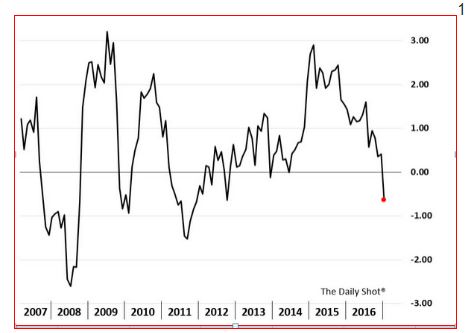
Start with the consumer. Consumer sentiment set a 13-year high last month, a sign that it is the best of times. However, nominal wages are virtually flat and real wages actually fell last quarter, a sign that it is the worst of times for the American worker. Chart 1 shows a very dramatic and disturbing fall in U.S. real average weekly earnings. This past year annual wage growth steadily declined and by the fourth quarter real wage growth fell into negative territory. Inflation growth exceeded wage gains, setting employees’ incomes down a further notch.
Workers see corporate profits growing steadily, the stock market reaching new highs almost daily and the President and Congress considering lowering corporate taxes. Yet, workers will not participate directly in any of these benefits.
Chart 1 Annual Growth in Real Average Weekly Earnings
It seems that the consumer has turned to the debt markets to compensate for a decline in real wage growth. Total debt held by U.S. households climbed in 2016 by the largest amount in a decade. Consumers relied upon increases in credit card debt, auto and student loans, plus a strong surge in mortgage re-financing. Many consider this rise in debt as an example that it is the worst of times. The combination of weak earnings and rising debt loads cannot be viewed in any positive light.
Next let’s consider the corporate sector. The promise of lower corporate taxes and deregulation gives rise to the belief that it is the best of times. Bank shareholders are almost giddy over the promise to eliminate many of the Dodd Frank regulations, allowing the banks to return to their lending practices during the halcyon days pre-2008.
Other segments of the corporate world greatly fear the imposition of border taxes (tariffs). Retailers, especially, are under great stress as e-commerce radically altered the retail landscape. Large consumer retailers might aptly claim that this is the worst of times.
Finally, the large multinationals are very concerned about the Trump administration’s attacks on their supply chains. The administration has made no bones about the fact that is wants to alter the supply chains in favour of more production at home. Yet, doing so would in all likelihood raise the cost of production, especially in the technology industries.
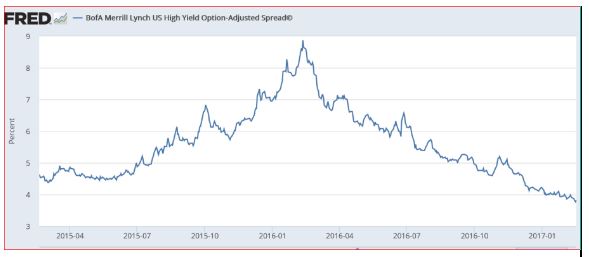
The corporate world has joined the consumer in assuming greater amounts of debt. Corporate issues reached new highs in January 2017 as companies turned to the debt markets while interest rates remain low. Corporate bond holders have driven HY bond spreads to less than 300 basis points; compared to nearly 900 basis points at the start of 2016 (see Chart 2). In just a short time, fear gave way to complacency. Is it the best of times for the corporate sector?
Chart 2
However one characterizes the current times--- the best or the worst— the U.S. economy’s performance leaves a lot to be desired. Fed Chairperson Yellen in her most recent testimony to Congress touted that the Fed is very close to achieving its employment and inflation goals. However, she made it abundantly clear that economic growth has been “quite disappointing” and has fallen well short of expectations given the extraordinary degree of monetary stimulus since the financial crisis.
Perhaps, if growth were more robust, maybe there would no confusion as to whether it is the best or the worst of times. Meanwhile, investors are faced with a set of inconsistent policy initiatives from the President that makes the achievement of greater growth unattainable.



Comments
Log in or sign up to join the conversation.