

By: Steve Sosnick, Chief Strategist at Interactive Brokers
Equity markets rebounded nicely yesterday, with investors showing relief that Russian President Putin confirmed reports that there had been a partial withdrawal of Russian troops near the Ukraine border. That was indeed welcome news to investors who had become more risk-averse because of war fears and the higher energy prices that resulted from the saber-rattling.
We concluded yesterday’s piece by saying: “For now, let’s enjoy the good news coming from Eastern Europe. We can resume our usual concerns tomorrow.”Traders have indeed resumed some of their concerns today. As I write this, major US indices have given back about half of yesterday’s gains and US Treasury yields are lower as risk aversion returns. These moves come on the heels of Retail Sales numbers that were well above expectations. Normally a strong economic report would have the opposite effect, so we can reasonably attribute today’s activity to the resumption of geopolitical worries.
Yet we had reason to resume those worries during yesterday’s trading. President Biden spoke roughly ½ hour before US equity markets closed. His message was that there was no verifiable evidence to Putin’s assertions about troop withdrawal and asked Americans to be prepared for potential economic stresses, particularly in energy prices, if the US imposes sanctions to dissuade or punish Russia for a Ukraine incursion. Traders would normally consider this message to be worrisome, and they did for a few minutes. Stocks fell in the immediate aftermath of those comments but then rallied a few minutes later to push indices to close near their highest levels of the session.
A friend asked me how we could push higher after a sobering Presidential address. I explained that the institutions already had their buy orders in place, and there either wasn’t enough content in that speech to change their minds or there was insufficient time to persuade them to so do. It is important to understand how the trading desks at major “buy-side” firms operate. At large pension and mutual funds, the portfolio managers’ various buy and sell orders are accumulated and executed by teams of traders. Those traders frequently have their performance measured against the volume-weighted average prices (VWAP) and/or the closing prices of the securities that they are trading. It is not uncommon for those traders to work their orders over the course of the day but leave a relatively large percentage of the order to be executed at or near the close. That offers them a better chance of meeting or beating those benchmarks. It would not surprise me in the least if those buyers were able to buy on the post-Biden dip – as they had throughout the day — and then allowed the balance of their orders to reverse the quick drop higher into the close.
When it comes to geopolitics, it makes perfect sense to “Trust, but Verify.”This phrase, popularized by President Reagan during the Cold War, ironically may have been derived from a Russian proverb. This seemed to be the message sent by Biden’s response to Putin’s claims. But it is useful in other market contexts as well.
It pains me to paint Federal Reserve governors as being similarly disingenuous with investors, but that is the only conclusion I can draw from their commentary about reducing the levels of bond purchases undertaken by the FOMC. We have been told that the Fed has been slowing down its open market purchases of bonds for its balance sheet, but there is little evidence that they are actually doing what they suggest.I know this is a topic we covered at length recently, in a piece called “Taper, What Taper?”, but I can’t help revisiting it.
As we noted in the linked piece above, the November FOMC statement indicated that they would be reducing the pace of their purchases by $15 billion per month, as they first indicated at their prior meeting. They subsequently indicated slowdowns of $30 billion per month in the next two statements. By January, the implication was that they would be buying $20 billion in government and $10 billion in mortgage securities for a total of $30 billion that month. But they used the key phrase “at least” in each of their statements. In reality, the pace barely budged. The table below, compiled from the Fed’s weekly H.4.1 releases, shows that the holdings of bonds on the Fed’s balance sheet rose by $112 billion from January 5th to February 2nd. That is much closer to the $120 billion per month pace that persisted during 2020 and 2021 than the implied “at least” $30 billion.
Holdings of Securities on the Federal Reserve Balance Sheet, Reported Weekly
(Click on image to enlarge)
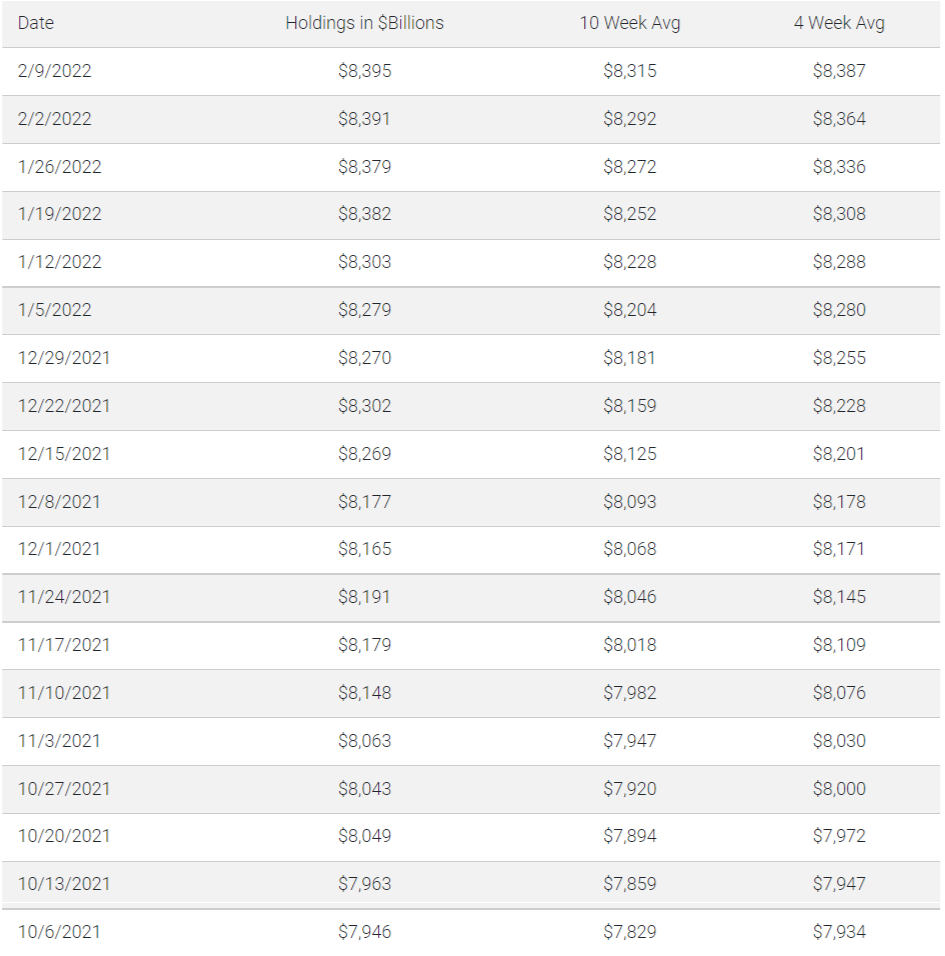
Source: Federal Reserve, Interactive Brokers
The same data in graphical form shows the picture plainly. If the Fed was tapering its purchases by the stated amounts we would see the 4-week moving average (grey) declining faster than the 10-week average (red). Instead they are both rising at a similar pace.

Source: Federal Reserve, Interactive Brokers
The implication remains the same as the one we related over two weeks ago:
“We have seen increased volatility in stock and bond markets as the Fed’s rhetoric veers away from continual stimulus. But they haven’t yet begun to remove that stimulus, only discussed it. We would expect markets to continue to wobble further when the Fed finally decides to actually remove their training wheels. So far it’s been watch what I say, not what I do. Be wary once they actually do what they say.”
It is quite unfortunate that the same admonition applies to both the Federal Reserve and President Putin.



Comments
Log in or sign up to join the conversation.