

US and Japanese authorities have confirmed that they have jointly intervened in FX markets to support the yen. Joint intervention is rare and points to new FX activism from the US Treasury. Yet a successful turn lower in USD/JPY will require softer US data, no Fed hikes and possibly some new initiatives from Japan to keep more money at home
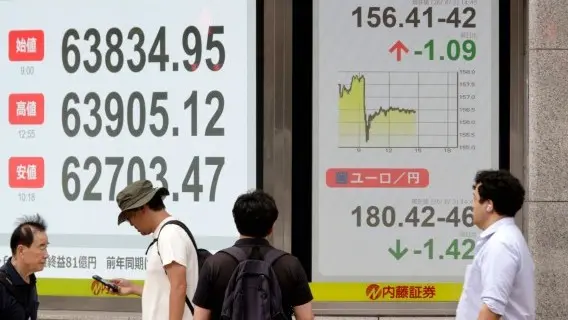
The US dollar has weakened sharply against the Japanese yen after market intervention.
Q: What’s happened?
Reports over the weekend suggest US and Japanese authorities have jointly intervened to support the yen. This marks the first coordinated G7 FX intervention since March 2011 following Japan's earthquake and tsunami, and the first joint US-Japan yen-buying intervention since June 1998, when USD/JPY was approaching 150 during the Asian financial crisis.
Tokyo appears to have remained an aggressive seller of USD/JPY. Intervention on Thursday and Friday alone may have totalled close to $80bn, exceeding the scale of operations seen in late April, and further intervention may have been conducted today. On the US side, reports suggest the Federal Reserve was checking rates in EUR/JPY and may have been selling euros against the yen, although it remains unclear whether US authorities have also been directly selling USD/JPY.
Questions also remain over the scale of US participation. Reuters published a photograph of Treasury Secretary Scott Bessent's handwritten notes referencing plans to purchase $5-10bn of yen. In practice, we suspect the amounts deployed may prove smaller. Unlike Japan, the US holds only limited foreign exchange reserves, meaning the signalling effect of intervention is likely to matter more than the volume of flows.
The US holds roughly $38bn of foreign currency reserves, split broadly evenly between the Treasury's Exchange Stabilization Fund (ESF) and the Federal Reserve's System Open Market Account (SOMA). Around 70% of those reserves are held in euros, with the remainder invested in yen-denominated assets.
Q: Why now?
Joint intervention has not come as a complete surprise since the Fed did check the USD/JPY rate back in January. Bessent has been supportive of Japanese intervention for a while and has acknowledged that the yen is very undervalued.
Perhaps Washington felt that Tokyo required some help with the heavy-lifting of the yen, since April/May’s $70bn of FX sales had failed to prevent USD/JPY from trading to a new high at 164. That yen weakness was seen contributing to Japan’s 30% year-on-year increase in import prices and, in turn, weighing on JGBs.
Also, in the rates space, the nervousness from investors about Japan has been mounting since the start of the year. The 10Y JGB is trading at the highest yield since the 90s and the momentum is clearly there to move higher still. And this is not just an inflation story – real rates rose more rapidly over the past year than break-evens.
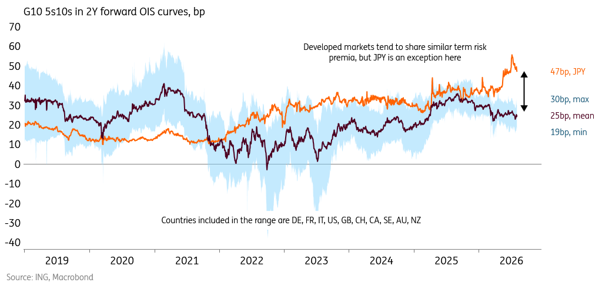
Instead, we argue that investors are also increasingly demanding a risk premium to hold JPY rates, adding upward pressure to 10Y JGB yields. In the figure below, you can see that the slopes (in 2Y forwards) of most G10 currency swap curves tend to trade very closely together, especially in recent years. The JPY curve is the exception here. The much steeper curve is evidence that investors are demanding a higher return for exposures to Japanese rates.
Investors are demanding an increased term risk premium for holding JPY rates
Did Washington feel that the JGB sell-off was undermining Treasuries as well? The higher risk premium of JPY does not immediately trigger large spillovers to markets abroad, but the selling of UST holdings by Japan would pose a more material risk. Japan is one of the largest foreign investors with holdings of around $1.1tr. However, there have been reports today that Japan could use the Fed’s FIMA repo facility to raise intervention dollars against its Treasury collateral, rather than selling those securities. Yet, the single counterparty limit there is $60bn, which could be quickly consumed.
When looking at historical flows data, we see that Japanese investors tend to buy USTs when relative FX-hedged yields are attractive. With a steeper JPY curve, the relative value turns away from USTs, in favour of JGBs. With the record US deficit unlikely to be addressed anytime soon, foreign buyers will need to play an important role to prevent UST yields from breaking higher.
Q: Will the US try to get the rest of G7 and G20 on side?
For now, intervention remains a bilateral US-Japan operation. A more powerful signal would come from broader G7 or G20 backing. The next opportunity arrives at the G20 Finance Ministers and Central Bank Governors meeting in Asheville, North Carolina, from 31 August to 1 September, where Washington could seek wider endorsement for efforts to stabilise the yen.
We think the chances of securing explicit multilateral support are low. The challenge is that many G20 members are likely to view yen weakness not as a case of market dysfunction, but as the consequence of Japan's own policy mix. Loose fiscal policy, still-accommodative monetary settings and the Takaichi government's growth agenda have all contributed to a weak yen environment. Against that backdrop, other countries may be reluctant to commit political capital or market credibility to a coordinated campaign to strengthen the currency.
Indeed, a formal G20 statement backing yen appreciation would be difficult to reconcile with the longstanding G20 principle that exchange rates should be market-determined. While policymakers may endorse efforts to address excessive volatility or disorderly market conditions, explicit support for a stronger yen appears a much higher hurdle.
Q: Does this represent a new era of US FX activism in global financial markets?
Confirmation of US Treasury purchases of yen would come less than a year after Washington's intervention to support the Argentine peso. In October 2025, the Treasury extended a $20bn ESF-backed swap facility to Argentina and subsequently used the Exchange Stabilization Fund to help stabilise the peso ahead of the country's mid-term elections. Argentina ultimately drew around $2.5bn from the facility and repaid the amount in full before year-end.
Taken together, the Argentine and Japanese episodes suggest a Treasury that is becoming more willing to use the ESF in support of broader economic and geopolitical objectives. That marks a notable departure from the relative passivity that has characterised US foreign exchange policy for much of the last two decades.
The comparison should not be taken too far. Argentina was facing an acute balance-of-payments challenge and severe pressure on its currency, whereas Japan remains one of the world's largest creditor nations. If anything, Washington's willingness to support the yen reflects a view that the currency has moved substantially below levels justified by economic fundamentals. On that point, we share Bessent's view that the yen remains materially undervalued.
Q: Will intervention be successful?
With his long experience in currency markets, Bessent will appreciate that macro fundamentals ultimately dominate exchange rates. FX intervention can smooth disorderly market conditions and alter market psychology at the margin, but its primary function is typically to buy time rather than engineer a lasting shift in trend.
Japan's intervention campaign in the summer of 2024 illustrates the point. Those operations proved effective not because of their size alone, but because they coincided with a genuine turn in the US rate cycle as softer economic data paved the way for three 25bp Federal Reserve rate cuts later that year.
The same lesson applies today. The success of this latest intervention effort will depend less on how many yen authorities purchase and more on whether US economic data soften sufficiently to prevent further Fed tightening. That remains ING's central view and underpins our forecast for USD/JPY to decline to 158 by year-end and 152 by end-2027.
Those looking for an aggressive Bank of Japan tightening cycle to reinforce yen strength may be disappointed. The Takaichi government's emphasis on growth suggests the BoJ will remain cautious in withdrawing accommodation. In our view, more promising support for the yen could come from policies designed to redirect domestic savings back into Japanese assets.
This is where developments around NISA merit close attention. The 2024 NISA reforms encouraged substantial retail investment into overseas equities, contributing to persistent capital outflows and a weaker yen. Any future adjustments that broaden the appeal of domestic assets, including greater access to instruments such as JGBs, could help reverse some of those flows.
Ultimately, intervention can create an inflection point, but it cannot overturn fundamentals. A sustained move lower in USD/JPY will require narrower US-Japan rate differentials and a softer US economic backdrop. Without that, even coordinated intervention risks being remembered as another attempt to slow the dollar's rise rather than reverse it.


Comments
Log in or sign up to join the conversation.