

For 50 years, Washington treated gold as a relic.
Wall Street left it out of asset allocation models. Central bankers dismissed it. Mentioning Fort Knox as a backstop for the dollar got you looked at like you were talking about Bigfoot.
That era is ending. And very few investors have noticed.
Over the last 18 months, this administration has made a series of moves that, taken together, tell us exactly how Washington now views gold. Let’s walk through them.
The first came on March 20th, 2025, when President Trump signed Executive Order 14241, “Immediate Measures to Increase American Mineral Production.” The order directed federal agencies to fast-track permitting and production for a list of minerals vital to national security. Gold was on that list, right alongside copper, uranium and potash.
That was the President, in the text of a formal executive order, treating gold as a strategic national security asset.
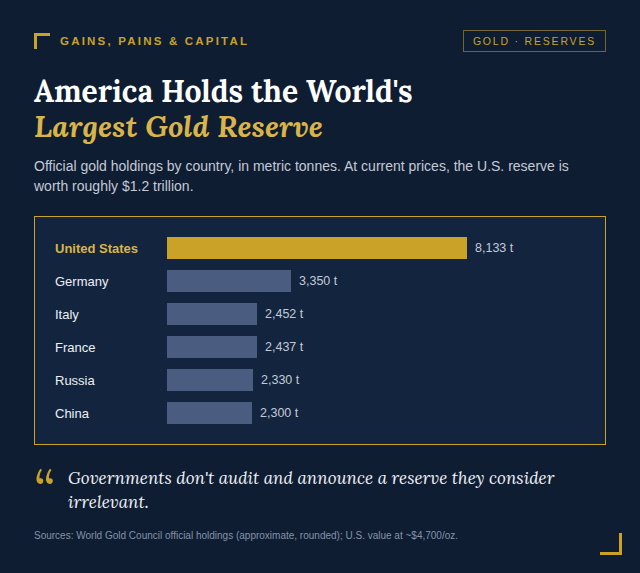
The second came from Treasury Secretary Scott Bessent. In an interview this summer, Bessent stated that the U.S. had audited its gold holdings at Fort Knox, that all of the gold was accounted for, and that at market prices the U.S. gold reserve is worth over $1 trillion, the largest gold holdings in the world.
Governments don’t audit and announce a reserve they consider irrelevant. They audit and announce the one they believe matters.
The third came in late August. During a press conference on new Iran sanctions, Bessent formally named gold as one of five sectors subject to sanctions, alongside digital assets, technology, aviation and shipping. Iran had been using gold to move money outside the SWIFT system and the U.S. dollar.
Put simply, Treasury now treats gold as a channel for moving value that Washington needs to control. That is a monetary judgment as much as a sanctions one.
Now consider the backdrop.
The 10-year Treasury yield recently hit 5.34%, its highest level since 2002. Treasury has been running multibillion-dollar buybacks to support the bond market. And the U.S. government has roughly $40 trillion in debt to finance.
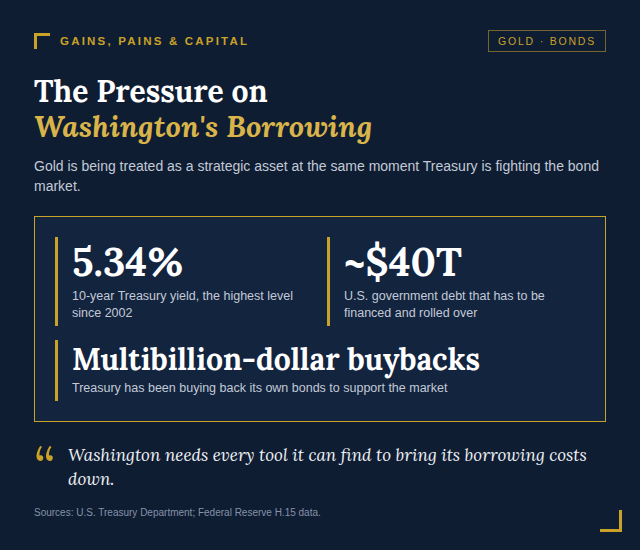
Washington needs every tool it can find to bring its borrowing costs down. And it is treating gold as a strategic asset at the exact same time.
I want to be careful here. Nobody in Washington is announcing a return to the gold standard, and I would not invest on that basis. But the direction of travel is clear. Gold is moving back toward the center of U.S. monetary and national security policy, one step at a time.
Which brings me to the fourth move.
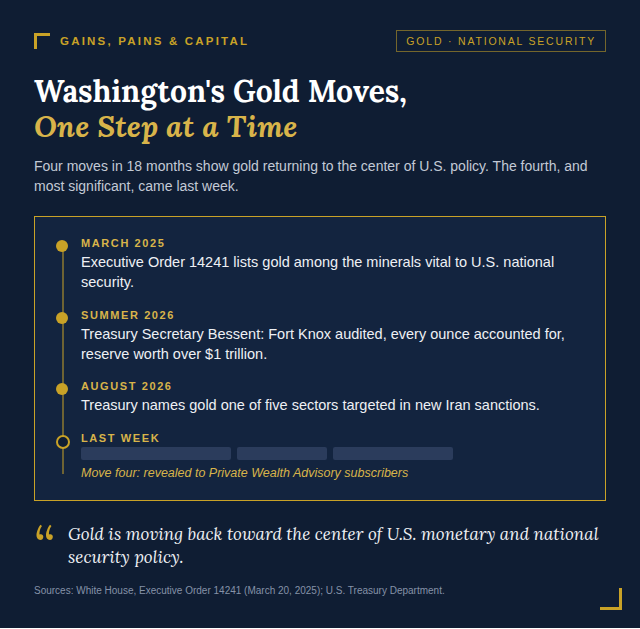
It happened just last week, inside the Treasury Department. It is the most significant of the four, because it suggests gold could play a role in addressing Washington’s single biggest financial problem. And as far as I can tell, almost no one in the financial media has connected it to the other three.



Comments
Log in or sign up to join the conversation.