

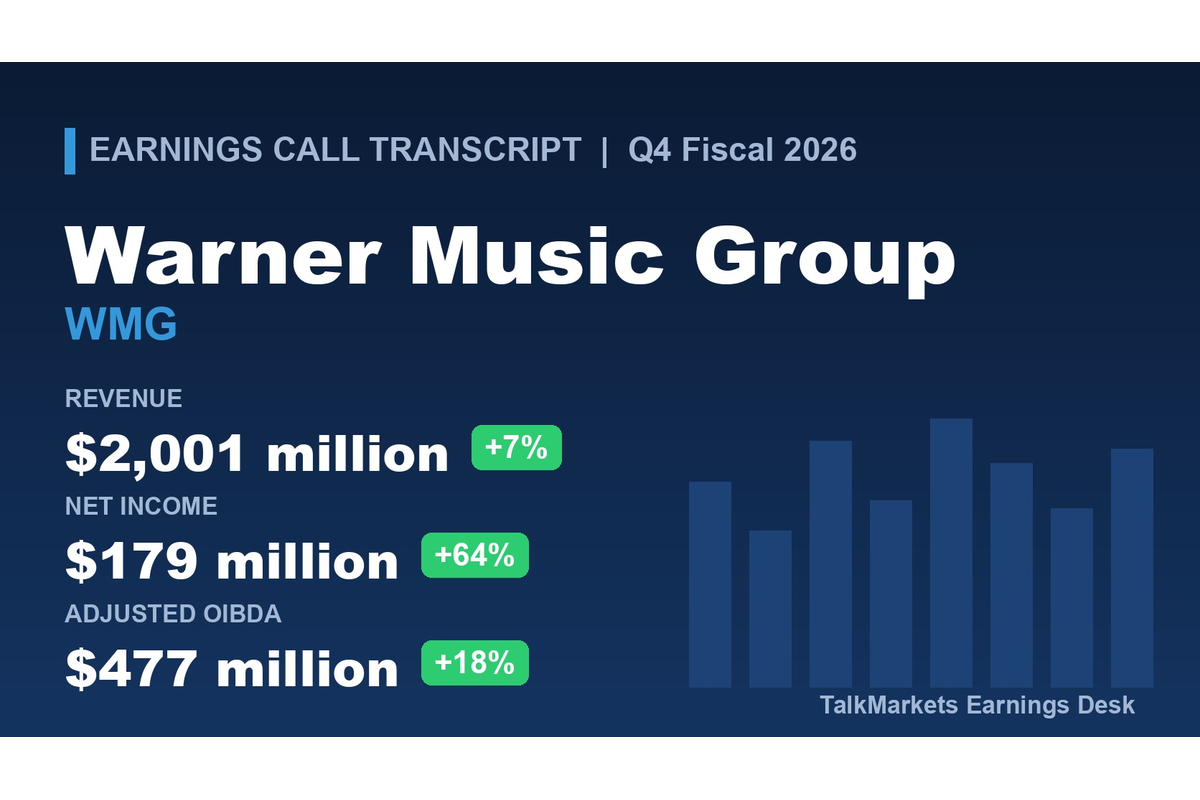
Warner Music Group's fiscal Q4 2026 revenue rose 7% to $2,001 million as digital revenue grew 13%, while net income rose 64% to $179 million and Adjusted OIBDA rose 18% to $477 million.
Ticker: WMG
Warner Music Group Corp. (WMG) reported results on 19 November 2026 for its fiscal fourth quarter and full year ended 30 September 2026. The music company said quarterly and annual revenue both reached all-time highs. Streaming growth drove the quarter, and both of its segments, Recorded Music and Music Publishing, grew revenue and operating income.
The key numbers (three months ended 30 September 2026)
Metric | This year | Last year | Change |
|---|---|---|---|
Revenue | $2,001 million | $1,868 million | +7% |
Operating income | $320 million | $143 million | |
Adjusted OIBDA | $477 million | $405 million | +18% |
Adjusted OIBDA margin | 23.8% | 21.7% | |
Net income | $179 million | $109 million | +64% |
Basic EPS | $0.34 | $0.21 | |
Adjusted EPS | $0.55 | $0.53 | |
Free cash flow | $133 million | $203 million | -34% |
Digital revenue increased 13.2% and streaming revenue increased 13.7%. Revenue growth was held back by the termination of the distribution agreement with BMG, which meant $7 million less Recorded Music digital revenue than a year earlier. Cash provided by operating activities decreased 32% to $158 million, which the company put down mainly to the timing of working capital.
Results by segment
Recorded Music: revenue of $1,639 million against $1,534 million, up 7%, with digital revenue of $1,074 million against $951 million. Operating income rose to $365 million from $208 million.
Music Publishing: revenue of $363 million against $337 million, up 8%. Operating income rose to $65 million from $57 million.
Balance sheet
At 30 September 2026, Warner Music Group had a cash balance of $589 million, total debt of $4.704 billion and net debt of $4.115 billion, compared with $3.833 billion at the end of the prior year.
CEO Robert Kyncl said: "Our Q4 and full-year results demonstrate the success of a multi-year, transformational strategy that sets a new bar for WMG."
Full year
For fiscal 2026, revenue increased 11% to $7,437 million from $6,707 million. Net income was $735 million against $370 million, and Adjusted OIBDA increased 23% to $1,770 million. Basic earnings per share was $1.41 for Class A shareholders, against $0.69 a year earlier, and adjusted earnings per share was $2.03 against $1.67. Cash provided by operating activities increased 28% to $866 million.
Source: SEC Form 8-K Exhibit 99.1
Full call transcript
Operator:
Welcome to Warner Music Group's fourth quarter earnings call for the period and fiscal year ended September 30th, 2026. At the request of Warner Music Group, today's call is being recorded for replay purposes, and if you object, you may disconnect at any time. Now I would like to turn today's call over to your host, Mr. Kareem Chin, head of Investor Relations. You may begin.
Kareem Chin (Head of Investor Relations):
Good morning and welcome to Warner Music Group's fiscal fourth quarter and full year earnings call. Please note that our earnings press release, earnings snapshot, and Form 10-K are available on our website. On today's call, we have our CEO, Robert Kyncl, and our Acting CFO, Lou Dickler, who will take you through our results and then answer your questions.
Before our prepared remarks, I would like to remind you that this communication includes forward-looking statements that reflect the current views of Warner Music Group about future events and financial performance. We plan to present certain non-GAAP results, including metrics that are adjusted for notable items during this conference call and in our earnings materials, and have provided schedules reconciling these results to our GAAP results in our earnings press release. All of these materials are posted on our website.
Also, please note that all revenue figures and comparisons discussed today will be presented in constant currency unless otherwise noted. All forward-looking statements are made as of today, and we disclaim any duty to update such statements. Our expectations, beliefs, and projections are expressed in good faith, and we believe there's a reasonable basis for them. However, there can be no assurance that management's expectations, beliefs, and projections will result or be achieved.
Investors should not rely on forward-looking statements as they are subject to a variety of risks, uncertainties, and other factors that can cause actual results that differ materially from our expectations. Information concerning these risk factors is contained in our filings with the SEC, and with that, I'll turn it over to Robert.
Robert Kyncl (CEO):
Good morning, everyone, and thank you for joining us today. You just heard music from some of our Grammy-nominated artists and songwriters, including Bruno Mars, Madonna, and Ray, who earned 11 Grammy nominations on Monday, more than any other artist, including in the top categories of album of the year, record of the year, song of the year, and songwriter of the year. We delivered a stellar Q4 to cap off a full year of industry-leading performance.
I want to take a moment to thank our amazing artists and songwriters and the teams that support them across the globe. Their tireless work and commitment are what powers our growth. Our quarterly and annual revenue reached all-time highs as we delivered high single-digit revenue growth and double-digit adjusted OIBDA and adjusted EPS growth for the full year. In Q4, total revenue increased 7%, led by an acceleration in recorded music, subscription streaming growth to 15%.
This performance was bolstered by the successful implementation of contractual PSM increases across several of our major DSP partners and continued market share gains in most of our major operating regions. Total adjusted OIBDA grew 17%, while margin expanded 190 basis points, reflecting strong operating performance, improved operating leverage, and benefit from our strategic realignment, which has enabled us to sharpen our organizational structure. For the full year, revenue grew 9%, as recorded music subscriptions streaming revenue increased 12%, or 13% on an adjusted basis.
Adjusted oil-gooder grew 19% with margins expanding by 210 basis points above the high end of our target, while adjusted EPS increased 22%, operating cash flow increased 28%, and the conversion was approximately 50% of adjusted OIBDA. These strong results show that our multi-year strategy is paying off. Our performance is a testament to our creative success, discipline capital allocation with high return investment into A&R and catalog, investment into technology, proactive approach to pricing and monetization of music, and the strategic realignment of our business.
Our progress has been guided by our three strategic priorities, growing our share, increasing the value of music, and becoming more efficient, starting with our first priority growing our share. Our market share growth in 2026 was broad-based, durable, and overwhelmingly organic, driven by development across our impressive portfolio of talent. Our expertise is in delivering success for artists we represent, often on multiple fronts, from recorded music, to publishing, to merch.
My Chemical Romance, a band we support across these three businesses, just scored their first number one, with the 20th anniversary reissue of their landmark album, The Black Parade. The success of the reissue proves the band's enduring cross-generational power and shows how we keep our timeless music connecting with new generations of fans. Another example is Colombian breakout Aria Vega, whom we represent both as a songwriter and a recording artist, and who just won best new artists at the Latin Grammys.
Both Aria and My Chemical Romance showcase our strategy to represent talent across multiple rights to maximize value for our artists and songwriters. And we continue to advance the next generation of stars, like Ash, a fast-rising singer-songwriter. Her first album, On Atlantic, has quickly propelled her career to new heights, with her single Stop the Wedding hitting number one this week on Global Spotify chart. We've long been the go-to music company for blockbuster soundtracks, like Barbie and F1.
And we continue to conquer the category with our soundtrack for Grand Theft Auto 6, which was released today, and features Dua Lipa, Cardi B, Burna Boy, Fred again, and PinkPantheress, among others. Our music publishing business delivered another strong quarter with revenue of 7%, driven by streaming growth of 15%. Highlights include chart-topping album from Genai Ico and Nathaniel Kano. Overall, our sustained chair performance reflects our laser-focused capital allocation strategy, as we continue investing in the highest ROI areas and most valuable, compared to our markets.
Next, turning to our second priority, increasing the value of music. Our commitment to increasing the value of music is evident in the acceleration of our paid streaming growth, the result of contractual PSM increases that we negotiated to provide us with greater baseline certainty in our DSP deals. We also view AI as an incremental growth engine that will play an important role in increasing the value of music, and we're leading the charge on this frontier.
As a result of our partnership, in September following the launch of its latest model, Suno now became the first of what will be many generative AI companies paying revenue to rights holders. That means our artists and songwriters will be getting paid from an AI creative tool for the first time in history. This is a watershed moment for the industry brought about by our efforts. By partnering with Suno and other AI companies, we've got a seat at the table to shape the space and write the rules.
Through our deals, we've secured crucial protections for our artists and songwriters while creating new monetization opportunities for them. As we collaborate with our partners on derivative use cases, we're well positioned to continue to lead the industry in capturing value from AI. Finally, on to our third priority, becoming more efficient. Our strategic realignment, financial transformation initiatives, and investments in technology are driving meaningful operating leverage and enabled us to deliver margin expansion above our original target range for the full year.
We've been on a multi-year transformational journey to 45 WMG and reimagine it as the music entertainment company of the future. With our foundation stronger than ever, we've successfully reset the bar for ourselves in 2026, positioning us to drive significant shareholder value for many years to come.
Looking ahead to fiscal 27, we're optimistic about our substantial momentum underpinned by greater visibility around how the value of music will grow, our disciplined return focus investment framework, AI monetization ramping up, a leaner that can enable the operating structure, and creative prowess resulting in exciting releases across different regions and advantages, which include new music in Q1 from Zach Bryan, Ash, Dan Thaliver, Jack Harlow, Gunna, Sam Barber, Fallout Boy, Goo Goo Dals, and many more.
We've delivered on the financial targets we laid out last year and are doubling down on them for this year. Our goal remains to deliver high single-digit revenue growth on a comparable basis, double-digit adjusted and adjusted EPS growth and 50 to 60% operating cash flow conversion over a multi-year period. And this year, we expect to deliver roughly 100 basis points of margin expansion during by operating leverage and cost savings. I'll now turn it over to Lou to walk through our financial results in detail.
Lou Dickler (Acting CFO):
Thank you, Robert, and good morning, everyone. I am pleased to report that we delivered yet another strong set of results to close out our fiscal 2026. And as Robert mentioned, we delivered against our targets of high single-digit revenue growth, double-digit adjusted and adjusted EPS growth, and healthy operating cash conversion of 54% when adjusted for the impact of restructuring payments. We close the year with strong top and bottom line growth, delivering full-year margin expansion that came in above the high end of our target range.
Our results reflect the combination of contractual PSM increases, global market share improvement, disciplined cost management, and improved operating leverage. I will begin with our fourth quarter results. Total revenue increased 8% on an adjusted basis with healthy growth across recorded music and music publishing. Recording music revenue grew 8% on an adjusted basis, subscription streaming revenue growth accelerated to 15%, driven by PSM increases across our major DSP partners and broad-based market share gains.
Our recent acquisition of Revelator and the $7 million benefit from a DSP audit waiver contributed roughly 2 percentage points to the accelerated growth. And supported streaming grew 11% on an adjusted basis, reflecting positive market share gains in the quarter, as well as improved the economics from our social media partners. Physical revenue grew in impressive 30%, due to strong releases in the quarter, including Madonna and Charli XCX, as well as releases in Japan.
Licensing revenue increased 12%, reflecting an increase in licensing deals, especially with artists in Asia. Artist services and expanded rights revenue decreased 20%, due to a difficult comparison, resulting from significantly elevated merchant revenue in the prior quarter, primarily from OASIS. Music publishing revenue increased 7% in the quarter, led by robust streaming revenue growth of 15%, reflecting continued market growth and the impact of deal renewals. Performance revenue declined 7%, due to the timing of payments from collection societies and mechanical decline 6%, while synced declined 2%.
Total company adjusted OIBDA arose 17%, and adjusted OIBDA margin expanded by 190 basis points, reflecting strong operating performance, revenue mix, and cost savings, a portion of which has been reinvested. Operating cash flow decreased 32%, largely due to the timing of working capital items, including the timing of payments related to our restructuring plans and contractual digital advances.
Turning to our full-year results, total company revenue increased 10% on an adjusted basis, recording music revenue grew 9%, driven by double-digit subscription streaming growth of 13% on an adjusted basis, and music publishing revenue increased 11% on an adjusted basis. Total adjusted OIBDA increased 19%, resulting in 210 basis points of margin expansion, surpassing the high end of our full-year target range of 150 to 200 basis points. Adjusted net income and adjusted EPS both increased 22%.
Operating cash flow increased 28%, and our conversion ratio was roughly 50% of adjusted OIBDA in line with our multi-year target range. Adjusting for the impact of restructuring payments, conversion would have been 54%. As of September 30th, we had a cash balance of $589 million total debt of $4.7 billion and net debt of $4.1 billion. We continue to maintain a strong balance sheet that supports investing in the business as well as our quarterly dividend and share buyback program.
For fiscal 2027, we remain committed to delivering on our financial targets of high single-digit consolidated revenue growth on a comparable basis, double-digit adjusted EBITDA and adjusted EPS growth, and an operating cash flow conversion ratio of 50 to 60% of adjusted EBITDA. As Robert mentioned, we expect to deliver approximately 100 basis points of margin expansion in fiscal 27 on a comparable basis. One housekeeping item to mention as we looked to fiscal 27, we completed the sale of EMP at the fiscal 27.
EMP contributed approximately $180 million of revenue in fiscal 26, with approximately $70 million of revenue in Q1 of 26. The impact to adjusted EBITDA was immaterial for Q1 and the full year. We're excited to continue building on our strong momentum and optimistic about the opportunities ahead to continue driving profitable growth and shareholder value. Thank you. We will now open the call up for questions.
Operator:
We will now begin the question and answer session. If you would like to ask a question, please press star 1 to raise your hand. To withdraw your question, press star 1 again. We ask that you pick up your handset when asking a question to allow for optimum sound quality. If you are muted locally, please remember to unmute your device. Please stand by while we are in steam. Your line is open, Ian. Please go ahead.
Analyst:
Probably one for Robert. Thanks. Impressive results, you know, once again. But as you look ahead, can you talk about why you're confident that your performance, you know, is sustainable? And kind of what are you doing differently versus your peers to deliver results that are well ahead of the industry on pretty much every metric on a consistent basis?
Company Executive:
Thanks, Ian. Well, the short answer to your question is we are reimagining what the tech-enabled music company of the future should look like. When I joined a few years ago, I had the benefit of being an outsider, which really meant that I could take an unbiased view and not be encumbered by traditional ways of doing things. So that really led to installing strategic pillars to serve as guiding principles for the company and not only for the company, but for the entire ecosystem.
So to give you examples, in growing share, I immediately identified that we need to be much smarter capital allocators. So we installed discipline around that process, capital allocation process, by creating a deal steam, centralized deal steam, prioritizing allocation to the highest value revert to our markets, installing rigid return thresholds. And as a result, we now have improved return on a vested capital. And by the way, our growth is largely organic today. So we're not chasing empty calories of unprofitable market share.
On increasing value, we're operating with a mindset of growing the entire ecosystem, not just Warner. And I'm really proud of our role in reshaping the industry standard around contractual PSM increases, which are now in all of our deals. And now we're creating new and potentially meaningful revenue opportunity through AI, which our progressive stance has enabled the landmark deal with Suno, which for the first time in history means that a generative AI company is paying royalties for audio and video.
Our artists and songwriters are being paid for creation in addition to consumption now. And it also means that we have a seat at the table and we're shaping the rules of engagement. And finally, on efficiency, it really is simple, which is I made some really tough decisions. And it's moved us from being a holding company mindset to an operating company mindset. We were previously set up for physical business and we strategically realigned it for the digital world.
So as a result, we drove operating leverage and significant margin improvement, which you see in the results. So the results today are their result of intentional and hard work over multiple years. It shows up consistently and durably in our performance now. And it really is providing us with clear baseline growth and multiple vectors of incremental upside, including AI and M&A. So I feel like we're really well positioned to deliver healthy growth for the years to come and expect to translate it into shareholder value.
That, by the way, is underappreciated by the market today. It's our color to clear.
Operator:
Your next question comes from the line of Cameron Mansson-Perrone with Morgan Stanley. Your line is open, Cameron. Please go ahead.
Cameron Mansson-Perrone (Morgan Stanley):
Thank you, too, if I could. First for Lou, could you provide some more detail on the components behind both the 15% subscription growth and also your ad supported streaming growth and just any context around ad supported growing above peer levels would be helpful. And then I have a follow-up for Robert.
Company Executive:
Sure. Thanks, Cameron. So we had a very strong quarter. We grew paid streaming 15% and then ad supported grew 11% of the quarter on an adjusted and constant currency basis. The growth in paid accelerated this quarter and the growth was really driven by four main items, no surprises here. First, we had high single digit subscriber growth of six to seven percent. Second, we had pricing which contributed about four and a half percent of growth.
That's up sequentially from prior quarter when we delivered three and a half percent of growth. And that now includes the benefit from the Apple renewal. Three, we continued to have global market share gains that drove about one percentage of growth. We've seen that pretty steady as we move through fiscal 26 and really is a testament to the discipline and capital allocation approach that Robert just referenced.
And then fourth, and finally, we had the benefit from an audit waiver which was related to a historical period that totaled about seven million dollars. It was tied to a renewal. It impacted the quarter. It's not recurring. And then we also had the acquisition of Revelator and just the revenue we acquired through that acquisition created some upside in the quarter. Both of those items individually contributed about one percent of growth.
And then I'll just remind everyone that the Q4 did not include any meaningful contribution from AI revenue. We expect that to start flowing through in Q1. Shifting to ad supported, as I mentioned, revenue increased 11 percent on a adjusted basis. That certainly exceeded our expectations. The growth really reflected very strong market share gains within the quarter, most notably with YouTube, a partnership with YouTube in the US. We also saw some improved deal economics with some of our social media platform partners.
So overall, really happy with the strong paid streaming growth in the quarter.
Cameron Mansson-Perrone:
And that's helpful. Yeah, Robert, following up on the market share gains, you mentioned in your prepareds that you see those gains as durable, just any additional color on kind of what gives you the conviction on that front would be helpful. Thanks.
Company Executive:
Sure. Our data indicates our global market share was up across all key regions with the which is so it's quite broad based. And we know what we need to do in APAC. We're very, very focused on it. I was actually just there all of last week visiting multiple countries. And our teams, I'm very focused on execution. And Alejandro, who runs our international business is still there working on things. So rest assured that our focus is extremely high.
On APAC, only one area where we haven't grown our market share. You know, over the last three years, we've grown globally and increased our market share. So this is not just something that happened in the last quarter or last few months. We're focused on durability. And it's been largely organic. Yes, we have some small acquisitions here and there, but nothing major and no empty calories. So we're really focused on, as I mentioned earlier, where I think it's a result of strict capital allocation framework.
Across the entire portfolio, across the entire company, across all types of deals and very, very strong pipeline management for A&R and acquisitions. So I'm like looking forward, we have a growth oriented culture in the company. It's humming on all cylinders. And I'm confident that we can continue into the future. And even looking at our creative pipeline, I'm very excited.
You know, with Zach Bryan, Ash, Don Toliver, Jack Harlow, Gunna, Sam Barber, Fola, Boy, Gugudalves, you know, our labels are firing on all cylinders and it's great to be here.
Cameron Mansson-Perrone:
All helpful. Thank you both.
Operator:
Your next question comes from the line of Michael Morris with Guggenheim Securities. Your line is open, Michael. Please go ahead.
Michael Morris (Guggenheim Securities):
Thank you. Good morning, guys. Lou, can you talk a little bit more about the subscription streaming outlook for fiscal 27? Appreciate the color you just gave us on the quarter, but would love to hear about your outlook for subscription streaming, specifically in the context of the overall revenue growth you spoke to.
And it'd be helpful if you can provide any detail on, excuse me, the sort of quarterly cadence, how that might be impacted by PSM increases or any renewals that you have or need to work on. Thank you.
Company Executive:
Great. Yeah, we feel great about our outlook for 27, and that's underpinned by continued healthy paid streaming growth, while we don't provide guidance specifically on paid streaming, we do have confidence in our ability to continue to deliver steady growth. I'll start with a couple of the items where we think we have the most visibility. We expect global subscriber growth to continue to be strong.
We think that'll be in the mid to high single digits, and then on pricing increases, these are now the industry standard and will continue to flow through in 2027, and then in future deals. That does create some lumpiness, depending on the timing of those uplifts, but we'll have to manage that and be transparent, set expectations. There are a few points I will make on pricing impact as we move through 27.
So we expect to see a similar contribution from pricing in Q1, but that will moderate in Q2 as we lap the anniversary of the Spotify price increase. The rest of the year, we'll continue to see some small benefits, smaller benefits from DSP price increases, but more modest. Obviously, we're actively negotiating renewals with several of our large DSPs, including Spotify, and that'll provide some incremental visibility into the next wave of price increases once those deals are complete.
And at that point, obviously, we'll be in a better position to update our outlook. There are several items that can drive upside to this outlook. We've talked about these before, so nothing new here, but we've delivered meaningful market share gains in 26. Those, as Robert had mentioned, are largely organic. We think that share will continue to be supported by ongoing M&A. We're obviously focused on high quality of creative assets, including acquisitions we can do through the joint venture with Bain.
We do have a robust pipeline, but obviously acquisitions are opportunistic and we want to be both patient and disciplined about our transactions to make sure we're meeting the right return thresholds. And then we've obviously expanded the distribution capabilities with Revelator. We've talked about that. We think that that's going to start contributing and started to contribute to growth in 26 just based on what we acquired. To the extent we can also create a nice pipeline for that and drive incremental deals that should improve our outlook.
And then finally, but certainly not the last item, least item here is a new revenue from AI licensing deals. We're in active discussions with the number of the DSPs around licensing and tiers. And as I said, as those materialized, we'll be able to provide some additional guidance on that work. So overall, we've been really successful in installing this more dependable, resilient construct for paid streaming and created a lot of opportunities for growth and upside, as I just mentioned.
So we do expect that we'll see healthy growth in fiscal 27.
Michael Morris:
Great. Thank you. Appreciate that.
Operator:
Your next question comes from the line of Benjamin Black with Deutsche Bank. Your line is open, Benjamin. Please go ahead.
Benjamin Black (Deutsche Bank):
Very good morning. Thank you for taking my question. Robert, I'd be interested to hear how much revenue contribution you're expecting from AI sources, you know, now that, you know, Suno has officially launched, new license model. Also, you know, any metrics can share in terms of engagement or our uptake of the service. And then finally, maybe touch on your other AI partnerships. Are you seeing any additional revenue contributions from those as well? Thank you.
Company Executive:
Thanks, Ben. So we're very excited about the Suno partnership because and I said this before, but it's worth repeating, which is this is the first time that generative AI company is paying our royalties to a music company. It's a watershed moment. And, you know, this is really exciting for artists and songwriters everywhere and for our shareholders. Just like we do, we're now getting paid for audio and video. And the video making tool that just launched to speak compliments their music offering.
And this is something that we had not even planned on a year ago when we worked on our agreement. So it's incredible to be part of this journey and unlocking new, new opportunity for artists and songwriters. In Q4, the impact is in material because it launched halfway through September. So we're not prepared to share any details on that, but it will we will see material revenue contribution in fiscal 27. They have well over two million paying subscribers growing fast and have significant engagement.
So we see a lot of opportunity to innovate. It's important to have partners who are building and innovating at all times and growing opportunities to engage with users and drive revenue. And that's what Suno is doing. So we're really excited about it. Which is other opportunities were very, very busy working on partnerships with others, especially in the derivative space. And nothing new to announce today. But rest assured that we're very, very positive on that space.
We're very supportive of our partners working on those products and we will participate.
Benjamin Black:
Great. Thank you very much.
Operator:
Your next question comes from the line of Kutgun Maral with Evercore ISI. Your line is open. Kutgun, please go ahead.
Kutgun Maral (Evercore ISI):
Good morning. I thank you for taking the question. Robert, can you provide an update on your conversations with Spotify on their AI offering? Any color you could share on where those discussions stand today and how they've been progressing would be very helpful. Thank you.
Company Executive:
Sure. Yeah, it sort of touches on my previous answer. One, we're very supportive of Spotify's efforts. We like the direction of the product. They have an amazing team led by Charlie and we're just working through the details with them in context of our overall deal. And nothing new to announce other than we have a wonderful partnership with Spotify and we couldn't be closer and nothing to announce. Nothing new to announce today.
Kutgun Maral:
Understood. Thank you.
Operator:
Your next question comes from the line of Batia Levi with UBS. Your line is open. Batia, please go ahead.
Batia Levi (UBS):
Great. Thank you. Question for Lou. Can you talk to what drove your margin performance above the guidance range in 26? And what are some of the drivers that will take margin expression by about 105th and 27th? Thank you.
Company Executive:
Yeah, so thanks for the question. Yeah, margin expansion is one of the key metrics of driving shareholder value and we're very focused on delivering that and hitting our targets. We've made incredible progress on expanding margin this year. We set a target at the start of the year of 150 to 200 basis points and we over-delivered that by delivering 210 basis points.
The expansion is really driven by several items, our strategic reorganization and the ongoing cost management efforts including the savings we've realized from their structure and plan which will continue into 27. We're very focused on driving more profitable growth on the deals that we do and putting on the distribution side. And then a huge focus on growing our higher margin catalog business and we've picked that market year there and then also streaming revenue which comes at a high margin.
All of that is now institutionalized within Warner and in how we operate and how we track and measure performance so we have confidence as we look forward in 27 that we can that we can hit 100 basis points of margin expansion. Really driven by the same drivers I just referenced and then have confidence in the sustained margin expansion in the mid 20s in the short term and then high 20s in the longer term.
Just one item on housekeeping while I got the question of margin on EMP divestiture that I've mentioned in the prepared remarks that does create some revenue headwind for us. It is a low margin business and as a result of that that will create some margin improvement in 27. We estimate that to be about 50 basis points and that will be incremental to the 100 basis points I just referenced.
Batia Levi:
Got it. Thank you.
Operator:
Your next question comes from the line of David Karnovsky with JPMorgan. Your line is open David. Please go ahead.
David Karnovsky (JPMorgan):
Hey thank you. Maybe just one for Lou. Operating cash conversion for the year I think was attached below your 50 to 60 percent target at 49 percent. Can you just run through the factors driving that and then kind of one underpins your confidence delivered to the reader rated target. Thank you.
Company Executive:
Great. So yeah operating cash food conversion for the four year was 49 percent and that was just a hair below the 50 percent target. That's really due to timing of working capital including some of the DSP advance payments and then we also have the impact of restructuring. In the year that was about 100 million cash outflow. If you adjust that out of the metric the conversion ratio increases to 54 percent. So we're all within and aligned with the multi-year target of 50 to 60 conversion.
So even though we missed the 50 percent just by tick we're still really confident our cash conversion. I think we did a good job executing this year. We obviously continue to be incredibly financially disciplined in deploying capital. When we review deals for approval we've got a scorecard that also includes a cash on cash return threshold and I think the operators at Warner really understand the importance of generating solid cash returns as it allows us to reinvest that cash back in the business.
So no change in our overall target and remain committed to delivering the 50 to 60 percent conversion over multi-year.
Operator:
Your next question comes from the line of Doug Creutz with TD Cowen. Your line is open, Doug. Please go ahead.
Doug Creutz (TD Cowen):
Hey thank you for Robert. First I saw that you're going to be the you know speaker at CES. I think that's great. I imagine you're going to be talking about AI there and I just wondered if you could give us an update on your conversations with artists about their willingness and excitement about opting in for some of these different AI offerings and products that you're building. Thank you.
Company Executive:
Thanks Doug. Yeah I'm very proud for our company to be asked to keynote CES. It's first time for music company to headline there and I think it's a testament to all the work that I mentioned initially which is the transformation that we've been under from operating from holding company to operating company supported by technology investments and forward leaning in terms of AI often.
Let me back up a little bit you know when we did our initial wave of deals one of the things that I realized is that we cannot manage all of the permissions for songs and for name, image, likeness and voice in spreadsheets. That we will have way many more partners in AI that we have in UGC and in UGC we have to manage everything on their own platforms. It will be unsustainable to do that in AI because every company will have an AI component to it.
So we decided that we need to have a platform that helps us scale it, do it once and syndicate it through APIs to all of these platforms.
So in June we acquired a small company called Surreal.ai that helps us do just that and we've been working since then sprinting on developing more features for our artists and songwriters which we've developed in consultation with many artist managers, artist attorneys with artists so that we would have an understanding of what it is that they're looking for and what makes them comfortable.
So we've been sprinting on that and just about a month ago we started to show it to our artists and songwriters and it's proving to be incredibly helpful in getting them engaged on the topic and manage their permissions. So it is important to not only say that we have to do things contractually but actually build for it so that we can operationalize these things and so we're having great traction.
We have a great tool in Surreal and by the way we open that tool not it's not just for Warner but we're opening it to other you know any other participant in the music industry can use it. So this is again one of the examples where we're not looking to only enhance the position of Warner music group but of the industry as a whole. So overall it's going well.
Doug Creutz:
Great, thank you.
Operator:
The next question comes from the line of Rich Greenfield with LightShed Partners. Your line is open, Rich, please go ahead.
Rich Greenfield (LightShed Partners):
Hi thanks for taking the question. I just wanted to follow up on the last question. When you get an artist Robert who is you know there's been plenty of artists that have sort of publicly spoken out sort of against AI. What is your pitch to them or like how do you explain to an artist that you know it's gonna happen illegally if they don't participate.
Like I'm just curious what that conversation looks like and how you sort of approach the artists themselves in terms of this conversation.
Company Executive:
Sure. So rule number one, you can't force anyone to do anything. Because of that what you need to do is explain and provide a lot of context because there's so much fun related to AI and not just in music but in general that most people don't actually understand it accurately. So it is our job to actually bring that transparency and accuracy to our artists and songwriters and then let them make their decision. The conversation generally centers around one, the need for protection, right?
There's protection and then there's opportunity. And I think everyone first and foremost looks at protection which is understandable, because it is their name image likeness voice or it's copyright, so people want to make sure including ourselves that it is protected. And so by simply using a platform like Surreal, you start working on protection. You don't have to tap into the opportunity to unlock new revenue stream.
You can simply say no to a bunch of things and that in itself is valuable for the artist, but it's also valuable for the platforms because they know what is not allowed. And so we're starting there. We're starting with protection, and then, you know, as people trust it they can turn the nose into yeses should they choose to. I think the opportunity here is very large because as I said many times before, AI is bringing what we've been missing in digital music, which is interactivity.
And interactivity usually aligns with higher ARPU. And we're seeing that with Suno, right, where we're getting played from creation in addition to consumption. And we'll see that from our DSP partners who will launch AI tiers for incremental fees. So this is truly an opportunity to engage with users who want to engage with either the copyright you know with the song that they love, or they want to engage with the artist that they love, and it's the highest form of flattery.
Now not everybody's comfortable with that, and that's okay. So we just want to have the best tool for them to manage it and be absolutely transparent about how this works, so that they're well-educated to make their own decision. And I think over time you see more and more people embracing the opportunity because it is exciting. But you can't force people, that would have the opposite effect.
Rich Greenfield:
You think it'll be very much like what happened in digital music where people weren't, a lot of artists weren't comfortable early on, but slowly but surely they all fell into line, and now obviously it's their core of their business.
Company Executive:
Yes, and actually, especially with UGC, right, if you think about it, user-generated content, which really started on YouTube, you know, now almost close to 20 years ago, was really shunt initially. And now it's a multiple-dollar business uses our engagement music. We all have embraced it really well. So I think of this as UGC on steroids, and it just needs to be managed very properly, and that's exactly what we're doing. So the opportunity is there and people embrace it.
Operator:
We have reached the end of the Q&A session I will now turn the call back to Robert Kyncl for closing remarks.
Robert Kyncl:
Thank you. Thank you all for spending the time today with us. I like to reiterate how proud I am of our team, of our artists and songwriters, to deliver stellar results capping off a great year and really excited about the future going forward because of all of our investments into the company into the operating structure capital allocation framework into technology, which all created a very durable foundation for a strong technology enabled music company that can thrive in this ever-changing space. And our creative success is amazing.
It's really great to see both Warner Records and Atlantic humming and all cylinders, and many, many of our international affiliates doing the same. So with that, we're going really excited into fiscal 27 and to look forward to talking to you in 90 days.
Operator:
This concludes today's call. Thank you for attending. You may now disconnect.
Comments
Log in or sign up to join the conversation.