

In its most recent forecast, the IMF does not mince words when it comes to identifying the causes of the worldwide economic slowdown. The international agency made it abundantly clear that the outlook for trade and investment has weakened considerably since its earlier forecasts in January and April.
The Trump Administration is making sure everyone is losing out from its tariffs. Accordingly, the agency points out that[1]:
Global growth remains subdued. Since the April World Economic Outlook (WEO) report, the United States further increased tariffs on certain Chinese imports and China retaliated by raising tariffs on a subset of US imports……. Investment and demand for consumer durables have been subdued across advanced and emerging market economies as firms and households continue to hold back on long-term spending.
Could the implications of a trade war be more explicit?
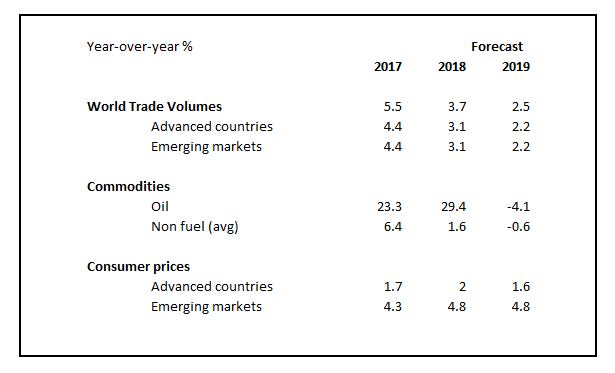
Source: IMF, July, 2019
The most startling downgrade occurs with respect to trade volumes, the most important measure of the health of international trade (accompanying table). Trade volumes in the advanced economies and the emerging markets will be cut in half compared to the performance in 2017 and by one-third from the rate achieved in 2018. Commodities, the main source of international trade, are expected to experience price declines in energy and non-energy products, after relatively robust increases in 2017 and to a lesser extent in 2018.
The agency discusses the nature of the downside risks. The IMF identifies the escalating tensions regarding trade in technology goods (e.g. issues regarding the use of 5G technology developed in China) which have been brewing for several years and represents one of the most intractable international trade issues to date. Further downside risks have intensified in the first half the year from disinflationary pressures that are a result of lower commodity prices and greater production efficiencies in the emerging markets. Consequently, the IMF anticipates that the advanced economies will experience modest disinflation, the bane of existence for central bankers who have struggled ever since the 2008 financial crisis to reach their inflation targets.
Since mid-June, the Federal Reserve has signaled a dovish stance and most market participants expect rate cuts to come very shortly. The ECB has also indicated it is ready to act should these downside risks grow. The Bank of England faces a more immediate issue regarding the impact of Brexit and remains on full alert for anticipated disruptions. The only central bank that remains on the sidelines is the Bank of Canada which has, as yet, not given any indication that is prepared to shift towards a policy of greater monetary easing. Elsewhere, central banks in Asia, Latin America and Australia have announced the adoption of much more accommodative policy in the face of the dim trade outlook.
However, the real anxiety is that monetary easing will do very little to stop the slide in growth, as trade restrictions overwhelm any efforts by central bankers to stimulate growth.
[1] IMF World Economic Outlook, July 23,2019



Comments
Log in or sign up to join the conversation.