

There was no gain, except from the point of view of Netanyahu.
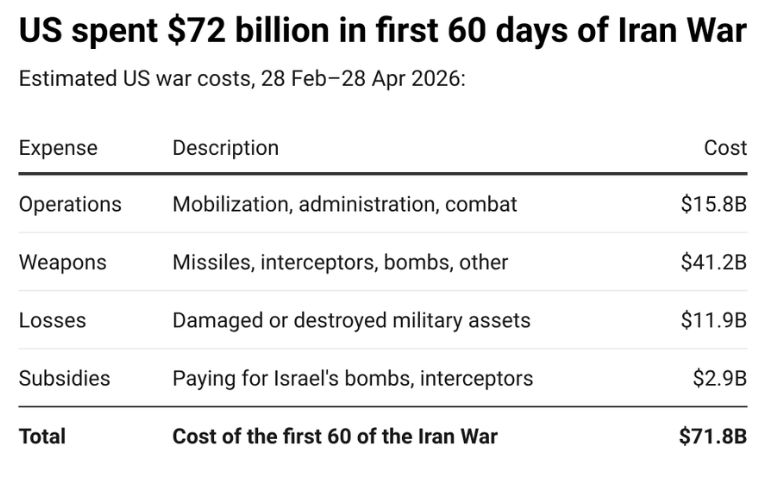
Secretary of Defense Pete Hegseth is lying about the costs. He came up with $25 billion.
Those are just the direct costs. The true numbers counting lost business, rising gasoline prices, rising fertilizer costs, etc., are in the many hundreds of billions of dollars.
The costs go beyond the tangible to loss of respect, waning US global influence, relations with China and the EU, and the need to replenish weapons.
Daniel Davis Deep Dive
This is stunning. To solve a problem that didn’t exist (a nuclear weapons program which US intelligence confirmed has not existed since 2003) in search of an outcome that air power alone could not accomplish (the military defeat of a country as big as much of western Europe), we have squandered the blood of hundreds of Americans (including 13 dead), the loss of 16 military bases, the destruction of scores of aircraft and billions of dollars worth of high-tech radar systems, and laid the foundation for likely global recession and possibly depression.
And we are shelling out $1.5 billion PER DAY to continue deepening our failure.
That is a profound casualty and loss statement for a war of choice that was obviously doomed to fail before it started.
Profile: 4x combat vet (DS, OIF, AFG x2). Host Daniel Davis Deep Dive YT
Forces Trying to Push the US Back to War
That’s a great listen but long.
Davis cited military experts who thought it was likely Iran would end up controlling the strait if the US started a war in Iran.
Now forces want to keep us in war.
A No Win Escalation
Joe Kent exposes how “poison pills” in current diplomatic discussions seem to ensure “there’s no way that it can actually end via an agreement” acceptable to the United States and Israel.
Demanding zero enrichment is a “non-starter” for Tehran, leaving President Trump with zero diplomatic room to maneuver, and retaining its nuclear materials and reprocessing capacity is a non-starter for the president. Strategically, Kent argues the President must “flip the script” and pull U.S. forces out to empower Iranian moderates and restart *real* diplomacy.
This bold move allows both nations to “say domestically… that they had won the conflict,” averting a catastrophic Middle East conflict.
Without this radical shift in U.S. strategy, the only remaining political option is to double down and restart a hot war – which would *greatly* increase the cost of our strategic failure and likely devastate GCC oil production capacity for years – or kick the can down the road and not decide by keeping the blockade in place. These two options would be result in the oil and gas and petroleum products remaining blocked inside the Straits and keep building damaging economic results for the U.S. and our Asian and European allies. Those options are catastrophic and awful. The best option is the ‘ugly’ deal we call ‘walk-away’ option.
Kent discusses how Israel purposely killed the moderates with full understanding radicals would take over ensuring there could be no possible deal.
Trump is looking for an off-ramp, but an off-ramp is not what Netanyahu, Lindsey Graham, Ted Cruz, or the industrial military complex wants.
We are in a no-deal-possible setup at the moment and many want to keep it that way.
We’ll Close the Strait Too
Col. Douglas MacGregor
“The goals were never realistic. We didn’t go through the process of establishing the attainable political-military goal was. We never understood the limits of our military power. We didn’t look at Iran honestly, its size, its population, its capabilities. We grossly underestimated Iranians. I think we can attribute a lot of that to Israel. And we marched head long into something at the behest of Israel.”
Tucker’s Private Talk With Trump
Tucker to Trump: “Look Netanyahu hates you. You know that.”
“People pushing you to do this, want to destroy you. And they are doing this on behalf of Israel, whose goals include getting the United States out the Middle East. … I said that right to his face.”
“And he [Trump] said ‘Yeah, I know.’”
Tucker listed a big batch of names all acting on behalf of Israel.
How Long Can Iran Survive a Blockade?
The Washington Post reports U.S. intelligence says Iran can outlast Trump’s Hormuz blockade for months
A confidential intelligence community assessment delivered to the White House also finds that Iran retains a substantial missile and drone arsenal.
The analysis by the U.S. intelligence community, whose secret assessments on Iran have often been more sober than the administration’s public statements, also found that Tehran retains significant ballistic missile capabilities despite weeks of intense U.S. and Israeli bombardment, three of the people familiar with it said.
One of the U.S. officials who spoke to The Washington Post said they thought Iran’s capacity to endure prolonged economic hardship is far greater than even the CIA estimate. “The leadership has gotten more radical, determined and increasingly confident they can outlast U.S. political will and sustain domestic repression to check any resistance” inside Iran, the official said. “Comparatively, you see similar regimes lasting years under sustained embargoes and airpower-only wars.”
White House spokeswoman Anna Kelly said Iran is losing half a billion dollars daily because of the blockade. “During Operation Epic Fury, Iran was crushed militarily,” Kelly said in a statement. “Now, they are being strangled economically by Operation Economic Fury and losing $500 million per day thanks to the United States Military’s successful blockade of Iranian ports. The Iranian regime knows full well their current reality is not sustainable, and President Trump holds all the cards as negotiators work to make a deal.”
But the CIA estimate says Iran can survive the U.S. blockade for 90 to 120 days — and maybe longer — before facing more severe economic hardship, the four people familiar with it said.
Key findings regarding the blockade’s impact, as of May 2026, include:
Resilience Timeline: The CIA estimates Iran can endure for at least three to four months, challenging claims that the blockade would cause immediate collapse.
Economic Adaptation: Iran is storing oil on tankers and reducing production to keep wells functional, while using overland rail/truck routes to bypass the naval blockade.
Military Capabilities: Despite the blockade, Iran retains approximately 70% of its prewar missile stockpile and 75% of its mobile launchers.
The Iranian leadership has shown increased confidence in their ability to outlast U.S. political pressure, with some officials believing they can sustain the current situation for months or even longer.
No Good Options
Trump literally has no good options.
He does not want to escalate the war. We know that because he didn’t, even when Iran directly attacked US ships.
Yet, Trump keeps making idiotic demands that he knows Israel cannot accept.
And he makes counterproductive statements” like “small price to pay” statements on the price of oil and gasoline.
Consumer sentiment and Trump’s polls are in the gutter.
For What?
To solve a problem that didn’t exist at the explicit request of Benjamin Netanyahu.
Related Posts
April 9, 2026: Inflation Has Been Above the Fed’s Target for 5 Straight Years
The Fed’s preferred measure of inflation has been above 2 percent since March of 2021.
May 8, 2026: Consumer Sentiment Falls to a Record Low, Consumers Cite Gasoline and Tariffs
Consumers Inflation expectations and overall concerns remain elevated.
May 8, 2026: Trump Again Negotiates by Demanding Unconditional Surrender, TACO or War?
It appears Netanyahu is making demand on Trump again.


Comments
Log in or sign up to join the conversation.