

There has never been a currency intervention in history that has worked.
Yen Gains on Intervention
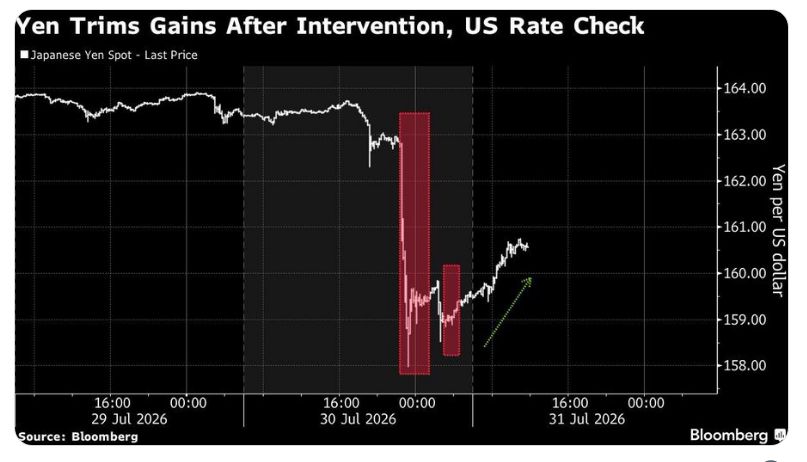
Bloomberg reports Yen Gains on Intervention, Reports of Buying By Both US, Japan
US and Japanese authorities extended efforts to shore up the yen on Friday, with the currency strengthening more than 1% against both the dollar and the euro.
Japanese authorities bought yen and sold dollars during New York trading on Friday, and the US Treasury Department reportedly sold euros to buy yen on behalf of the US Treasury Department.
The moves by Japanese and US officials speak to a coordinated pushback against the depreciation of the yen, which last week touched its weakest level since 1986.
The FT said this marked the first joint intervention by the Washington and Tokyo to prop up the Japanese currency in nearly 30 years.
Largest Intervention in History
Japan just conducted its biggest one-day currency INTERVENTION EVER:
Japan deployed an estimated $53 billion, or ¥8.45 trillion, to defend the yen on Thursday, likely the largest single-day currency intervention on record, according to a Bloomberg analysis of Bank of Japan accounts.
The move came as the yen surged as much as +3.3% against the US Dollar, its biggest intraday gain since December 2023.
The intervention followed a rate check from US authorities around 2:30am Tokyo time and coincided with South Korea also stepping into currency markets to support the won, which strengthened to its highest level since mid-October.
By comparison, Japan’s previous record intervention totaled ¥11.73 trillion, or roughly $74 billion, over an entire month during April’s Golden Week holiday.
What’s Going On?
Mugalli Comments
The US govt intervening directly in the yen market isn’t the typical “bilateral cooperation” imo. It’s a de facto bailout of the BOJ’s broken FX framework.
Japan’s central bank trapped itself between runaway imported inflation and an unserviceable sovereign debt load. To stop Japan from dumping long dated U.S. Treasuries to defend the currency, spiking our own 30 year yield to 5.24% which has been the case all week. T[he] U.S. Treasury is stepping in to manage the exchange rate for them.
Two Key Observations
Japan’s central bank trapped itself between runaway imported inflation and an unserviceable sovereign debt load.
To stop Japan from U.S. Treasuries to defend the yen (spiking US treasury yields) the U.S. Treasury is stepping in to manage the exchange rate for them.
Point one seems obvious. Point two is the more interesting one.
The only time foreign nations “dump the dollar” is to prop up their own currencies.
Every dollar dumping episode is a sign of US dollar strength, not weakness or avoidance.
My point number two is a more generalized statement than what Mugalli stated.
It’s unclear if Japan was about to dump long-dated treasuries. But the general idea is to sell treasuries and use the dollars to buy the Yen hoping to stop the decline.
Doomed to Fail
Q: Why?
A: Because it fixes no fundamental problems.
What About the Plaza Accord?
The Plaza Accord was a 1985 agreement by five major nations to weaken the U.S. dollar, reduce trade deficits, and coordinate currency market intervention. It was signed on September 22, 1985, at the Plaza Hotel in New York City by the G5 countries: the United States, Japan, West Germany, France, and the United Kingdom.
Plaza Accord Details
Currency Shifts: The U.S. dollar fell sharply over the next two years, dropping more than 25% against major foreign currencies.
Trade Balance: Successfully lowered the U.S. trade deficit with European nations, though it was less effective at immediately resolving imbalances with Japan.
Japan’s Economy: The soaring yen hurt Japanese exports, prompting aggressive domestic monetary easing that helped fuel Japan’s massive asset price bubble in the late 1980s and its subsequent “Lost Decade” of stagnation.
Successor Agreement: Succeeded by the Louvre Accord in 1987, which aimed to stabilize falling currency values and halt the dollar’s rapid decline
Some might believe the Plaza Accord agreement worked. But that’s false.
The dollar had already started to weaken. The Plaza accord happened right as the dollar trend reversed anyway.
The irony was the new Louvre Accord to stop the dollar slide.
What’s Japan to Do
If Japan wants to halt the slide of the Yen then it needs to raise interest rates or take other actions to make the yen more attractive.
But Japan does not want to hike rates fearing a recession.
Yen Intervention Is Actually Counterproductive
Q: Why?
A: Instead of having US dollar reserves it wasted them, weakening the yen over the long haul.
Think of it this way. What if Japan sold all its dollars and gold to buy yen?
How would that help Japan at all?
It wouldn’t. No reserves would make matters worse.



Comments
Log in or sign up to join the conversation.