


The US ISM manufacturing index improved further in March, led by strong production levels. A decent order book suggests production will continue growing in coming months, but rising prices and reduced employment underscore the lingering challenges for the sector
Manufacturing continues to make progress
Recent US activity data has, in general, surprised to the upside so far this year and that has continued with today’s retail sales and ISM manufacturing numbers, suggesting that the economy is in a relatively good position to withstand the economic challenges presented by the Middle East conflict.
The US ISM Manufacturing index rose to 52.7 in March from 52.4 in February. This is the best print since August 2022, while the consensus view was looking for it to come in at 52.3. Production rose to 55.1 from 53.5, reflecting a legacy of strong new orders in recent months and a rising order backlog. New orders for March did dip to 53.5 from 55.8, while the order backlog figure came in at 54.4 versus 56.6 last time, but both remain ahead of their six-month averages of 51.6 and 50.1 respectively. This suggests that production can continue to grow strongly for the next couple of months at least.
The less positive details are a soft employment component of 48.7 versus 48.8 previously. This is below the 50 break-even level, suggesting jobs continue to be shed by the sector. Unsurprisingly, there was a big jump in the prices paid component to 78.3 from 70.5 reflecting the spike in oil prices, while reduced tariff rates following the striking down of IEEPA are offering only a mild mitigating offset at this stage. As such, profit margins remain under pressure.
ISM services likely to face more headwinds
Overall, the ISM report suggests that the US manufacturing sector started the year in a very healthy position, especially relative to international peers. Moreover, the chart below shows the relationship between GDP growth and the ISM output series for the manufacturing and services sector and suggests we would likely have had to revise up our 2026 GDP growth forecasts were it not for the uncertainty and the spike in energy costs being caused by the conflict in the Middle East. That said, while the manufacturing sector is doing well, we suspect the high energy/economic uncertainty will be more of a drag for Monday's service sector ISM where we expect the headline index to drop to 53.0 from 56.1.
ISM output series versus GDP growth YoY%
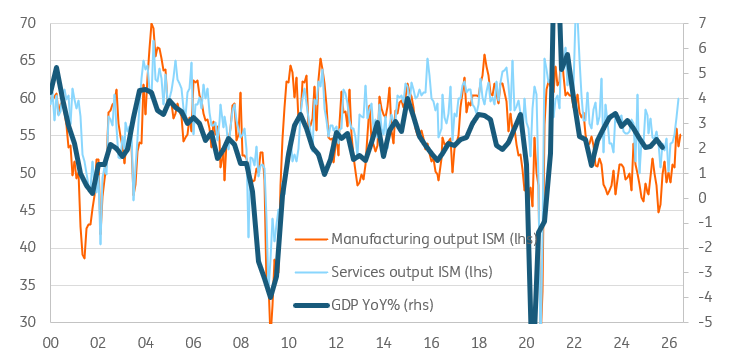
Source: Macrobond, ING estimates



Comments
Log in or sign up to join the conversation.