

After three years of stagnation, US manufacturing appears to be on an upswing as production and order books gain momentum. Tariffs and energy costs pose challenges, but trends in reshoring, AI/robotic technologies and rising defence spending provide reasons for longer-term optimism.
The US manufacturing sector has experienced a torrid couple of decades. Output volumes remain 10% below the peak level hit just before the Global Financial Crisis in December 2007. The sector employs a million fewer workers than it did 20 years ago. Reasons for this poor performance include consumer demand preferences shifting ever further toward services over physical goods, underinvestment in advanced production facilities relative to international competitors, high US labour costs and the removal of trade barriers allowing foreign manufacturers to gain market share.
Manufacturing output levels and manufacturing employment
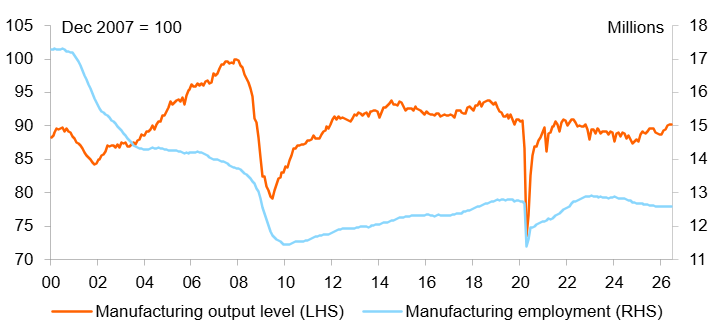
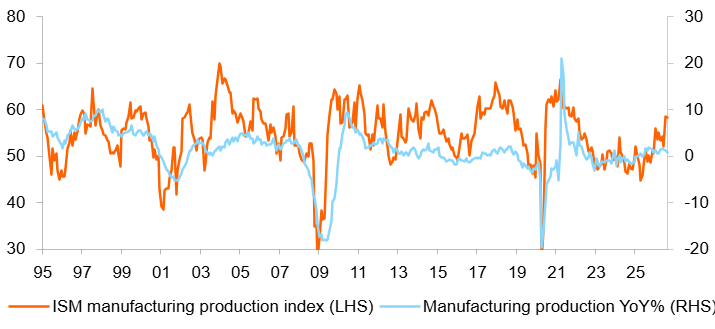
Nonetheless, the sector has shown genuine signs of a revival over the past year. The ISM production index has moved from sub-50 contraction territory to signalling robust growth ahead. Below, we look at what is driving this turnaround and how it could evolve.
ISM production index points to an ongoing manufacturing output upturn
Tariffs remain President Trump’s primary tool
Reviving manufacturing has been top of mind for all recent presidents. In his first term, President Trump’s solution was to impose tariffs on Chinese-made imports along with sector-specific levies. The rationale being that this would boost the price competitiveness of US manufacturers in key sectors. Yet it failed to generate the desired turnaround. Initiatives from President Biden similarly yielded little benefit.
In his second term, President Trump doubled down, initially announcing 25% tariffs on steel and aluminium, and then a 25% tariff on auto parts before launching into his 'Liberation Day' tariffs in April 2025 that dramatically expanded coverage.
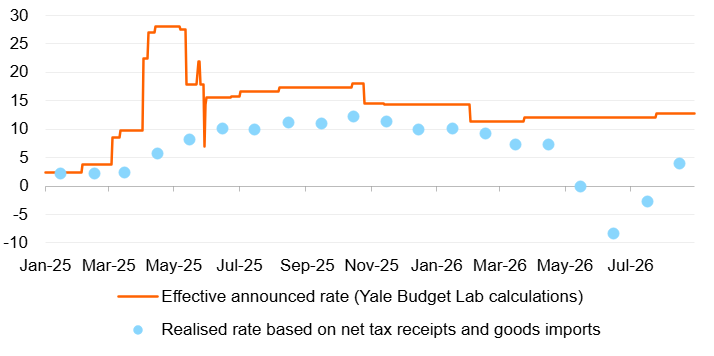
Invoked under the International Emergency Economic Powers Act (IEEPA), individual tariff rates changed based on a trading partner's willingness to open markets to US manufacturers and guarantee investment within the US. The chart below shows that the realised tariff rate undershot the calculated implied average tariff rate based on the full-year 2024 import mix.
Reasons for this include import substitution via switching to lower-tariffed foreign suppliers, a surge in tariff-exempt high-tech imports, and better USMCA compliance. This means a greater proportion of Canadian and Mexican trade qualified for tariff exemptions, and some modest evidence of switching towards US-made products.
Effective announced tariff rates versus realised tariff rates (%)
Source: Yale budget Lab, Macrobond, ING
The Supreme Court ruled against those tariffs in late February. In response, Trump swiftly invoked Section 122 of the 1974 Trade Act. It allows tariffs of up to 15% for as long as 150 days before the US Trade Representative launches Section 301 investigations. The end result is 10% tariffs on 14 countries, including the EU, Mexico, Canada and the UK, with 46 other countries, including imports from China, Japan and India facing a 12.5% tariff. This, in itself, is a lower tariff regime under the IEEPA system.
Given several important tech and medical categories are exempted, we expect the realised tariff rate to come close to 7%. This is a less onerous environment than 12 months ago. Moreover, importing companies' cash flows are being boosted by the Supreme Court’s decision to insist that the $166bn of IEEPA tariffs be fully refunded. That means the realised tariff rate temporarily fell into negative territory in July, as IEEPA refunds more than offset all other tariff charges.
Reshoring yet to show up in construction activity
Citing the effectiveness of tariffs, the Administration has touted the “largest reshoring wave in American history”. It points to a four-year high for the ISM manufacturing index while employment in the manufacturing sector rose 58,000 in the first eight months of this year. Amid pledges from corporate America to invest more in the US, the National Association of Manufacturers reported that foreign direct investment in US manufacturing reached a new record level in 2025 of $2.5tr.
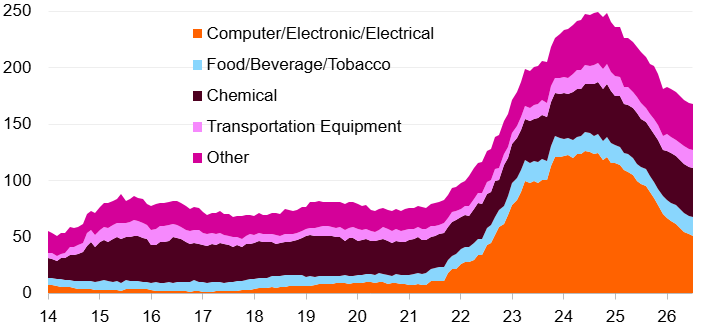
Yet manufacturing-related construction activity does not reflect this positive narrative. Manufacturing construction spending peaked in September 2024 at an annualised $249bn and currently stands at $170bn. We’ve seen a sharp slowdown in construction activity in the computer, electronics and electrical sector from $126bn to $57bn over that same period. That follows the conclusion of the CHIPS and Science Act from the previous Biden Administration, which provided nearly $53bn to boost the domestic semiconductor industry. Strip out this sector and construction activity tied to the rest of manufacturing has changed little over the past two years. So, despite commitments from business leaders, little evidence suggests that a reshoring boom is underway just yet.
Manufacturing sector construction spending ($bn)
While tariffs may improve the relative cost comparison versus foreign products, the National Association of Manufacturers states that in 2024, manufacturing employees earned an average of $106,691, including pay and benefits. That is substantially higher than the average cost of employing someone in China, South Korea and even Germany. This suggests that for manufacturing reshoring to make sense, it would be tied to companies that are highly automated with high value-added production. Alternatively, there could be an appetite to reshore where consumers are willing to pay the premium for a 'Made in America' label or where security of supply chains is an imperative.
Sectors most likely to receive a boost include technology, transport and aerospace, electric vehicles, clean energy and pharmaceuticals. The latter is where we have seen the largest announcements, with Johnson & Johnson’s $55bn investment spending plan over the next four years and Eli Lilly announcing a $27bn investment in its US manufacturing operations. And in solar manufacturing, tariffs, price floors, and China-focussed trade restrictions are supporting the expansion of US manufacturing across the value chain.
While the construction numbers aren’t showing any uplift yet, it takes significant time to get planning in place. Advanced manufacturing plants also take a long time to construct. Intel, for example, suggests it takes three to five years with 6,000 construction workers at a cost of $10bn to build a new factory. An aluminium smelter takes two to three years for construction, in addition to the time needed to design and secure planning approval. Significant infrastructure is also typically required for all new manufacturing sites, including power, road, rail and water, adding to the cost of reshoring.
The Middle East conflict and energy prices
Restrictions on shipping through the Strait of Hormuz have raised concerns about energy shortages, higher prices and potential production disruption for manufacturers globally. However, the US is better positioned to manage those challenges than European and Asian competitors. The US produces more energy than it consumes. Oil prices are set in global markets and push up the cost of gasoline and diesel, with freight costs consequently increasing in the US and elsewhere. However, the US is in a better position relative to foreign competitors in terms of natural gas. Abundant domestic production is keeping prices well below long-run averages.
This has a knock-on effect: lower electricity prices vis-à-vis other countries, which should give US manufacturers a cost advantage over foreign peers. US-based companies involved with steel, metal and glass production – heavy industries that require high-temperature processes – and agriculture and fertiliser production, which use natural gas to convert into nitrogen fertilisers, should be relative winners on the global stage. Similarly, the availability of natural gas, used as a feedstock to create products such as plastics, should give a competitive boost for US manufacturers.
Nevertheless, electricity-intensive manufacturers could come under pressure as AI-driven data centre growth drives up power demand. For example, Emirates Global Aluminium and Century Aluminium are planning a 750,000-ton aluminium smelter in Oklahoma, the first new US smelter in almost 50 years. The facility would double current US aluminium output, but may face challenges competing with data centres for power.
Financial conditions are a headwind
Borrowing costs have risen in response to elevated energy prices and a belief that the Federal Reserve is set to tighten policy and keep interest rates higher for longer. In an environment of substantial government fiscal deficits and anxiety about debt sustainability, US longer-dated Treasury yields have pushed above 5%. Corporate bond spreads have tightened, but not by enough to prevent an overall rise in borrowing costs. Moody’s 10Y Aaa corporate debt benchmark index is pointing to a 56bp increase in borrowing costs since the start of the year.
Mortgage rates, auto loans and credit card borrowing costs all increased for similar reasons. This will act as a brake on economic activity over time. Auto loan and credit card delinquencies are already on par with the rates recorded in the aftermath of the Global Financial Crisis, and the household saving ratio is around 3pp below its long-run average of 6%. As such, this tightening of financial conditions, amplified by the recent strengthening of the US dollar, is a headwind for the sector.
Sector performance diverges markedly
Tariffs and energy security do boost the attractiveness of manufacturing in the US. But so does US economic growth continuing to outperform other key markets. Between 2023 and 2026, the US economy has grown an average of 2.5% year-on-year in volume terms versus 0.9% in Europe.
At the same time, the US Administration believes maintaining the lead in the AI/technology frontier is imperative for both economic and national security, given competition from China. Rapid AI adoption is leading to robust construction of data centres, boosting electricity demand and spurring investment across the power supply chain, from generation and transmission to electrical equipment. In response, gas turbine manufacturers such as GE Vernova and Caterpillar are planning major capacity expansions in the US. ABB has also announced a $110m investment to expand production of switchgear and other electrical components in Virginia, Puerto Rico, and North Carolina. The Trump administration's focus on expanding US energy dominance and industrial competitiveness is increasing the appeal of manufacturing these in the US.
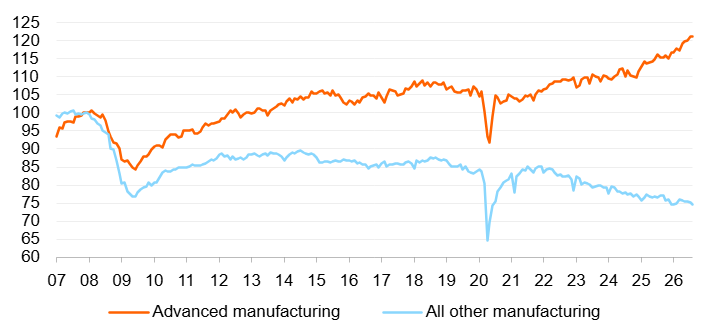
As we can see in the chart below, high value-added or advanced manufacturing, within which we group tech, electronics, transport and power-related sectors, has significantly outperformed other sectors. We expect this story to continue. We also see defence as a sector that should continue to post strong growth. As more countries increase military spending, US companies may benefit from strengthening order books.
Traditional, labour-intensive, commoditised manufacturing sectors continue to shrink under pressure from foreign competitors. Here, tariffs are not enough to provide the competitiveness boost needed to offset the high cost of producing in the US. These US producers are also often detrimentally impacted in foreign markets by retaliatory tariffs.
Advanced manufacturing versus traditional output (Dec 2007 = 100)
Modest growth disguises growing bifurcation
Business surveys point to strong order books, and we see this supporting manufacturing’s ongoing revival. Our volume growth forecast for US manufacturing of 1.5-2% per year over the next three years may not seem like much, but it should be seen in the context of the sluggish activity experienced over the past 20 years. This headline forecast also masks increased bifurcation, with advanced manufacturing growing rapidly while more traditional sectors look set to retrench further.
Highly automated, high-value-added sectors at the forefront of the AI/technology revolution are seen as national champions by the government and are able to absorb the relatively high wages on offer in the US. The desire to incorporate AI advances should, in theory, drive advances in productivity-enhancing initiatives that further support innovation. As such, pharma, tech, transport & aerospace, electrical and power-related sectors should continue to grow robustly.
Lower value-added production, where labour costs make up a greater share of the overall cost base of production, will continue to struggle unless it can garner a 'made in America' premium. Heavy industry, such as steel, is likely to be somewhere in the middle. While costs have risen, they have risen more elsewhere. And the perception of the US as a source of reliable energy, backed by strong political support in a higher-tariff environment, also presents opportunities for growth.


Comments
Log in or sign up to join the conversation.