

China’s exports, imports, and trade surplus all comfortably beat expectations in September as the trade boom continued. Key trade ties look set to remain stable through year-end, which should keep this year's key growth engine humming
Exports stronger than execrated again in September
China's exports grew 36.3% year-on-year in September, up from 25.0%, far stronger than forecasts (market: 25.7%, ING: 24.8%). It was the highest growth since 2021, when data were heavily affected by base effects from pandemic-related shutdowns in 2020. The 2026 data is considerably more impressive, building on the solid growth seen in 2025. In the first three quarters of the year, exports rose 21.3% YoY, totalling $3.37tn.
By product, this year's strength has been concentrated in the tech and transportation sectors. In the first three quarters, hi-tech product exports rose 45.6% YoY. Semiconductor exports rose 108.1% YoY, while exports of automatic data processing machines rose 54.6%. In transportation, auto exports rose 54.3% YoY, while ship exports rose 29.9%.
Higher prices also boosted the value of rare earth (46.6%) and refined fuel (37.6%) exports, even as volumes fell year-on-year.
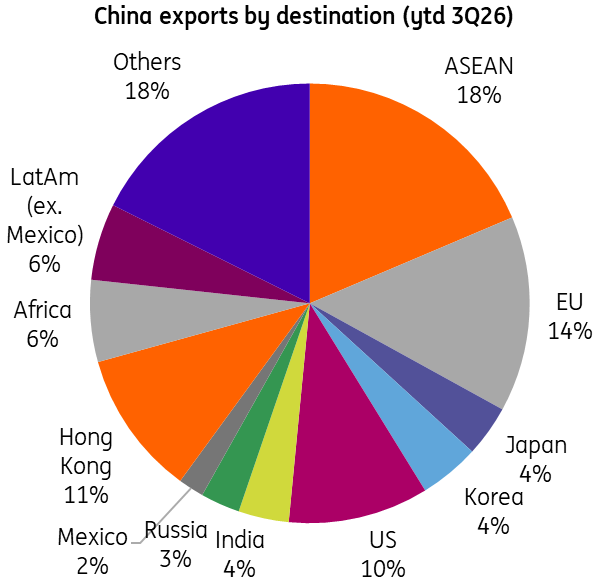
By export destination, exports to the US have continued to recover as the trade truce holds, surging 39.6% YoY in September and bringing year-to-date export growth to 9.8%. An extension of the trade truce through January 2027, combined with $30bn in tariff cuts on products such as toys, Christmas decorations, and kitchenware, should keep the recovery trajectory intact for the rest of the year. Exports to ASEAN, China's largest export market, surged 52.3% YoY in September, bringing the year-to-date growth to 28.7%. Exports to the EU also surged 25.3% YoY in September, hitting a 7-month high and bringing the year-to-date export growth up to 16.4%. Finally, exports to Korea also hit 68.2% YoY in September, the highest level since 2021, bringing year-to-date growth to 39.1%.
China's exports have evolved significantly over the past decade, both by product breakdown and by destination. As China moves up the value-added ladder, its fastest-growing exports increasingly include higher-margin goods, while low-end manufacturing is moving elsewhere in the region. Rising trade barriers have sharply reduced the US share of China's total exports from 19.2% in 2018 to 10.3% through the first three quarters of 2026.
China's exports by destination in 2026
Tech products continue to drive import surge
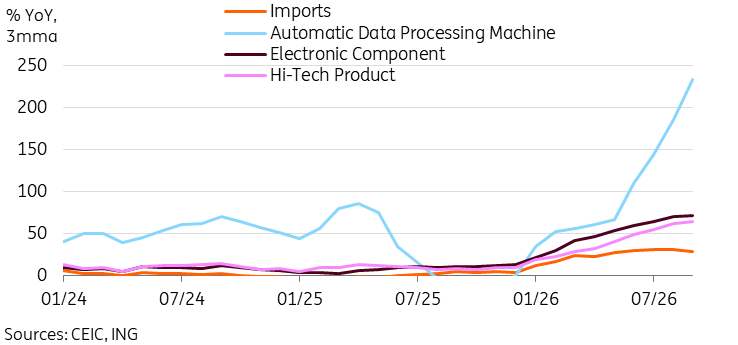
Import growth accelerated to 31.0% YoY in September, up from 28.2% in August and well above forecasts (market: 25.0%; ING: 21.7%). This brought first-three-quarter import growth to $2.43tn, up 27.5% YoY. Compared with early-year expectations, imports have been the biggest surprise this year.
Technology products remained the main driver of import growth, suggesting China continues to spend in the ongoing tech race. High-tech product imports rose 63.9% YoY in September, bringing year-to-date growth to 48.4%. Imports of automatic data processing machines and parts surged 296.5% YoY, up from 209.1% in August, lifting year-to-date growth to 124.8%. Semiconductor imports also remained strong, rising 74.7% YoY in September, bringing year-to-date growth to 63.5%.
However, strength outside technology remained less convincing. On the crude oil front, China imported 37.1m tonnes in September, with volumes down -21.5% YoY during the month and -15.3% in the first nine months of the year, though higher prices led import values to rise a modest 0.3% YoY year-to-date. Auto imports also fell -38.1% YoY in September, a deeper contraction than the -32.4% level recorded in August, as Chinese auto sales continue to fall after years of consumption front-loading driven by trade-in policies. We’re also seeing what appears to be a structural shift away from auto imports as domestic players gain market share.
Overall, the breakdown suggests that import growth remained concentrated in technology products, rather than reflecting a broad-based recovery across sectors.
Tech products are far and away outperforming overall imports
Trade surplus likely to break records again this year
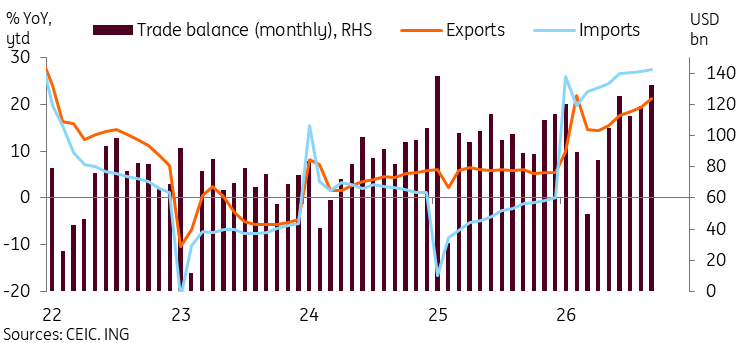
China's trade surplus reached $133.5bn in September, comfortably above expectations, as the export beat was larger than the import beat (market: 117.8bn, ING: 118.3bn). The September trade surplus marked a 20-month high.
In the first three quarters of the year, China's trade surplus is now $938.1bn, about 7.8% higher than the comparable period in 2025. The surge in imports at the start of the year shrank the trade surplus early on. Yet the subsequent pickup in exports in recent months has set China up to build on last year's record-breaking $1.2tn trade surplus this year.
Successful trade talks with the US and EU over the past month are likely to keep the commercial environment relatively stable through the end of the year. But uncertainties may hang over next year's outlook. As China's growth looks increasingly imbalanced, a slowdown in the tech capex cycle or new tariff shocks are the key risks to monitor moving forward for the year ahead.
Trade data beat forecasts across the board in September



Comments
Log in or sign up to join the conversation.