

Polish retail sales were resilient in October, helped by strong demand for durable goods. But slower real wage growth and a higher propensity to save have weighed on consumption in recent months. Softer demand is making it harder for firms to pass higher energy costs on to consumers, which prevents broad-based price growth in response to the energy shock
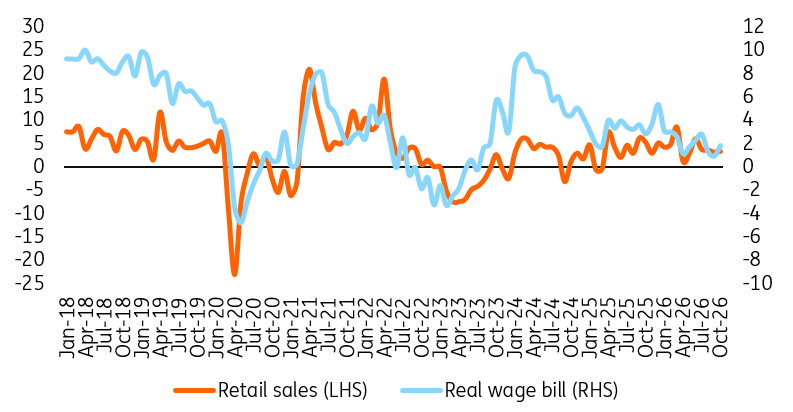
Retail sales in Poland rose by 3.5% YoY in October (ING: 2.7%; consensus: 3.4%), following a 3.6% YoY increase in September. Seasonally adjusted data points to 1.9% MoM sales growth. The implied retail sales deflator indicates that goods prices rose by 3.3% YoY.
The composition of sales highlights weak demand for essentials. Food sales increased by 1.5% YoY versus 1.4% YoY in September, while fuel sales rose by 1.6% YoY after falling by 9.8% YoY a month earlier. In the latter case, sales were supported by lower excise duty and VAT on fuels from the beginning of October, which lowered fuel prices. Solid demand was still observed for durable goods. Sales of furniture, consumer electronics and household appliances increased by 14.9% YoY, following a 10.7% YoY rise in September. One weak spot in this segment was sales of cars and parts, which rose by just 1.1% YoY after double-digit increases in the previous two months. Among semi-durable goods, the impact of cooler weather was visible in demand for clothing and footwear, where sales increased by 4.0% YoY after declines in the previous three months.
Elevated inflation and slower real wage growth, combined with a higher propensity to save, have translated into somewhat weaker private consumption growth, although consumer demand is still expanding. In 2027, however, consumption growth is likely to be weaker than in 2026. Together with less dynamic investment growth following the completion of projects supported by the National Recovery Plan (KPO), this is likely to push GDP growth below 3% next year.
Slowing real wage bill is putting pressure on retail sales
Real retail sales and real wage bill in entgerprises, %YoY
Cost pressures from higher energy prices are clashing with weaker demand, making it harder for businesses to pass higher costs on to consumer prices. As a result, increases in retail prices are currently concentrated in fuels and closely related goods and services. A prolonged energy shock creates a risk that price increases will spread to other goods and services, but at the current stage of the economic cycle this is being constrained by weaker demand.
Given a softer start to 4Q26 in the Polish economy and the absence of broader inflationary pressures, the Monetary Policy Council (RPP) can maintain its cautious stance. We expect interest rates to remain unchanged in December. Should elevated inflation persist, monetary policy tightening in 1Q27 may still be warranted. However, in light of the latest data from the Polish economy, the probability of rate hikes by the National Bank of Poland is falling.


Comments
Log in or sign up to join the conversation.