


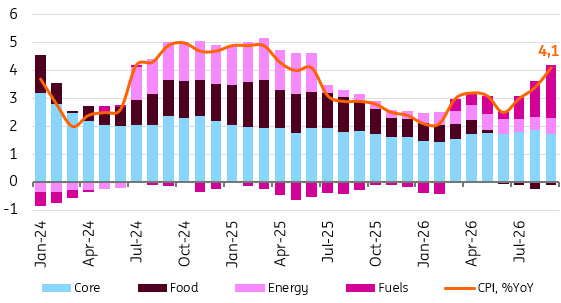
Poland’s September inflation was revised up to 4.1% YoY, with energy and fuel prices accounting for roughly 60% of the annual increase. Meanwhile, core inflation even eased, and there is still little evidence that the energy shock is passing through more broadly into other prices. The central bank should not rush to hike interest rates.
Higher energy prices boosted inflation in September
Poland’s StatOffice revised its estimate of September CPI inflation to 4.1% YoY from the 4.0% YoY reported previously. Goods price inflation accelerated to 3.6% YoY and services prices slowed to 5.3% YoY, compared with 2.5% YoY and 5.6% YoY respectively in August. Services inflation has fallen to its lowest level in five months, with no evidence of second-round effects.
Price growth continues to be driven primarily by rising energy costs. Compared with August, fuel prices increased by 9.2% MoM, while household energy prices rose by 1.0% MoM, mainly due to higher prices for liquid fuels (+14.7% MoM) and solid fuels (+5.5% MoM), including coal (+7.4% MoM). Higher energy prices contributed around 2.5 percentage points, or roughly 60% of September's annual inflation rate.
Food prices were broadly unchanged (+0.1% MoM), as were prices in core categories. We estimate that core inflation excluding food and energy slowed to around 3.1% YoY from 3.3% YoY in August. The deceleration in services inflation suggests that the energy shock is not spreading into other price categories. In September, even categories linked to the AI investment boom were not very buoyant.
Fuels and house energy accounted for 60% of annual CPI in September
CPI inflatigon and its sources, %YoY, perc. points.
Inflation likely to remain around 3.5% YoY in the near term
In the fourth quarter of 2026, CPI inflation is expected to stabilise near 3.5% year-on-year, the upper end of the National Bank of Poland's (NBP) tolerance band around its inflation target. The main reason is the reintroduction of government fiscal intervention, which reduces excise duties and VAT rates on fuels during the final three months of this year.
In our view, if oil prices remain elevated, the fiscal programme is likely to be extended in the first two months of 2027 despite the challenging fiscal situation. This would help avoid a sharp rise in CPI at the beginning of 2027, when the termination of the programme would otherwise push fuel prices higher. Suspending the scheme in March 2027 would allow this effect to coincide with a high base, generated by the start of the war in 2026, and smooth headline inflation.
An external supply shock with limited broader price pressures
At present, higher inflation is primarily the result of an external supply shock in the form of rising energy prices, while prices in other categories remain relatively stable. Food remains cheap, and there are no clear signs of broader inflationary pressure or significant second-round effects.
However, the prolonged energy crisis has somewhat worsened the inflation outlook. The beginning of next year will probably bring substantial increases in regulated household prices, particularly electricity and gas tariffs. Food prices are also likely to rise, reflecting higher agricultural commodity prices, a low comparison base and more expensive fertilisers.
The MPC can afford to wait, but rate hikes in 1Q27 cannot be ruled out
We believe that, under current conditions, the Monetary Policy Council does not need to rush into tightening monetary policy. The November inflation projection may initiate a discussion about whether interest rate increases are warranted.
In our view, rate hikes could take place in 1Q27, as further months of elevated energy prices increase the risk that the energy shock eventually spills over into other prices, although the scale of such effects should be much smaller than in 2022-23. We therefore assume that the Council will act pre-emptively and raise rates by a cumulative 50bp, taking the policy rate to 4.25%.

Comments
Log in or sign up to join the conversation.