

While U.S. - initiated tariffs dominate trade debates worldwide, it is easy to lose sight of how U.S. fiscal policy will thwart Trump’s efforts to narrow trade imbalances. As the United States government runs up ever growing larger deficits, it will be forced to rely on its major trading partners, such as China, Japan and Germany to use their surplus dollars to buy ever-growing amounts of U.S. debt. This pattern of relying on the kindness of strangers is not new to the United States, but it takes on a greater significance in the face of trade tensions that threaten world growth.
A recent IMF report[1] estimated that the overall global current account surpluses and deficits remained broadly unchanged, at about 3¼ percent of world GDP in 2017, with a growing concentration in advanced economies. The report stresses that these large external imbalances, especially in the world’s key economies, pose risks to global stability. We are now witnessing daily reports of threats and counter threats to raise tariffs. Purely from a trade viewpoint, U.S. current account deficits need to be financed by surplus dollars accumulated by its trading partners. However, this is not the only type of deficit the United States should be concerned with.
The passing of the massive tax cut for U.S. corporations nearly doubles the Federal government’s deficit which is projected to reach 6% of GDP, one of the largest in the advanced economies. For many years, the U.S. savings rate has been inadequate to finance its twin deficits. It has successfully relied upon savings generated by its trading partners to offset its current deficit and its federal government deficit.
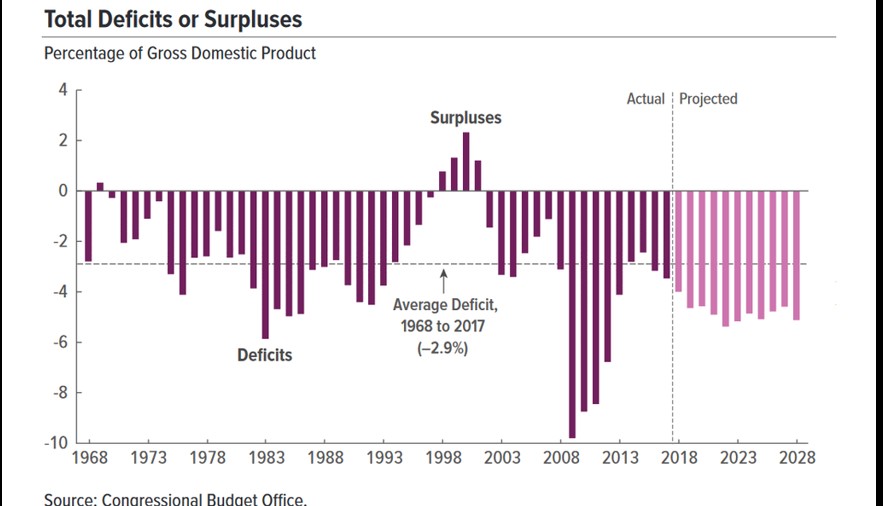
The fiscal expansion currently underway in the United States is leading to a tightening in monetary conditions, a stronger US dollar, and consequently a larger U.S. current account deficit. Fiscal deficits promote greater imports of consumer products which further amplifies the U.S. current account deficit and the higher dollar works against the promotion of U.S. exports. In other words, the U.S. government deficits work against the interests of the reducing trade imbalances. In the short term, these trends only risk further trade tensions. The stronger USD puts greater strain on the emerging market economies and this, in turn, forces these nations to do more to generate exports. Bashing one’s trading partners while relying on their surplus earnings to fund one’s deficit is no way to solve the problem.
The U.S. administration reported this week that it expects annual budget deficits to grow nearly $100 billion more than previously forecast for each of the next three years, pushing the government’s budget deficit beyond $1 trillion starting next year. We can expect that this additional deficit spending will generate greater reliance on imports and a possible further widening of the current account deficit.
[1]IMF, Tackling Global Imbalances amid Rising Trade Tensions, July 2018



Comments
Log in or sign up to join the conversation.