

US intervention shows all isn’t well with the US dollar.
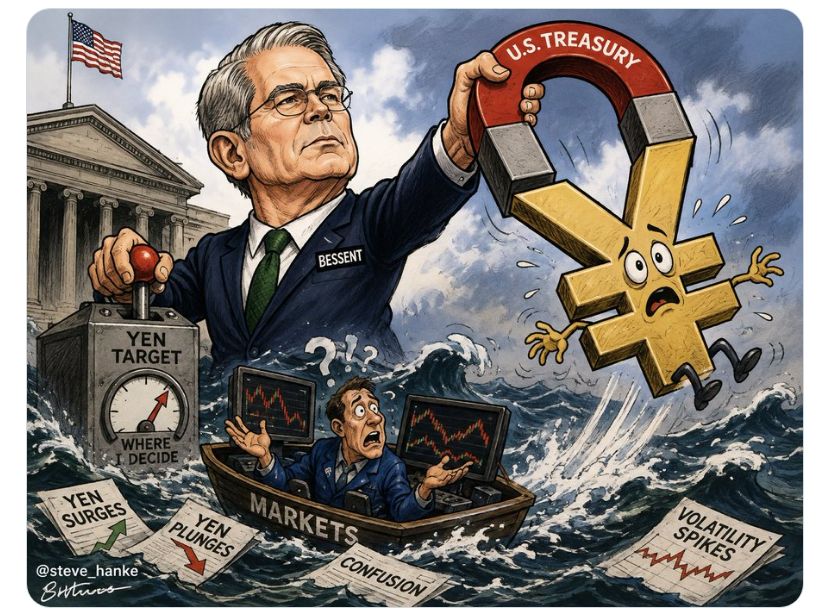
Yen Intervention and Unintended Consequences
The Wall Street Journal reports Scott Bessent’s Yen Trade Has Unintended Consequences for the Markets
The joint U.S.-Japan support of the yen is unusual. The way it is being financed is unprecedented, and adds liquidity when the punch bowl of the U.S. economy and markets is already overflowing.
So far the scale is small, but Treasury Secretary Scott Bessent wants the Fed to drop its $60 billion cap on the emergency facility being used—or abused, given there’s no emergency—to lend to Japan, and pledged to do “whatever it takes” to help.
Knowing the Correct Price of Things
Not Attractive Reserve Currency
Financial Times
Central banks are accustomed to holding foreign reserves in dollars because markets in US Treasury securities are liquid. Central banks hold US Treasuries because they can be freely bought and sold and used in interventions. But not now, at least not in unlimited quantities. Instead, we see the US Treasury stepping in with euro sales as part of its contribution to the intervention, thus limiting the volume of dollar sales needed by the Japanese authorities.
TINA to the Forefront
The first sentence by Tyson above is flat out wrong.
The US has a trade deficit with most of the world. As a direct function of that trade math foreign governments accumulate US dollar reserves.
Japan has a mountain of US dollar reserves due to trade surpluses with the US over the course of decades.
No country accumulates these massive reserves because they want to or because dollars are liquid. Rather, Central banks primarily hold US dollar reserves because of trade math.
There Is No Alternative
Liquidity, a free floating currency, a large global bond market, and willingness to have massive fiscal and trade deficits are requirements to having the world’s global reserve currency.
The US is the only country that meets all of the requirements.
Dollar Attractiveness
“The dollar is not the attractive reserve currency it once was,” says Tyson.
That is correct. But so what?
T.I.N.A. There is no alternative.
Robin Brooks
I have a long running feud with Brooks over sanctions.
He likes them. I claim they don’t work. Time and time again I have been right.
Regarding currency interventions, I am firmly in Brooks’ camp here.
Financial Stress Hits Lack of Alternatives
To stem the plunge in the Yen, Japan needs to hike interest rates, reduce debt, or take other measures to support its currency.
But fearing recession, Japan does not want to do what it takes.
Instead, Japan (with unprecedented US help) has been selling dollars to buy Yen (its own currency).
Since no fundamentals have changed, it’s absurd to believe intervention will fix anything.
Understanding the Intervention
Normally (not that normal would work) Japan would sell its stockpile of US treasuries for dollars, then use the dollars to buy yen.
Bessent’s fear (rightfully so) is selling huge amounts of US treasuries by Japan would put upward pressure on treasury yields.
Bessent does not want that. So he is using an emergency tool called FIMA, created in the Covid recession for a different reason, to assist Japan.
How the FIMA Repo Facility Works
Eligible counterparties (foreign official institutions with accounts at the Fed) can enter overnight or up-to-7-day repurchase agreements: they temporarily transfer Treasuries to the Fed’s System Open Market Account in exchange for dollars, then reverse the transaction at maturity (returning the dollars and getting the securities back).
The Fed’s stated purpose (from its own FAQs, dating to the facility’s creation/expansion around 2020 and made standing thereafter) is to provide “an alternative temporary source of U.S. dollars for approved FIMA account holders of Treasury securities other than sales of the securities in the open market.”
It is fully collateralized by the Treasuries (with margining similar to the discount window), so the Fed takes no credit or FX risk in the transactions. There are per-counterparty limits (commonly cited around $60 billion).
Japanese authorities have publicly referenced the FIMA facility in this context. Japan’s Ministry of Finance noted access to it as one of the tools for temporary dollar liquidity against Treasuries, and Finance Minister Satsuki Katayama and others indicated plans to utilize it (alongside the coordinated intervention) so that yen-support operations need not involve outright Treasury sales that could pressure U.S. yields.
Bessent has also publicly highlighted/encouraged the facility (and potential upsizing) in connection with supporting Japan’s efforts.
With FIMA, the US sold some Euro reserves to get dollars to lend to Japan rather than
A Bigger Bazooka
Bessent now wants unlimited ability to buy yen. That’s how absurd things now are.
Chris Martenson comments “Bessent thinks he knows the correct prices for things. He does not believe in markets finding authentic clearing prices. This is true for gold, silver, and oil. This will end badly. Plan accordingly.“
Actually, Bessent is just another charlatan who will do or say whatever it takes to support Trump.
That is part of the bargain when one agrees to work for Trump.
Interventions Don’t Work
Robin Brooks understands currency interventions don’t work.
He need to accurately generalize his thought process to “interventions don’t work“.
Sanctions have never worked as intended. Nor can one bomb one’s way to victory.
Russia, Iran, Afghanistan, Vietnam, and Cuba are proof over decades.
Attractiveness Irony
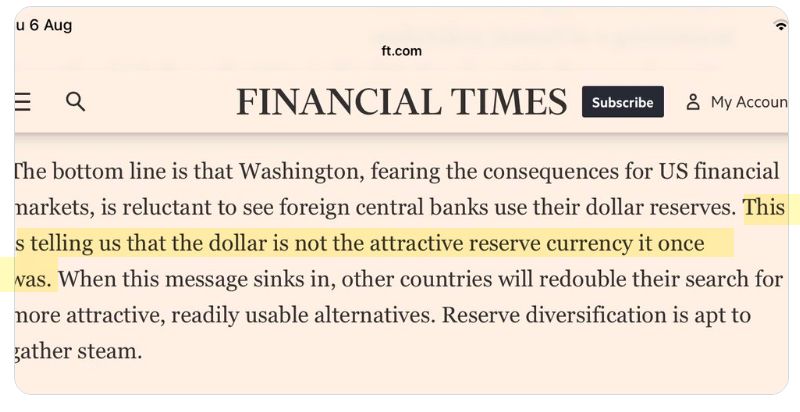
Returning to the Financial Times, Tyson says “The dollar is not the attractive reserve currency it once was. Countries will redouble their search for attractive, readily available alternatives. Reverse diversification is apt to gather steam.”
As long as the US runs trade deficits, mathematically foreign nations must accumulate US dollar denominated assets.
Attractiveness is meaningless.
Yet, the Fed and Treasury are now scared to death of Japan dumping dollars.
For years, we heard people say “Wait until China or Japan dumps treasuries.” But that was always in context of countries getting tired of their losses.
The irony is Japan is sitting on massive gains in its treasury portfolio!
Bessent wants unlimited ability to intervene to prevent a bond market selloff.
People who used to be free market advocates are now cheering this intervention. The mind-twisting to support Trump has been amazing.
US Dollar Dominance
Please recall What Would It Take to End US Dollar Dominance Over Global Transactions?
Questions of the Day
Q: Why does the world accumulate dollars?
A: The US runs a trade deficit with most of the word.As a direct result of huge persistent trade deficits, the world accumulates US dollars.
Q: What does the world do with the dollars?
A: Recycles them into US assets mainly US Treasuries and Agencies.Q: Is this why the US has the world’s biggest bond market?
A: Yes, that plus huge recurring fiscal debt and a mountain of debt held by the public to the tune of $31 trillion, $39 trillion total.Q: Can the US do anything about this?
A: Only superficially, without a complete global financial rework.Trump tried tariffs. Well guess what? Tariffs didn’t work and won’t.
The Fundamental Problems
There is no brake on deficit spending. Congress can and does keep raising the ceiling and spending more and more.
There is no brake on trade deficits.
Gold provided those brakes. When Nixon closed the gold redeemability window in 1971, all brakes were removed.
The US consumer became the buyer of last result. Later on, there were no brakes on Chinese exports.
China can fix this but doesn’t want to. Germany does not want to fix its reliance on exports either.
I have been discussing this for decades. And the answers never change.
Sustainability of the Setup
Q: Is this sustainable?
A: No.
Q: When does it end?
A: I have no idea, nor does anyone else.
Q: How does it end?
A: A global currency crisis.
Q: What’s the role of Bitcoin in the crisis?
A: None.
Q: What’s the role of gold following the crisis?
A: I don’t know.
My 2019 post is still accurate.
Flashback September 19, 2019: Nixon Shock, the Reserve Currency Curse, and a Pending Currency Crisis
Forget the Yuan
Many expect China to overtake the US and for the yuan to replace the dollar as the world’s reserve currency.
Such talk is nonsense. The reserve currency holder needs to meet several requirements of which China meets none.
Where’s De-Dollarization?
Is de-dollarization happening? If so, where and how?
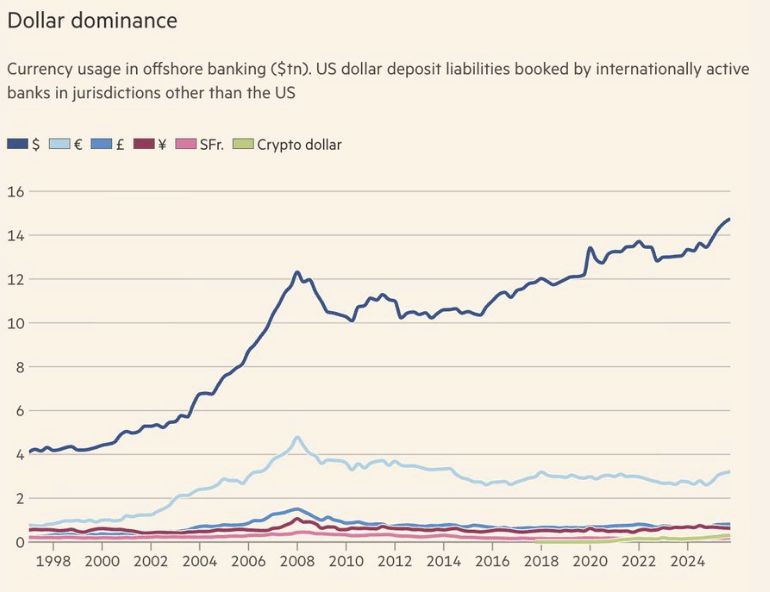
On April 30, 2026, I asked Offshore US Dollars Surge Over the $14 Trillion Mark, Where’s De-Dollarization?
King Dollar Top Line View
Record offshore USD liabilities reflect ongoing US deficits + structural global demand for dollars + offshore banks doing what they do best.
King Dollar isn’t strangely dominating despite everything. It’s dominating because of how the system works.
Trump’s Tariffs Didn’t Improve the Deficit
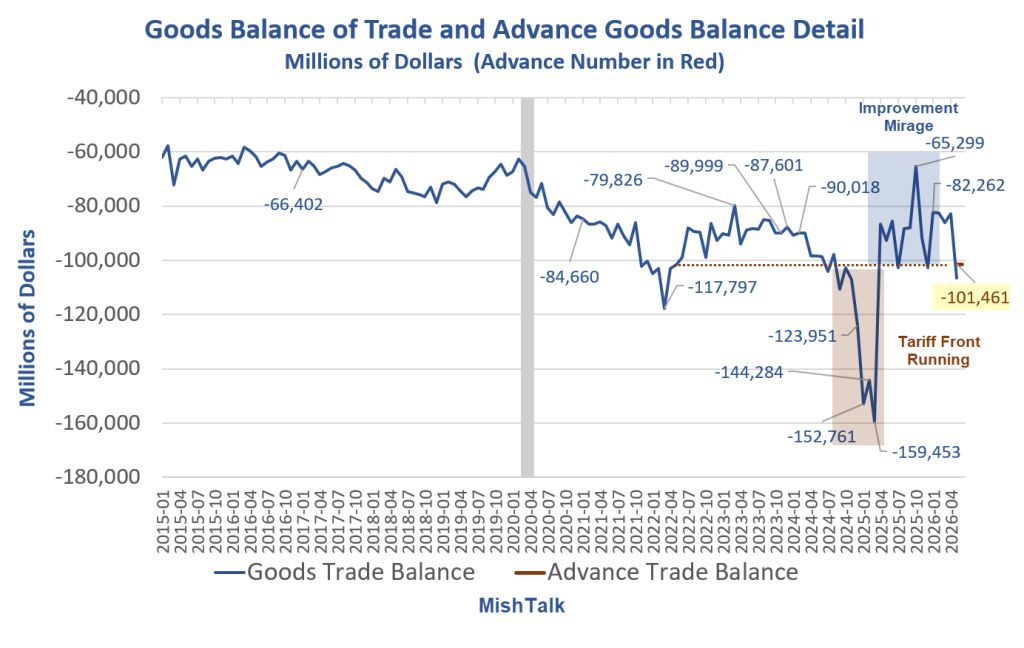
On July 28, 2026, I commented Trump’s Tariffs Didn’t Improve the Deficit but Did Increase Consumer Costs
The undeniable truth is easy to see in pictures.
Yes, there is a desire to change the system, but what is anyone going to do about it?
Five Things China Can Do
Float the yuan
End capital controls
Stop export subsidies
Be willing to have trade deficits
Build the world’s largest (or very large) global bond market.
China needs to do those things to increase yuan usage and become an alternate reserve currency.
So, it’s mostly up to China. However, Trump and Bessent are not helping.
Trump has even threatened to put 100 percent tariffs on any nation challenging US reserve currency status.
Not that anyone takes Trump’s threats seriously, but the ultimate irony is the world desperately needs to get off the current dollar dominance treadmill.
Meanwhile, stress builds and Bessent wants unlimited ability prop this mess up.



Comments
Log in or sign up to join the conversation.