

Market participants generally fret the upcoming financial results from big U.S. banks, as the novel coronavirus continues to take a toll on lives and economies across the globe.
Earnings season blackouts are also set to stunt investment-grade corporate bond sales.
Deals in the week ahead could amount to roughly US$35bn if market conditions remain intact after more than US$37bn worth of fresh, high-grade debt deals were priced in the past holiday-shortened week.
The latest round of new offerings contributes to an enormous spike of recent activity in the U.S. investment-grade primary market, as the Federal Reserve Thursday took several additional actions – culminating in US$2.3tn worth of loans to support the economy.
(Click on image to enlarge)

The central bank said its funding aims to aid households and employers regardless of size, as well as to bolster the ability of state and local governments to deliver needed services as the coronavirus pandemic continues to ravage the nation.
Federal Reserve Board Chair Jerome Powell noted that the country’s “highest priority must be to address this public health crisis, providing care for the ill and limiting the further spread of the virus.” He added that the Fed’s role is “to provide as much relief and stability as we can during this period of constrained economic activity,” while helping to ensure that “the eventual recovery is as vigorous as possible.”
The financial markets had generally responded favorably to the Fed’s efforts, while some analysts thought the bullish activity was somewhat reminiscent of how traders had reacted during the period of mid-March through end-April of 2008, in part after the central bank approved the sale of Bear Stearns to J.P. Morgan and cut interest rates by a total of 100 basis points to 2%.
No Limit to Losses
However, many in the market think the Fed’s measures will not stave off a further downturn in the financial markets as long as the virus remains a threat to the quickly deteriorating economy.
Ed Grebeck, a global debt strategist and CEO of Tempus Advisors, noted that the COVID-19-induced crisis results from the overreaction of state and local governments, as they “suddenly and immediately” shuttered “entire industries and businesses across wide areas, irrespective of the seriousness of the COVID problem, through ‘shelter in place’ and ‘self-quarantine'”, among other measures.
Moreover, apart from the Fed, fiscal stimulus and bailouts amounting to more than US$2tn to date were constructed in very short order, and “there is no end in sight,” he said.
Grebeck likened the actions to an artist who “wanted to restore a defaced masterpiece — and did it by emptying several different buckets of paint on it and using a broom to try to repaint specific colors and damages.”
He added that unlike the credit crisis of 2008, which had a ceiling of roughly US$4tn worth of documented losses from mispriced asset-backed securities, the current pandemic has no limit on how much could be lost, amid commercial business shutdowns, later business bankruptcies, and job losses of individuals everywhere, across the entire supply chain. Furthermore, “there is no telling how much U.S. government debt will need to be created” compared to 2008 losses.
(Click on image to enlarge)

To date, almost 1.9m of COVID-19 cases have been identified in 185 countries and regions, with nearly 30% of that total having hit the U.S., according to the Center for Systems Science and Engineering (CSSE) at Johns Hopkins University. More than 115k people have suffered fatalities globally.
Against this backdrop, market participants widely fear that some big U.S. bank’s first quarter of 2020 earnings, set for release in the week ahead, will reflect sharp declines in consumer activity and investments, while further color about government stimulus programs may help draw a better picture of their future financial stability.
Year-to-date in 2020, shares of major U.S. banks have plunged by double digits – some nearly halving their equity value, including J.P. Morgan Chase & Co. (NYSE: JPM, -28.27%), Bank of America (NYSE: BAC, -31.45%), Wells Fargo (NYSE: WFC, -40.34%), Citigroup (NYSE: C,-42.51%), Goldman Sachs (NYSE: GS, -20.33), and Morgan Stanley (NYSE: MS, 22.4%), while the S&P 500 has sunk around 15.15% over the same period.
(Click on image to enlarge)
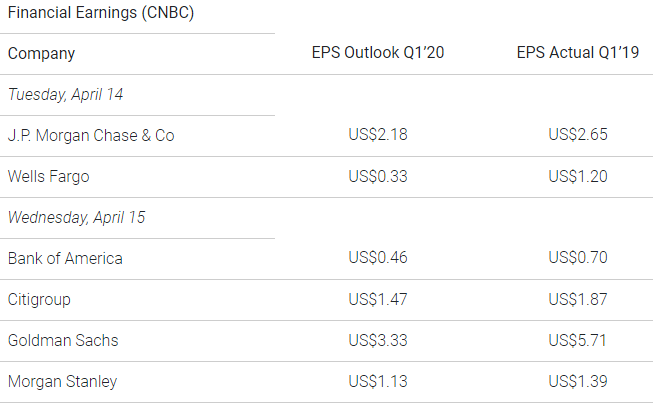
New debt issuance from these banks is likely to cross the wires following their financial releases and exits from their respective blackouts.
Support Spurs ‘BBBs’ Tighter
Meanwhile, other analysts think the Fed’s massive and numerous stimulus programs will provide a boost to high-in-credit-quality companies and potentially higher-yielding firms as well.
Barclays strategists noted, for example, that given “the combined effect of the various facilities, we believe the Fed is providing significant support for companies that were rated investment grade as of March 22.”
They added that the central bank’s assistance “should drive a rally in short-dated investment-grade debt generally as well as the lower-rated segments of BBBs,” while the “potential bright spot for high yield investors was that the Fed can purchase high yield ETFs, although they indicated this would not be their first choice.”
As of April 8, 2020, ‘BBB’-rated credits had narrowed by 52bps over a 10-day period – the most across the investment-grade rated spectrum – to 372bps. Still, the level remains a far cry from its post-2008 crisis low of 115bps, according to data compiled by Mischler Financial’s head of fixed income syndicate Ron Quigley.
In the meantime, holders of high-grade bonds generally remain nervous, continuing their exodus out of investment-grade corporate funds.
For the week ending April 8, Refinitiv U.S. Lipper Fund Flows reported additional net outflows of US$4.7bn from high-grade corporate funds after a total of around US$46.5bn was withdrawn over the prior two weeks.
Market sentiment in Monday’s intraday trading session also remains sour, with European financial centers closed for the Easter holiday. The Dow Jones Industrial Average and S&P 500 were each down around 2%, while the Nasdaq had fallen around 0.75%.
For more insights, use the global bond scanner in the IBKR Trader Workstation to locate corporate bonds that are available to trade in the secondary market, along with U.S. Treasuries, municipal bonds, non-us sovereign debt and more.




Comments
Log in or sign up to join the conversation.