

US retail sales posted their weakest performance in over a year as internet sales cooled following Amazon Prime day and consumers became more cautious on purchasing big-ticket items, such as autos. A soft jobs market and financial pressure amongst low and middle-income households aren't helping, either.

Retail sales held back by internet and auto weakness
Today's US macro data includes very poor US retail sales numbers for July, falling 0.6% month-on-month at the headline level versus expectations of a 0.1% rise. This is the weakest performance in over a year. The control group, which excludes volatile items such as autos, gasoline, building materials and eating out – and better tracks broader consumer trends – fell 0.4% versus expectations of a 0.3% gain, and June was revised lower by 0.1ppt to 0.4% MoM. This is all the more surprising given the FIFA World Cup, which had lifted tourist numbers and the 250th Independence anniversary celebrations.
There has been hot weather that can influence footfall, but the only category to perform well was clothing at +1.9% MoM, while health and personal care posted a respectable +0.7% increase. The underperformers were autos (-2.4% MoM), where higher gasoline prices may have led potential buyers to rethink their decision, and non-store/internet (-2.2%), which likely reflects a subsequent slowdown after the Amazon Prime Day discounts on 23-26 June.
Retail sales levels Feb 2020-100
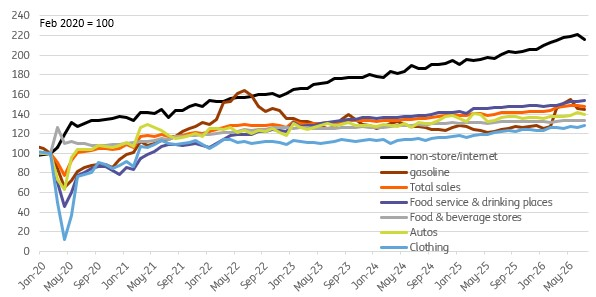
Source: Macrobond, ING
GDP contribution will be soft, but services can rescue things
Retail sales account for 41.5% of total consumer spending, with services such as hotels, airline tickets, insurance, etc. accounting for slightly more. Higher-income households tend to account for more spending in these areas, and we expect those components to hold up better than retail. Lower and middle-income households have a slight skew towards spending more on physical products, and concerns about job security and squeezed spending power are likely weighing on demand here. A 2.7% household savings ratio, well below the 6% long-run average, and a subdued jobs market with tepid wage growth underscore concerns about continued weakness.
We also have to consider that this is a nominal dollar figure, so when we try to translate what it may mean for 3Q consumer spending growth within GDP, we have to adjust for price changes, which means that in volume (real) terms, it is going to be an even bigger drop. Nonetheless, we still think there is scope for a rebound in August and continue to predict a 2-2.5% annualised growth rate for 3Q GDP, boosted by an ongoing tech investment boom, after the rather disappointing 1.5% outcome in 2Q.



Comments
Log in or sign up to join the conversation.