

While ETFs now account for a significant portion of investment demand, the price of gold appears to be influenced by multiple, sometimes conflicting forces. What is the respective contribution of the dollar, real interest rates, inflation, investment demand, and central bank purchases to the formation of its price?
Examining these questions requires an in-depth analysis of the gold market over the past twenty years. This analysis highlights the dominant role of investment demand, while also underscoring the importance of other variables such as real interest rates, the dollar, and momentum dynamics.
However, changes in the price of gold cannot be explained by economic and financial factors alone. Psychological factors — linked to how investors and different generations perceive the precious metal — also contribute to amplifying certain market cycles.
Gold: Fundamental and financial factors
Contrary to a widely held belief, the price of gold is actually based on fundamental factors that contribute to its pricing. These factors interact with external, speculative, or financial factors.
External or speculative factors include all macro-financial variables that can influence the price of gold, such as real interest rates, stock market indices, the value of the U.S. dollar, and market dynamics.
Fundamental factors refer to the actual determinants of the market — that is, supply and demand variables.
It is clear that the relative influence of these factors varies depending on the time horizon of the analysis (monthly, quarterly, or annual), as well as across different historical periods.
However, it appears that, in the long term, fundamentals remain the decisive factor. Among these, financial demand plays a central role, whether it involves ETF-related flows, demand for coins and bullion, supply from recycling, or demand from the jewelry industry.
The crucial role of investment demand
The most significant determinant is investment demand (R² = 0.50), which is equivalent for ETFs (R² = 0.48).
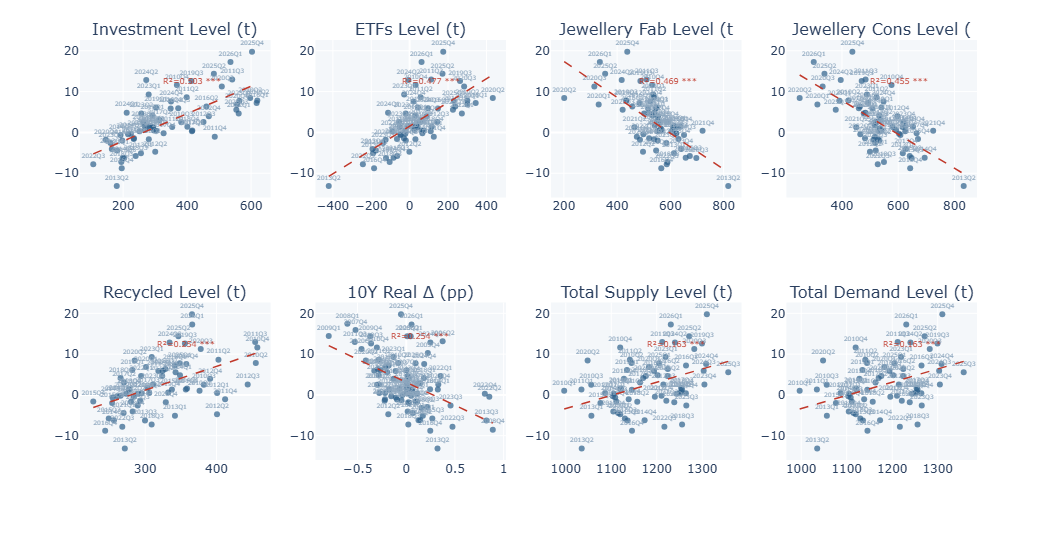
Demand for jewelry ranks third, whether measured in terms of production (R² = 0.47) or consumption (R² = 0.46), with a negative relationship in both cases. Unlike investment flows, demand for jewelry is therefore price-elastic. Consumers reduce their purchases when prices rise, reflecting classic price-elastic demand behavior.
Changes in U.S. 10-year real interest rates are the third factor after investment and jewelry (R² = 0.25), with a robust negative relationship. A one-percentage-point increase in real interest rates is associated, on average, with an approximately 11.3% decline in the quarterly price.
Recycled gold has an identical influence (0.25) but of the opposite sign: a higher supply of recycled gold is associated with higher prices, which again indicates price-adjusting behavior. Holders are more inclined to sell their gold when prices rise, making recycled gold a coincident indicator rather than a determinant of price.
The two major determinants identified at this stage are therefore investment demand and the level of real interest rates. Furthermore, it is worth noting the existence of cross-relationships between these variables. If the explanatory power of ETFs, investment demand, and real interest rates is high, it is partly because these variables are not independent.
Real interest rates directly influence the relative attractiveness of gold as a reserve asset, and thus flows into ETFs and investment demand; the two series show a correlation of -0.56 in this regard, confirming that rising real interest rates tend to discourage investment in gold.
Finally, it is important to distinguish the direction of causality. The relationship between ETF volumes, investment flows, and the price of gold is positive and likely bidirectional. Capital inflows into ETFs support the price, but a rising price itself attracts additional flows.
Furthermore, the short-term momentum effect is significant but modest (R² around 0.1 over a quarter), suggesting some persistence in returns.
Finally, mining costs constitute a long-term structural anchor for the price, the effect of which becomes apparent over longer time horizons. Other external factors also appear to be significant, such as the level of the dollar.
How significant is the impact of momentum?
Momentum refers to an asset’s tendency to extend its past movements, whether upward or downward. While this effect appears relatively weak for gold when measured over just a few months, it becomes much more pronounced and statistically highly significant over time horizons spanning several quarters.
An analysis of gold’s quarterly performance since 1990 thus highlights a strong persistence of returns. The results suggest that the precious metal’s current performance is influenced more by its average performance over the previous six to nine quarters than by its most recent fluctuations.
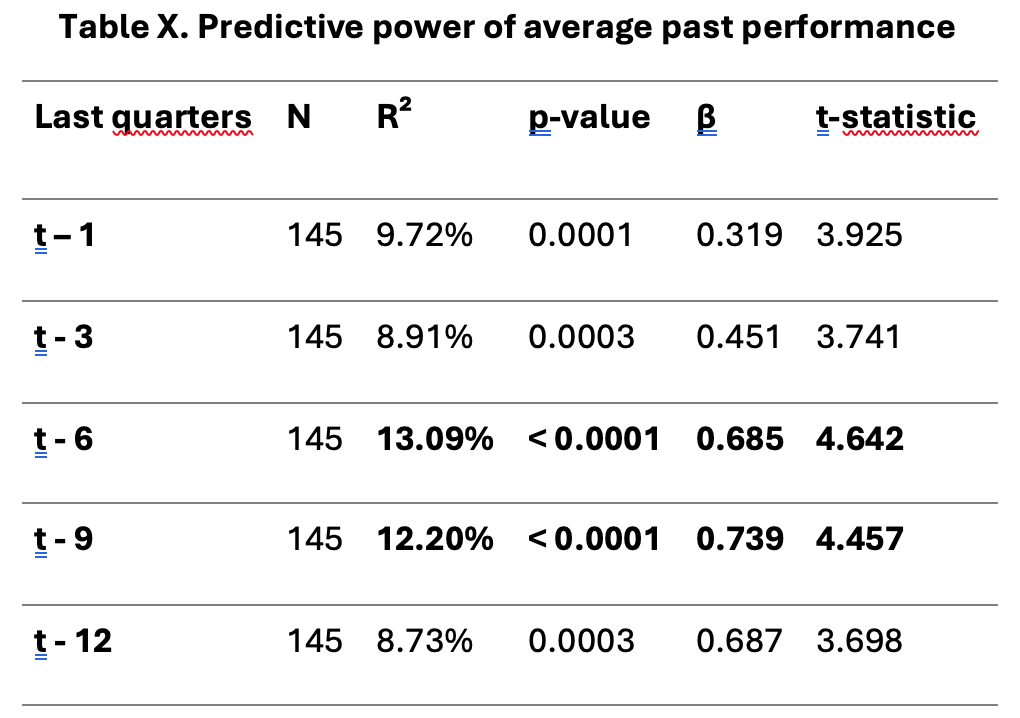
The estimated coefficients are positive and highly significant across all time horizons examined. The explanatory power peaks when past performance is measured over the last six quarters (R² = 13%), while the largest economic effect is observed over a nine-quarter horizon (β = 0.74).
The strength of momentum becomes even clearer when examining the ability of past returns to predict future performance over a long period. The results show that the signal is particularly effective at forecasting returns for the next three quarters based on performance recorded over the previous six quarters.
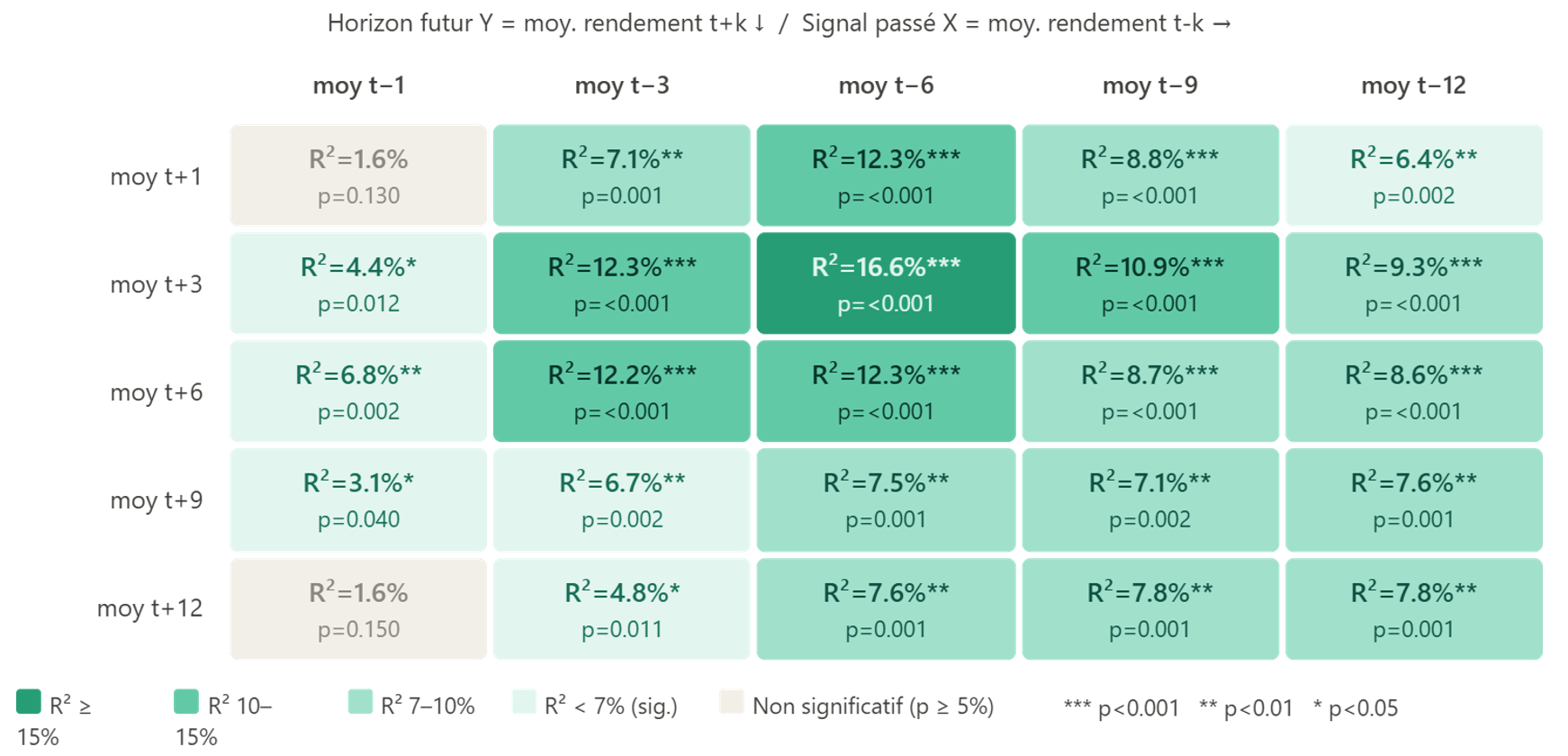
This pattern suggests the existence of a theoretical long-term cycle of approximately eight to nine years. In this context, the momentum signal appears to be most effective when calculated over about one-quarter of the cycle’s duration, which allows it to capture the dominant trend while limiting the impact of intermediate reversals.
The power of annual persistence
The momentum effect is clearly evident from one year to the next. On its own, it could account for a significant portion of the observed variations in gold’s annual returns.
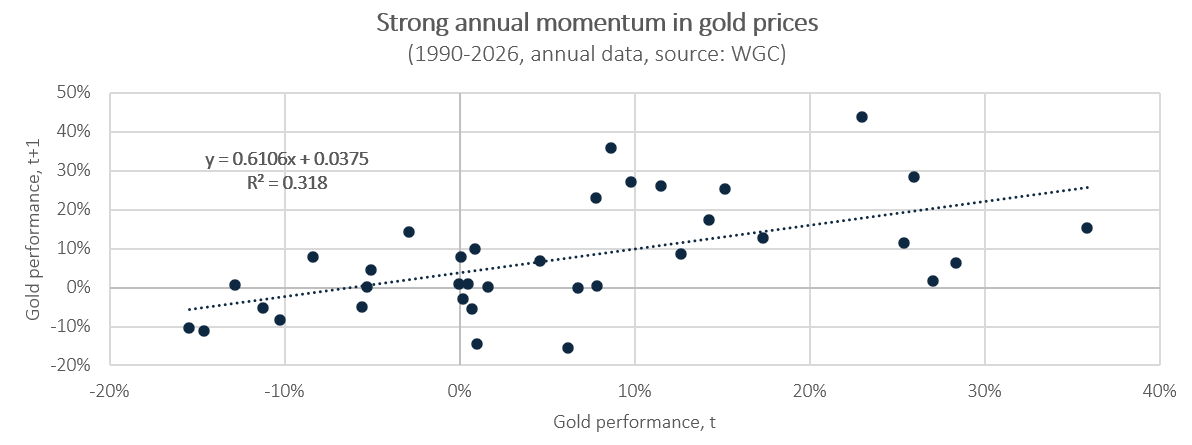
If this effect proves to be so pronounced, it is likely because it incorporates cyclical dynamics specific to the commodities market. In this sense, momentum also serves as a composite indicator of underlying trends.
Thus, the momentum measure actually reflects a composite phenomenon that aggregates multiple economic, financial, and behavioral influences. Its predictive power may therefore obscure the existence of other explanatory factors underlying the trend movements observed in the market.
Gold and its fractal nature
The factors that influence the price of gold in the short term are therefore not the same as those that determine its long-term trend.
In the short term, the price of gold is primarily influenced by intermarket relationships, particularly real interest rates, the U.S. dollar, and technical factors.
In the medium term, the price of gold depends more on fundamental variables, foremost among which is investment demand.
Finally, in the long term, mining production constitutes a structural constraint on the market, due to increasing extraction difficulties and a potential risk of supply drying up.
Psychological factors also play a role in determining the price of gold. For example, after the end of the gold standard in 1971, gold experienced one of the most significant bull markets in its history. Retail investors and other investors, now free to access gold without monetary constraints, fueled a wave of euphoria.
Conversely, the 1990s were a particularly unfavorable period for gold. Many central banks at the time viewed the metal as an outdated and largely useless asset, to the point of selling off a significant portion of their reserves. Market sentiment was therefore largely unfavorable toward gold, which reduced the magnitude of the bull market, rendering it nearly nonexistent.
Depending on market cycles, these psychological factors can amplify or, conversely, dampen the effects of fundamental drivers. This results in periods of relative overvaluation or undervaluation, linked to investors’ perceptions of gold’s economic and financial utility.
The interaction of all these factors thus gives gold a unique dynamic and a certain degree of decorrelation from other financial assets, even though it remains a constant focus of market concerns and expectations.
Does the existence of a derivatives market distort the fundamentals?
A major question arises in the commodities sector: Does the existence of a derivatives market alter price formation to the point of distorting market fundamentals?
While it is undeniable that derivatives improve the fluidity, liquidity, and efficiency of trading, they also pave the way for the increasing financialization of commodities.
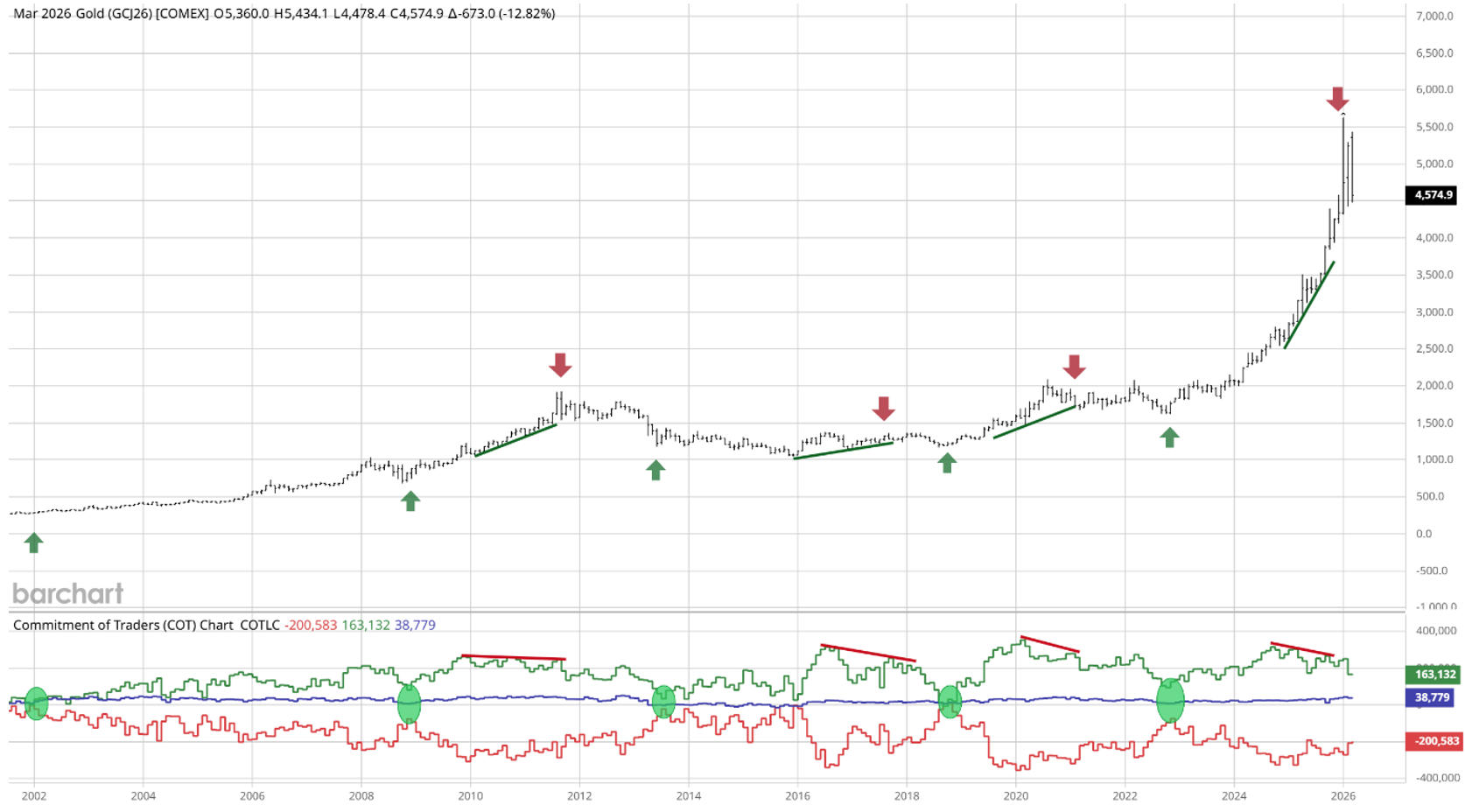
For example, lows in open interest on futures contracts have historically been an excellent indicator of a reversal in the price of gold. This phenomenon illustrates the importance of financial instruments in the price-formation process.
In the case of metals such as silver, several years may pass between the emergence of a structural supply deficit and its actual reflection in prices. When the adjustment finally occurs, it sometimes takes the form of a sharp upward move. Yet, in a perfectly efficient market, this rise should theoretically have been more gradual and better spread out over time.
The rise of ETFs further reinforces this dynamic. As the primary driver of investment demand, they are now among the most influential factors affecting the price of gold. Have ETFs gradually replaced physical holdings of bullion in price formation? Have commodities come to reflect financial valuations more than their physical reality?
It is worth noting, however, that commodities remain subject to the physical realities of their production. No matter how developed financial markets may be, they cannot permanently ignore the extraction conditions, production costs, and geological constraints that determine available supply.
Conclusion
The price of gold is influenced by a range of both external and internal factors. However, over the long term, its sensitivity to major financial indices remains relatively low.
More broadly, investment demand appears to be the most important determinant of the precious metal’s performance. This is followed by variables such as 10-year real interest rates, the dollar, and certain technical factors, notably momentum. Taken together, these factors account for a large portion of the fluctuations observed in the price of gold over the past two decades.
However, predicting future movements in the price of gold requires the ability to anticipate changes in these variables: What will future interest rates be? What trajectory will the dollar, inflation, and investment demand follow?
Finally, psychological factors also play a role in long-term dynamics. Investors’ optimism, skepticism, interest, or disinterest in the precious metal help amplify or dampen market movements. Thus, beyond economic and financial determinants, the collective perception of gold plays a key role in shaping its value.
Gold thus emerges as a unique asset, whose price results from the constant interplay between macroeconomic factors, financial dynamics, physical production constraints, and investor psychology.

Comments
Log in or sign up to join the conversation.