

DAX falls as US-Iran tensions rise and the Strait of Hormuz remains closed.
The DAX, together with its European peers, is falling sharply on Monday, amid renewed tensions between the US and Iran.
While stocks had risen firmly last week on optimism of a more lasting truce between the US and Iran, these hopes were dashed over the weekend after the US seized an Iranian vessel, and Iran said it would not send a negotiating team for peace talks this week.
The Strait of Hormuz, which was temporarily reopened on Friday, remains closed, reviving inflation worries and fears of interest rate hikes. Oil prices, which fell 13% last week, up 6% on Monday after a chaotic weekend. Bond yields are also heading higher after recent relief. German bund yields are rising 3.5 basis points.
Clarity remains in short supply ahead of the ceasefire deadline tomorrow, adding another layer of uncertainty.
Data today showed that German producer prices declined at the slowest pace in a year in March amid energy price fluctuations caused by the Middle East conflict. Producer prices fell 0.2% annually in March after a 3.3% decline in February. On a monthly basis, pretty surprised this show showed a 2.5% increase, versus a 0.5% decline in February.
The markets have added to rate hike expectations, pricing in almost two rate increases this year. These expectations are feeding into the weakest start in Europe.
The common pattern of rising oil prices is lifting energy stocks whilst airlines, travel, and tourism are under pressure.
However, the fact that stocks remain relatively close to Thursday's levels suggests there is still some sense that, whilst talks are rocky, the situation could move in the right direction and eventually find a way to end the conflict. The Middle East headline will remain key ahead of the Eurozone PMI data later in the week.
DAX forecast – technical analysis
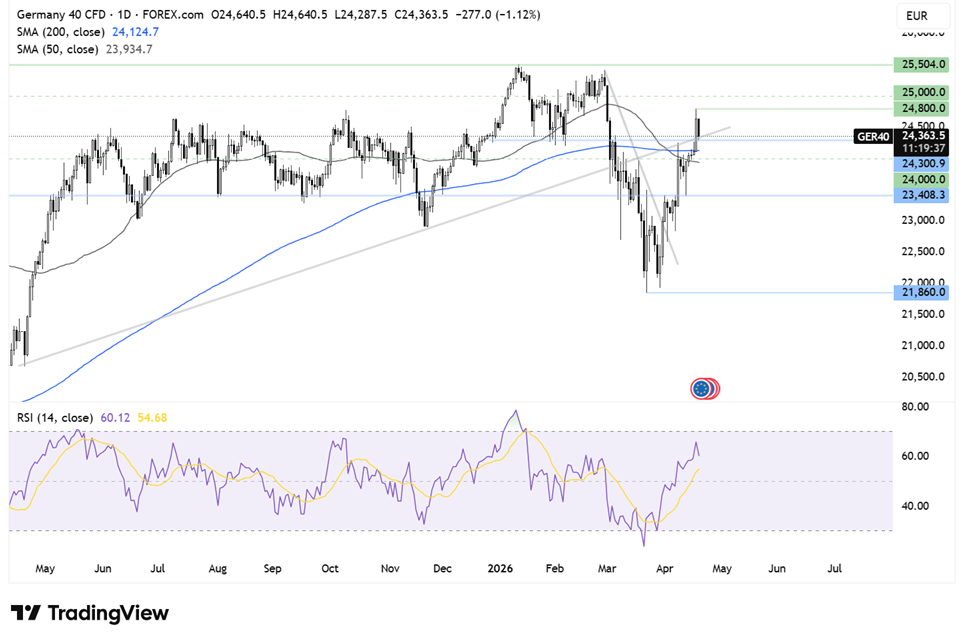
The DAX recovered from the 21860 low, rallying above the 200 SMA and the multi-month rising trendline to a high of 24,800. The price has eased back and today is retesting the rising trendline support and 24,300 a level, which offered support in February.
A break below 24,300 exposes the 200 SMA at 24,100 and also the 50 SMA at 24,000. Below here, attention will turn to 23,400, the April 13 swing low.
Should the support hold, buyers will still look to maintain gains supported by the RSI above 50, and head above 24800 towards 25,000, the round number. Above here, 25,500 comes into focus and fresh record highs.
Oil gaps higher on renewed tensions & ahead of the ceasefire deadline
Oil prices are rising by over 6% on Monday, recovering part of last week’s sharp 13% decline. The rebound comes as shipping through the Strait of Hormuz remains heavily restricted, and following the US seizure of an Iranian-flagged vessel, which has undermined confidence in the pace of diplomatic progress.
Iran has indicated that it will not attend upcoming peace talks, even as US negotiators are expected to arrive in Pakistan for a new round of discussions. This divergence highlights the fragility of current diplomatic efforts and raises the risk that tensions could persist or escalate.
Market attention is firmly focused on developments ahead of the expiration of the two-week ceasefire at midnight tonight. Conditions in the Strait remain highly constrained, with shipping activity reportedly close to a standstill. Data show that only three vessels have crossed in the past 12 hours, indicating ongoing disruption in a critical global energy corridor.
That said, there are signs of intermittent flow. Around 20 ships reportedly passed through the Strait on Saturday, carrying oil, metals, and fertilisers—marking the highest level of traffic since the conflict began. This suggests that while access is restricted, it is not entirely closed, contributing to heightened volatility and uncertainty in supply expectations.
Oil prices fell sharply last week amid optimism about progress toward a longer-term truce. However, the sharp move higher at the start of this week reinforces how sensitive the market remains to geopolitical developments, particularly those affecting the Strait of Hormuz. Until there is a clearer and more sustained resolution, price action is likely to remain reactive and headline-driven.
Oil forecast – technical analysis
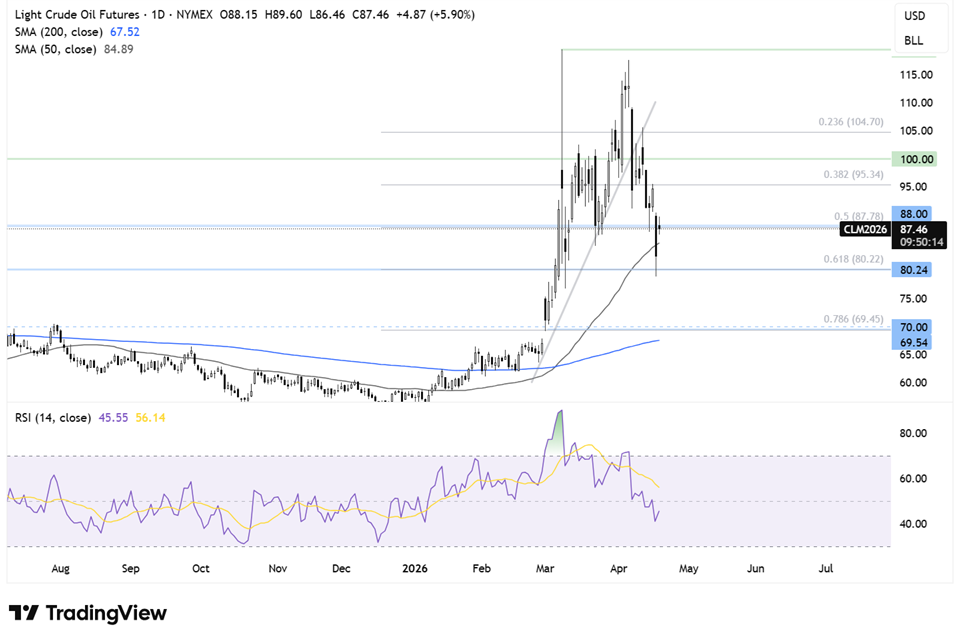
Oil prices rebounded lower from the 117.60 April high, breaking below the rising trendline and the 50 SMA before finding support at 79.00. From here, the price has recovered back above the 50 SMA, keeping the medium-term outlook bullish, to 88.00, the 50% Fib retracement of the 55.00 low and 120.00 high.
Buyers will look to rise above the 88.00 level and head towards 95.00, the 38.2% Fib level, ahead of 100.00, the psychological level.
Failure to retake 88.00 could see the price fall back to retest the 50 SMA at 85.00. A break below here could see sellers gain traction towards 80.00, the 61.8% Fib level, and last week’s low. A break below here creates a lower low.



Comments
Log in or sign up to join the conversation.