

FTSE 100 Rises for a Third Straight Day As Gilt Yields Ease
The FTSE 100 opened higher, rising for a third straight day as gilt yields eased, helped by falling oil prices and upbeat sentiment after the Nasdaq reached a record high overnight.
Oil prices are falling for a fourth consecutive session, down around 2.5% since Friday and putting crude on track for a fourth straight weekly decline. As a result, global bond yields are easing, although they remain near multi-decade highs.
The 10-year gilt yield has fallen to 5.36%, from 5.5% at the start of October, a level last seen in 1998. Elevated gilt yields and persistent inflation concerns have pushed swap rates higher, increasing borrowing costs across the mortgage market.
The five-year fixed mortgage rate is now around 6%, its highest level in three years and up from 4.94% in February. Meanwhile, the two-year fixed rate has risen to 5.98%.
Higher mortgage rates can weigh on housing demand and affordability, encouraging potential buyers to delay purchases and slowing house-price growth. Nationwide data showed annual house-price growth halved to 0.8% in September from 1.6% in August.
Higher mortgage repayments, both for new buyers and households refinancing existing loans, also put further pressure on disposable income and consumer confidence. If the squeeze intensifies, the impact could extend beyond the housing market to the broader economy.
UK construction PMI for September is the main data release today and is expected to show that construction activity remained in contraction, at 45.4, up slightly from 44.3 in August but still well below the 50 level separating expansion from contraction.
FTSE 100 Forecast – Technical Analysis
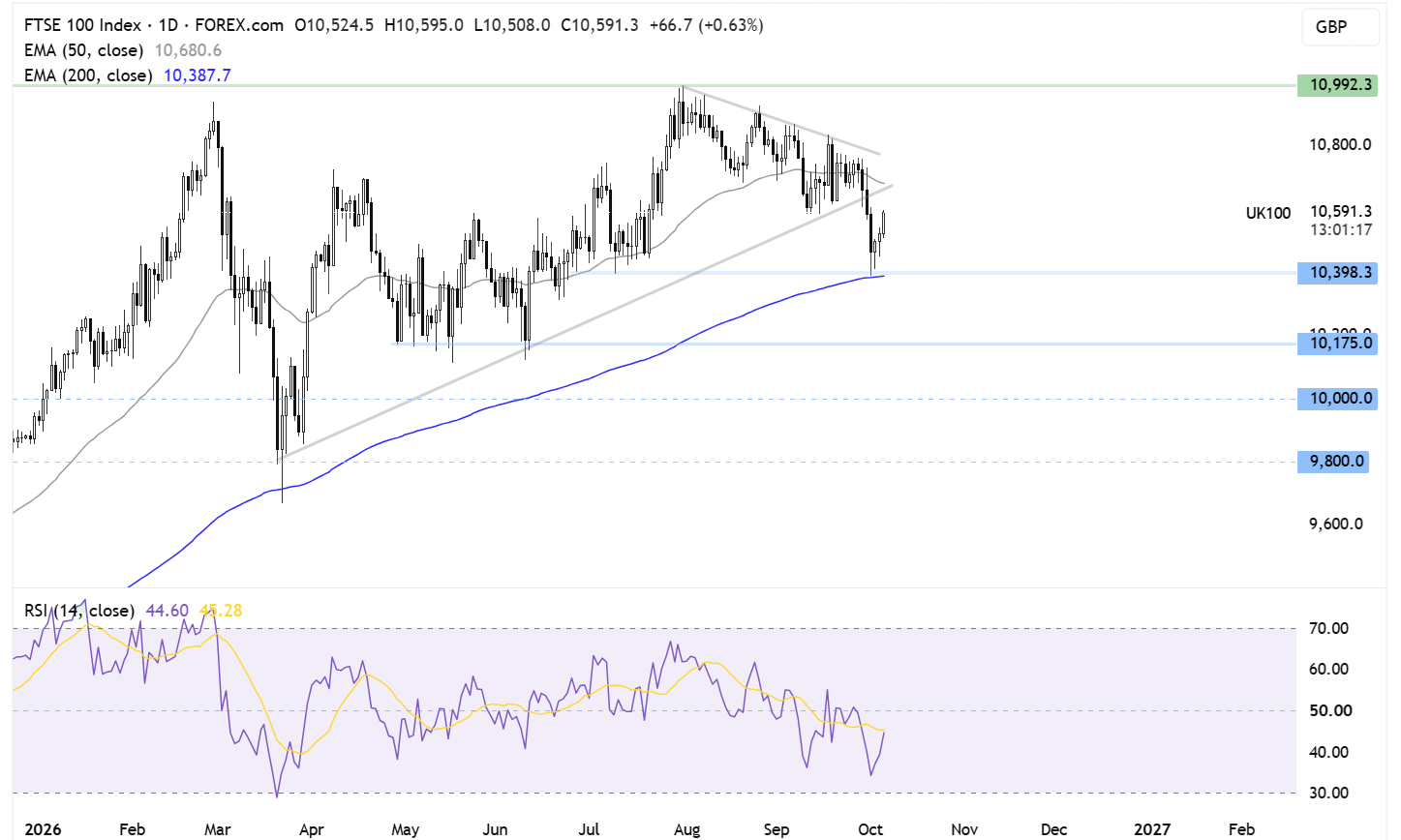
The FTSE 100 broke out of its symmetrical triangle pattern, falling to a low of 10,390, around the 200 EMA, before recovering to current levels near 10,580.
Should momentum continue to improve, buyers will look towards 10,700, where the 50 EMA and rising trend-line resistance converge.
Sellers would need to break below the 200 EMA at 10,400 for bearish momentum to strengthen, opening the door towards 10,175, a support level that was in play in April.
EUR/USD Struggles Around 1.12 amid Political Uncertainty and Weak German Data
EUR/USD is struggling around the 1.12 area against a stronger U.S. dollar, as growing political uncertainty and a deteriorating fiscal outlook in the eurozone renew fears of debt contagion.
Economic data has also weakened, with German factory orders plunging 10.6% month on month in August after rising 3.2% in July. This was the largest decline since January and highlights the challenges facing Germany's manufacturing sector.
The decline was mainly driven by a fall in major orders, casting a shadow over recent data that had pointed to some resilience in the eurozone's largest economy amid the inflation shock triggered by the conflict in the Middle East.
Germany remains particularly vulnerable to higher energy costs if the conflict intensifies. At the same time, competition with China remains fierce, while higher interest rates could further weigh on business investment.
Separately, French industrial production also unexpectedly fell in August.
The euro remains under pressure from concerns over high debt levels and political gridlock in France, while an upcoming snap election in Spain is adding to the headwinds.
For the euro to recover sustainably, markets would likely need to see a significant decline in oil prices, renewed expectations of ECB monetary tightening and greater confidence that eurozone governments can address their budget deficits. None of these catalysts appears imminent.
Meanwhile, the U.S. dollar remains supported by elevated Treasury yields, which have risen to multi-decade highs.
Dollar gains have continued despite reduced expectations for a Federal Reserve rate hike this month following weaker-than-expected U.S. jobs data and cooler-than-expected core PCE inflation. However, markets still expect the Fed to hike rates before the end of the year.
U.S. services PMI slowed slightly in September, while ADP payrolls and a speech from New York Fed President John Williams will be in focus for further clues about the outlook for interest rates.
EUR/USD Forecast – Technical Analysis
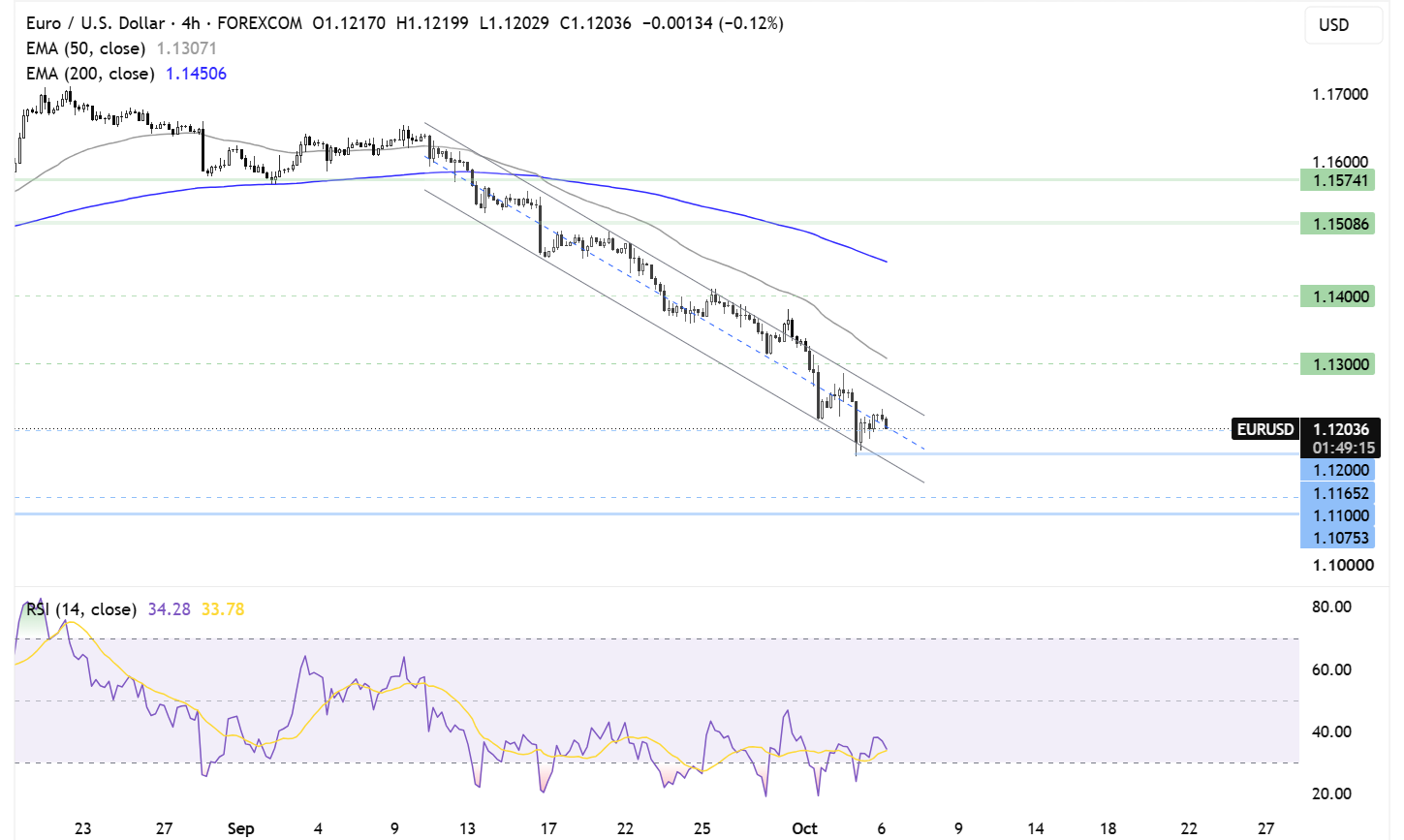
On the four-hour chart, EUR/USD trades within a descending channel dating back to mid-September. Sellers are testing support around 1.1200. A break below here would open the door towards 1.1160, the October low and the lower band of the falling channel.
A break below 1.1160 would turn attention towards 1.1075, the May 2025 low.
Any recovery would need to rise above 1.1250, the upper band of the falling channel. A break above here would bring 1.1300, the round-number level, into focus, followed by the 50 EMA and then 1.1400.



Comments
Log in or sign up to join the conversation.