

Despite fierce claw-back activity at the end of yesterday's session which caused the market to close higher, tensions over the Ukraine and anxiety about the Fed signal red.

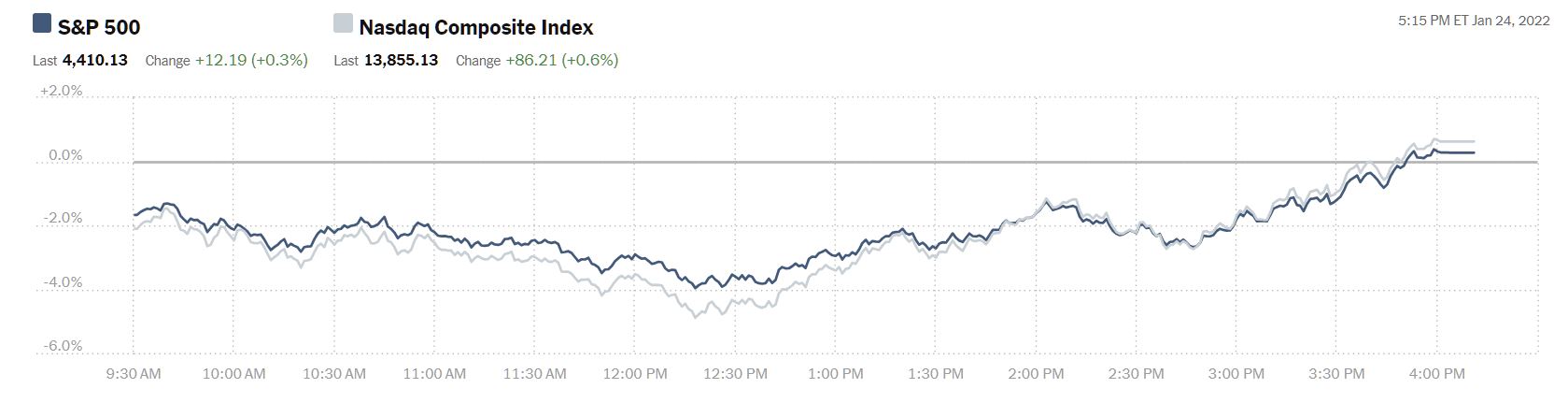
At the close of trading on Monday, the S&P was up 12 points, to close at 4,410, the Dow was up 99 points, to close at 34,365 and the Nasdaq Composite was up 86 points, closing at 13,855. And while the daily chart below may show a bullish tail, the yearly chart clearly illustrates how long a fall the market has taken so far, this year.
Daily
Yearly
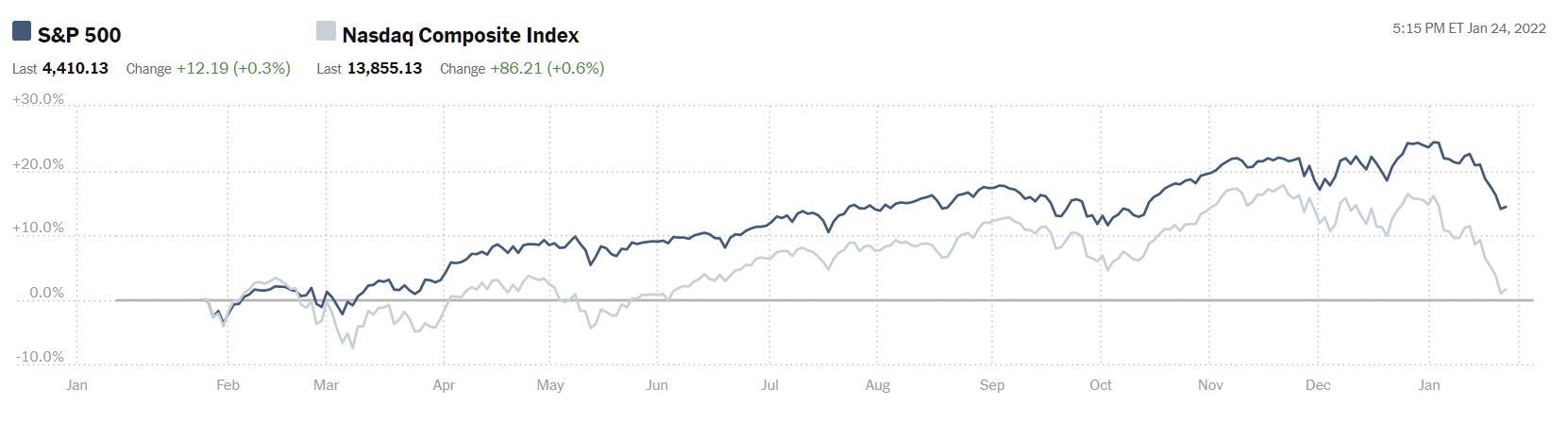
Charts: The New York Times
Currently market futures are wary of any bullish sentiment, S&P futures are trading down 60 points, Dow futures are trading down 267 points and Nasdaq 100 futures are trading down 284 points.
TalkMarkets contributor Paul Eitelman tries to make sense of What’s Behind January’s Market Swoon?
"The combination of higher interest rates, lackluster fourth-quarter earnings and geopolitical risks have taken a toll on the global equity market, with the selloff most pronounced in the United States...First, corrections—such as what the S&P 500 fell into during intraday trading today before mounting a stunning rally—are totally normal. Market corrections tend to occur once every two years. And it is precisely because of this volatility and risk that equities—as an asset class—are expected to return more than bonds over the long term. Second, equity market corrections have historically been short-lived, with the S&P 500 Index recapturing its previous highs in just four months, on average...higher discount rates catalyzed a repricing of unprofitable growth stocks whose valuations hinge heavily on earnings that are expected far off in the future...investor sentiment has pivoted hard through the current selloff and is approaching panicked levels. We view that as a positive indication, tactically, for the performance of risky assets."

Contributor Diego Colman notes that the S&P 500 Erases Losses And Stages Miraculous Rebound, FOMC & Geopolitical Tensions Eyed and seems to remain cautiously bearish.
"Before the late-afternoon rebound, concerns about the path of monetary policy were the main negative catalyst for equities, especially those in the tech and growth universe. Investors appear increasingly worried that the Fed's tightening cycle aimed at curbing inflation may be too aggressive and ultimately trigger a hard landing at a difficult time when the U.S. economy is rapidly losing steam...While the slowdown can be blamed in part on the omicron surge, the recovery is still weakening and bodes ill for corporate earnings."
"During most of the session, risk aversion was compounded by rising geopolitical tensions in Eastern Europe, specifically the latent threat of Russia invading Ukraine in the coming days or weeks...At its worst point of the day, the S&P 500 plunged roughly 4%, but selling pressure abated as the hours went by as dip buyers stepped in to blunt the sell off...Having said that, the near-term bias remains bearish after the extensive technical damage caused by the recent pullback...If bears manage to push the index below this floor, the corrective phase could accelerate and trigger a move towards the June 2021 low at 4,165."
While the market is waiting with bated breath ahead of any announcements from tomorrow's FOMC meeting, contributor Brian Romanchuk says the Fed Has Plenty Of Time To Decide.
"The risk asset sell-off has triggered a fair mount of “what does this mean for the Fed?” takes... One thing that I would like to emphasize: the Fed has a lot of time before the March meeting, which is the most plausible date for a first hike...If equities kept plunging for the next six weeks, that would imply a very severe bear market — which probably signals that something else is wrong in the financial system and/or economy...A rout in energy prices will knock a big hole in headline inflation, which will feed into “inflation expectations” for many individuals. That reduces the urgency to hike."
Wouldn't bet on that one, given the Russia-Ukraine situation.
"Crypto blowing up is not only hilarious, it might reduce the demand for high end chips. This in turn could reduce some of the knock-on supply chain problems. Otherwise, the collapse of crypto and tech darlings is a non-issue for central bankers. Although I respect the idea that some levered players are being liquidated in the “tech” area, expecting another six weeks of weak equities is quite a hurdle to jump."

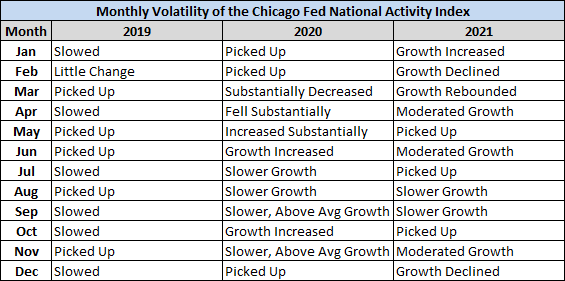
Looking for signs that the economy may be slowing Jill Mislinski turns to the Chicago Fed: "Index Suggests Economic Growth Declined In December".
"The Chicago Fed's National Activity Index (CFNAI) is a monthly indicator designed to gauge overall economic activity and related inflationary pressure...Negative values indicate below-average growth, and positive values indicate above-average growth."
"...here is the opening paragraph from the report (released 1/24):
Led by declines in production-related indicators, the Chicago Fed National Activity Index (CFNAI) fell to –0.15 in December from +0.44 in November. Two of the four broad categories of indicators used to construct the index made negative contributions in December, and all four categories deteriorated from November. The index’s three-month moving average, CFNAI-MA3, moved down to +0.33 in December from +0.40 in November.
In her article Mislinski provides several graphs to illustrate the November to December decline. Below I have included one of those graphs, plus an activity chart.
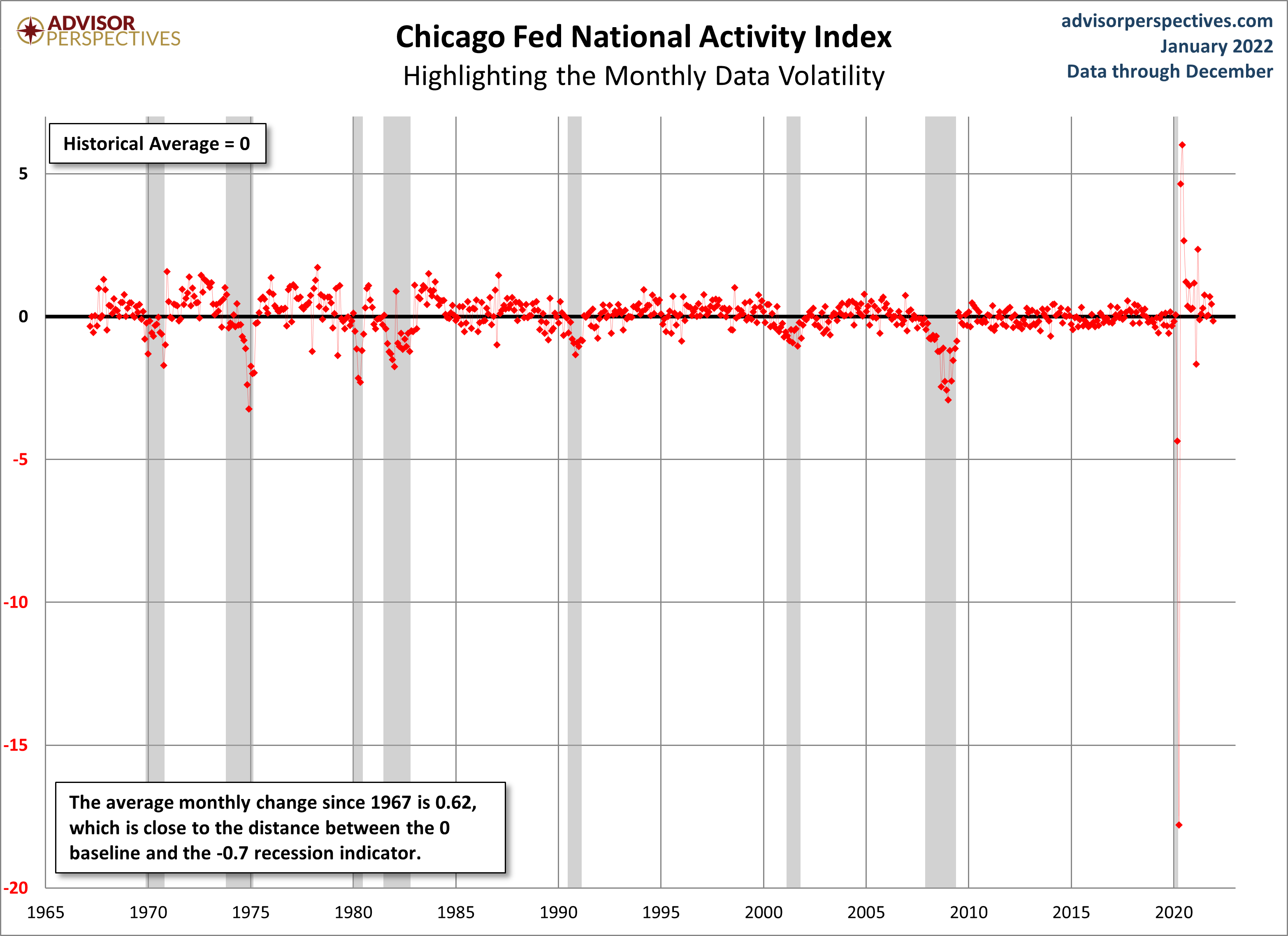
The last two red dots on the right are for November and December 2021, respectively.
Treading very lightly in the "Where To Invest" Department today, TM contributor Benjamin Rains suggests 3 Stocks To Buy On The Dip Amid The Market Selloff in the current episode of his podcast "Full Court Finance".
"Rapid selling can be scary and it can really hurt. Thankfully, buyers start to step in eventually and pick up strong stocks at discounts when things appear to be overdone. In fact, the market experienced some of that Monday, as all three major indexes recovered their earlier losses...Taking everything into account, the market appears to be on relativity solid footing. That is hard to swallow sometimes when stocks are being crushed."
Caveat Emptor

Image: Target
"The first stock up today is Target (TGT). The company thrived during the pandemic and Target’s e-commerce efforts set it up for success long after people return to their normal lives. Target is projected to post another year of huge top and bottom-line growth. The retailer’s recent fall and strong outlook has it trading at a discount to where it was prior to COVID in terms of forward 12-month earnings."

"The episode then takes a look at Apple (AAPL) ahead of its first quarter fiscal 2022 financial release on Thursday, January 27. The iPhone maker is down around 13% from its early January peaks and Apple is nearing some oversold technical levels. All in all, investors with longer-term horizons might want to consider adding Apple as it expands its services unit and explores new futuristic growth areas with its mountains of cash."

"Netflix (NFLX) plummeted from over $500 a share to its current $385 range following its Q4 earnings release last Thursday. Netflix fell for a variety of reasons, including streaming competition and slowing user expansion. Despite the valid worries, Netflix is still the largest streaming TV player and prepared to grow at a solid clip for years to come. And the massive selloff has NFLX trading at rather enticing levels."
Caveat Emptor Redux
That's a wrap for today. Take care, it's slippery out there.
I'll be back on Thursday.


Comments
Log in or sign up to join the conversation.