

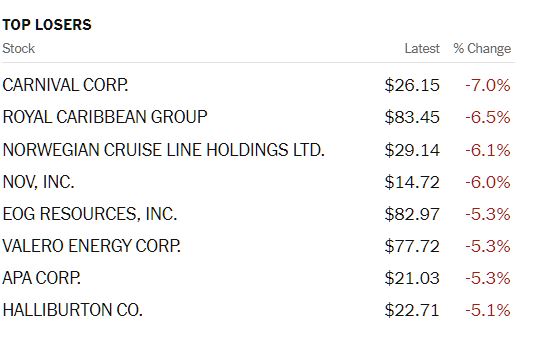
Stocks closed mixed on Monday with the Dow down nearly 151 points and the Nasdaq up 140 points, and the S&P 500 up a modest 10 points. Tech stocks rallied while Cruise Lines and Oil related issues were yesterday's biggest losers as can be seen in the chart below:
Source: The New York Times
Currently market futures are nearly flat with S&P futures trading down 1 point, Dow futures up 80 points and Nasdaq futures down 31 points. With bipartisan agreement on infrastructure seemingly in the bag market focus should shift to the upcoming Q2 earnings season, though lingering COVID-19 concerns are still hampering the resumption of economic activity in Europe and Asia.
TalkMarkets contributor Christopher Lewis is bullish about tech stocks in his article Nasdaq 100 Forecast: Index Captures 14,500. Lewis who had been forecasting the Nasdaq to hit the 14,500 is now looking toward 15,000.
Here is a bit of what he has to say:
"The Nasdaq 100 (NDX) rallied rather significantly during the trading session on Monday to make fresh new highs yet again. In fact, we ended up conquering the 14,500 level, opening up the possibility of a move towards the 15,000 level. A pullback at this point should be thought of as a potential buying opportunity, and as a result, I think that this market continues to be more or less a “buy on the dips” situation.
The 14,000 level underneath should continue to be a bit of a “floor in the market”, due to the fact that it was previously the resistance barrier and all-time high that had been so difficult to overcome...This is a market that I think is much more likely to go higher than lower, and if it did break down, it would more than likely have something to do with some type of overall “risk-off move”...I think that the handful of technology stocks that have the most influence on this market will continue to be major drivers of the market to the upside."
Contributor Lance Roberts continues to remain concerned about overvalued equities in the market and lays out quite a list of cautionary data in his article Technically Speaking: Warnings From Behind The Curtain. In his well documented style, Roberts details what he finds disconcerting.
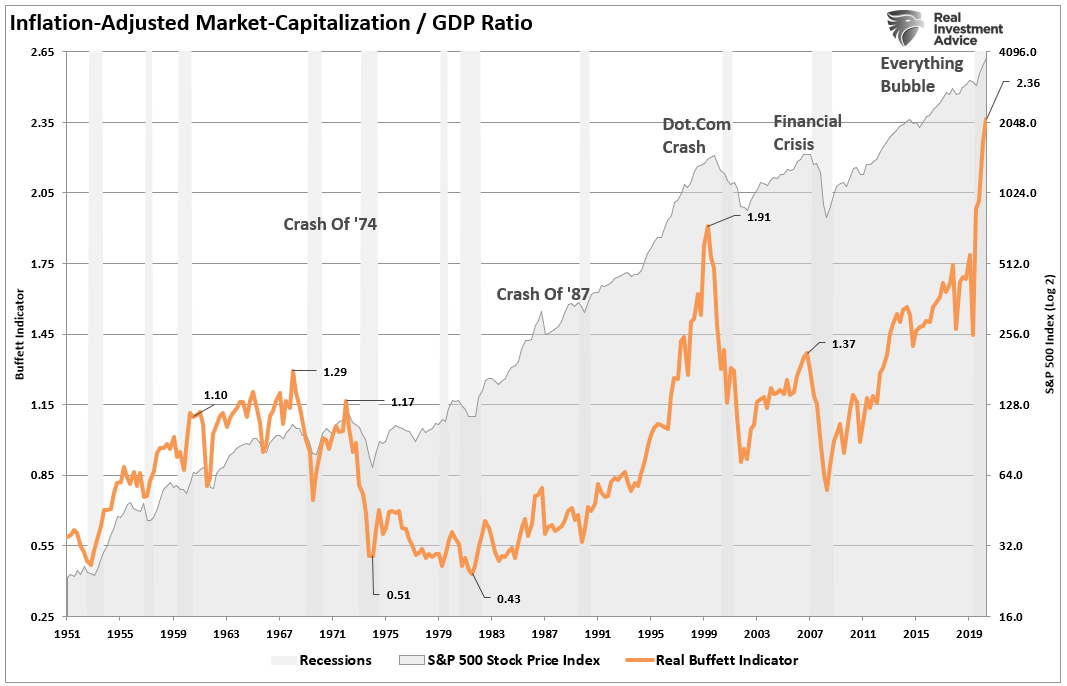
"Besides getting extremely extended, the market is also excessively overvalued. There are two critical takeaways from the chart below.
- The market is currently trading more than twice what the economy can generate in revenue growth for companies. (There is a long-term correlation between the rate of economic growth and earnings.)
- Valuations are terrible “market timing” indicators but are vastly crucial concerning future returns.
Lastly, investors are convinced there is “no risk” in the market because the Fed provided an “insurance policy” against loss.
Such is the very definition of “moral hazard.”
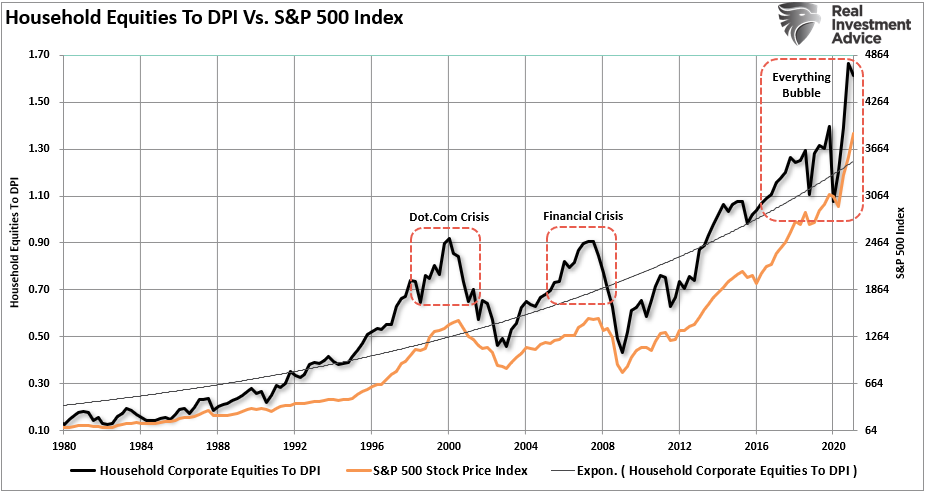
Investor exuberance is evident from the massive increase of household equity ownership as a percentage of their disposable personal income. The current deviation from the long-term exponential growth trend rivals every previous bubble in history.
Yes, this time could be different. But, unfortunately, it just usually isn’t."
Roberts continues with additional charts and historical comparisons and while I doubt he begrudges anyone who is making hay while the sun shines, he certainly wants investors to be aware of what he sees as today's environment. Commenting on a familiar graphic (see below, as rendered by Sentiment Trader), he has this to say:
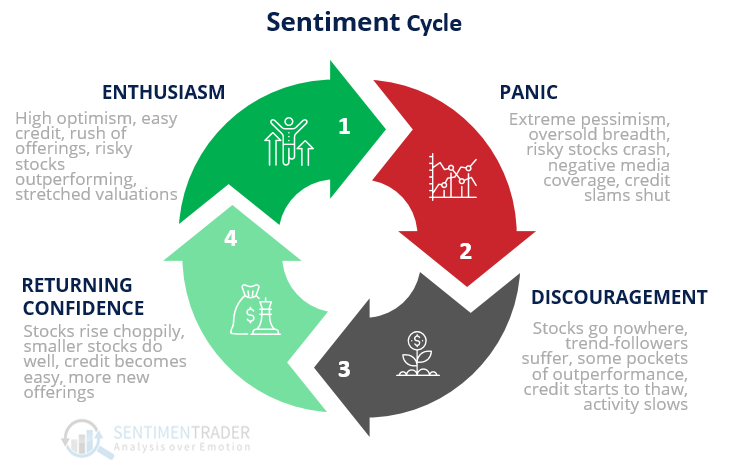
"Currently, we are seeing every box checked. Irrational exuberance from investors, easy credit with investors taking out personal loans to buy stocks, and risky stocks outperforming. The level of exuberance currently matches previous major market peaks, the only missing ingredient is a catalyst to start the reversal.
The biggest problem is that investors are crowded into a theatre with a single exit. When the selling starts, the exit will become very narrow, very fast."
In a TalkMarkets Editor's Choice piece, contributor Dr. Dan Steinbock looks at the impact of US-China relations on tech giant Apple (AAPL). Writing in Apple Amidst US-China Wars, Steinbock starts out by noting that:
That can't be good, and it isn't.
In the article Steinbock illustrates how Apple's success continues to be at odds with US interests. The full gist can be summed up as follows:
"Over time, Apple’s revenues from China have potential to increase significantly, thanks to its innovative ecosystem which is hard to replicate by the competitors. Yet, the White House could derail Apple’s plans, which rely on economics, not on geopolitics.
Who’s undermining US competitiveness
To sustain its global position, Apple is trying to navigate amid the US Cold War against China. If it ignores US views, it will face pressures in the US; its largest current market. If it neglects Chinese views, it risks failure in China; its pivotal future market. What is certain is that
- Apple cannot ignore local responsiveness in any global market.
- Americans did not lose their jobs to the Chinese. Rather, income polarization in America is driven by misguided domestic policies that derail consumer welfare.
- Nor is offshoring the cause of U.S. malaise. Apple’s success has benefited especially Taiwan. Chinese workers have salaries Americans won’t accept.
- If Apple is forced out from China, it stands to lose far more in smartphones, development, wearables, electric cars and new future segments.
Apple’s greatest challenge is not China, but the underlying conflict between its ecosystem and Trump-Biden protectionism."

Contributor Timothy Taylor in another TM Editor's Choice feature takes a look a the U.S.'s declining role in the world automotive market. In his article The Shrinking US Role In World Car Markets, Taylor writes that this has much to do with the growing demand for cars and trucks in developing economies versus the United States.
"The US accounted for 62% of all global car registrations in 1960... But by 2018, the US share of global car registrations was 11% and still falling. The US and European car markets are essentially stagnant in terms of the total quantity of cars, but rapid growth in cars is happening in the rest of the world, including in China."
The reason for this is that developing countries continue to have astonishingly lower levels of car ownership relative to the United States. The data is revealing, for instance in 2018 car ownership per 1,000 residents in India was similar to U.S. vehicle ownership in 1917. In 2018, even in Brazil (a relatively highly developed country) car ownership per 1,000 residents equaled that of the U.S. in 1928.
Taylor concludes thusly:
"In short, the future of the global car industry in terms of sales and technology and how automotive technology affects the world’s environment is going to be written largely outside US borders. A just-released study of demand for cars in China found an income elasticity of demand for cars in China of 2.5: that is, every 10% rise in incomes in China (roughly what has been happening every year or so) has been leading to a 25% rise in the quantity of cars demanded."
What would Henry Ford (F) and Alfred Sloan (GM) have to say about that?
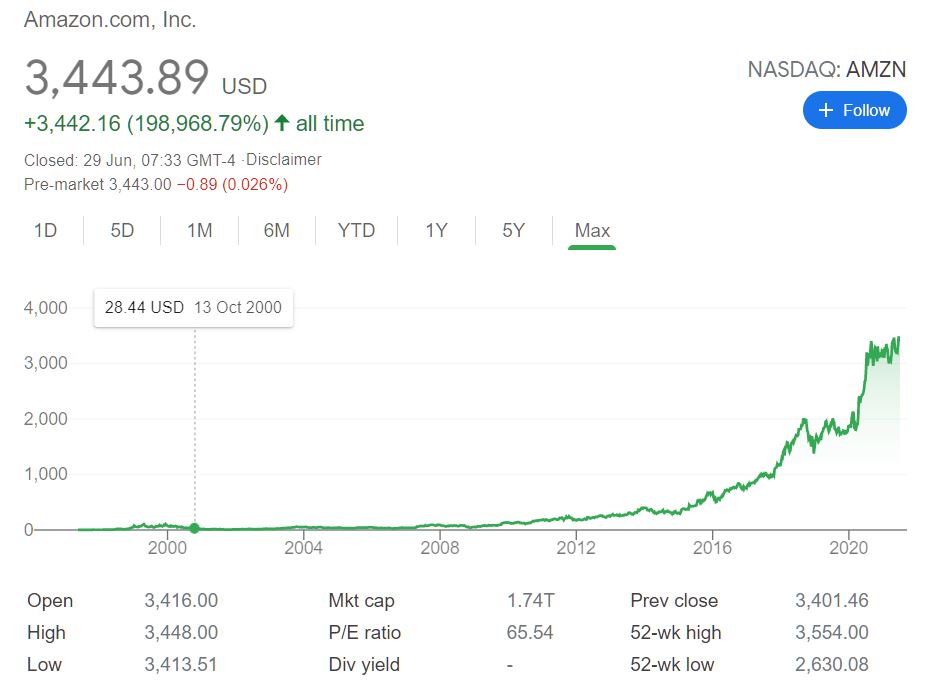
Still kicking yourself for not buying Amazon (AMZN) stock when it was in the low $30's? TalkMarkets contributor Mike Stenger writing in Amazon Stock Forecast Shows $5,500 A Share By 2022 looks at why now, might still be a good time to buy. Stenger provides a detailed (and bullish) look at what's ahead for the company as it approaches the start of its' post Bezos era.
"Though it’s highly priced after some insane growth over the last 10 years, it still has much further to go...Jeffries analyst Brent Thill gives Amazon a $4,000 price target over the next two or three years...One analyst (Susquehanna Financial Group ) gives Amazon stock a price target of $5,500 per share as soon as 2022. But even that is conservative for what lies ahead...Long-term, however, Amazon will keep innovating and expanding its key segments, which may quickly double those gains between now and 2030."
Read the full article to understand how the anaconda of internet commerce is planning to make it happen and as always, Caveat Emptor.
The Fourth of July holiday awaits us. Make it joyous and keep it safe.

Have a good week.

Comments
Log in or sign up to join the conversation.