

On Thursday, news broke that the US will likely start levying a 100% tariff on branded pharmaceutical imports. The specifics remain unclear, but the levy is expected to be relatively narrow in scope, since many exemptions have already been negotiated. The step appears driven primarily by geopolitics, limiting the economic impact.
Which exemptions have already been negotiated?
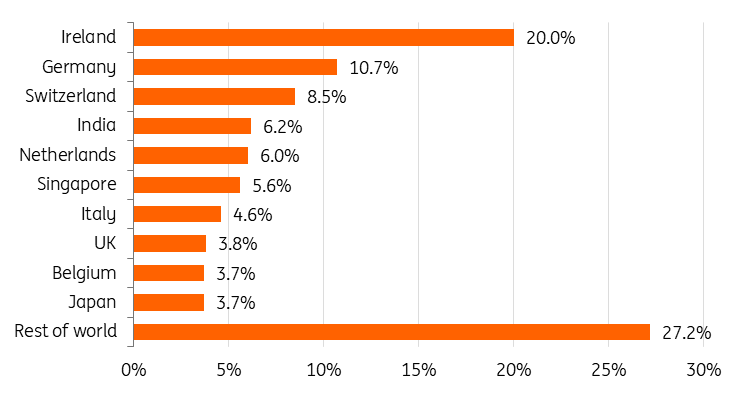
We expect the 100% tariff to apply to branded pharmaceuticals for which no exemptions have been negotiated. This means tariffs on branded pharma goods imported into the US from the EU, Japan, South Korea, Switzerland, and the UK would be capped at the rates negotiated in bilateral deals. Also, 16 big pharma companies are exempt for three years after concluding deals with Trump to lower the prices of new and existing medicines under most-favoured-nation (MFN) principles. And it’s likely that drugmakers now negotiating with the Department of Health and Human Services would be exempt. As such, the scope of this 100% tariff is rather limited, as evidenced by the US import figures below.
Most top exporters to the US are covered under trade deals
US imports of pharmaceutical products by country share, 2023
Source: Global Trade Tracker, LSEG Datastream; WITS; UN Comtrade; ING calculations
Why is this tariff mostly geopolitical
This leaves only companies without an MFN deal or a country-level bilateral agreement exposed to a possible 100% levy. The key countries involved include Singapore, India, and China –none of which currently export a substantial volume of branded pharmaceuticals to the US. The economic impact will therefore be negligible. Rather, the tariff is geopolitical in nature and should be seen as a shot across the bow for more intense competition between the US and China in biotech and pharma.
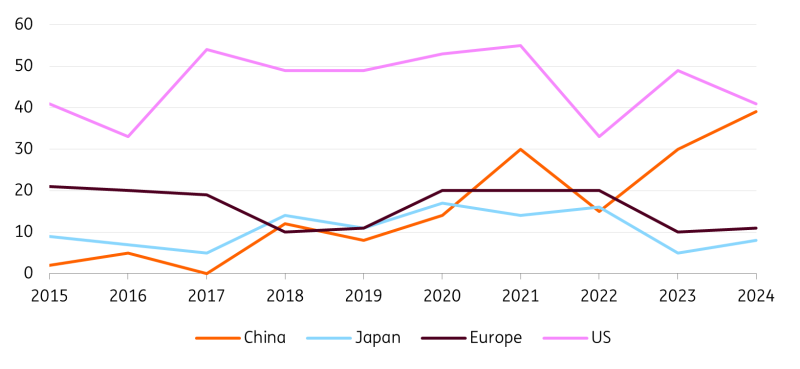
China has developed into a biopharmaceutical innovation hub. We estimate that roughly one‑third of all new molecules in global pipelines now originate in China – up from just 4% 12 years ago. The country has surpassed Europe and is nearing the US in the number of global drug approvals. This is why we believe that the next Pfizer will be Chinese rather than American or European.
US policymakers on both sides of the aisle have realised that China is a real threat to US dominance in biopharmaceutical innovation. This is why the new tariff follows an investigation by the Commerce Department that determined certain pharmaceutical imports pose a national security risk to the US, as well as deliberations in the House Select Committee on the CCP on the threat China poses to American biopharmaceutical innovation capacity.
In short, this is a geopolitical tariff with negligible short-term economic effects. We’re likely to see many more such policies in pharma, as the sector is now formally considered important to national security by US policymakers.
China is nearing the US in global drug approvals
Distribution of first global approvals of innovative drugs, 2015-24
Source: Nature publication; BMI; ING

Comments
Log in or sign up to join the conversation.