

“If you look at the actual composition of the U.S.-Canada trade, it suggests, if anything, that Canada is in a stronger position if a trade war breaks out”… Paul Krugman, Nobel Prize Winner in Economics, January 2025
It is often said that no one wins a trade war, but someone can definitely lose one. If President Trump is seeking to bring Canada into submission with tariffs, his efforts have failed to date, and doubling down will not likely produce any further results in his favour.
Trade Imbalances Still in Canada’s Favour
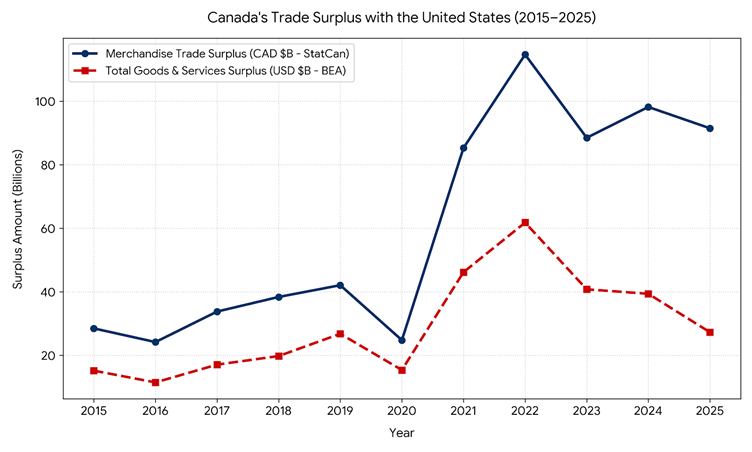
While China continues to be the largest source of US imports, Canada remains the US's largest overall trading partner. Canada relies on the US to take 75% of all Canadian worldwide exports. Meanwhile, Canada is the number one destination for US exports. Currently, Canada has a trade surplus of approximately $100 billion with the US. US tariff policy has failed to reduce its trade imbalance.
US Needs Canada
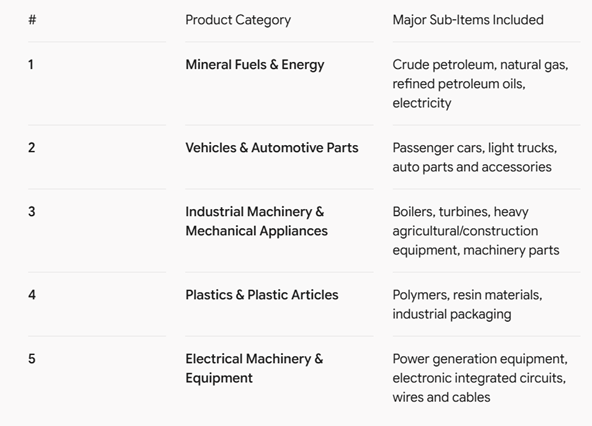
President Trump has notoriously said that the US does not need what Canada has to offer. Yet, the top 5 Canadian exports to the US include products essential to the US economy, including oil and gas and motor vehicles and parts, lumber, machinery and equipment. Canada is the single largest US oil supplier, providing approximately 4 million barrels a day, or 60% of US oil imports. The cross-border auto trade has developed into a very complex integration of parts crossing the border multiple times on the way to final assembly. There is no such thing as an “American-made car” that does not include parts made in Canada.
Top 5 US imports from Canada
Canada and US Operate in a Free Trade Zone
Ironically, in the first Trump term, he renewed the North American free trade agreement, referred to as the Canada-US-Mexico Agreement (CUSMA), which he now claims is the “worst trade agreement ever”. That agreement provides for 80-85% of cross-border sales to be exempt from tariffs, as long as those products comply with CUSMA origin rules. With CUSMA in place and even with this most recent flurry of tariffs on autos, steel, and aluminum, the US effective tariffs on all Canadian exports are less than 3%. Canada faces the lowest average tariff regime of any US trading partner. Maybe this is why Trump is so frustrated in trying to bring Canada to its knees.
Impact of Tariffs on Key Canadian Industries
It is hard to understand exactly what Trump’s tariffs are designed to do in bilateral trade, given their rather scattered approach and confusing aims and goals. Nonetheless, the impact on Canada has not been anywhere near what his administration expected:
US carved a 10% tariff on Canadian oil and natural gas; Canadian energy exports to the US have reached a record high, averaging 4 million barrels a day; with oil prices at $100, Canadian producers are reaping large profits, and the 10% tariff has had no impact on US volume imports from Canada; Albertan heavy oils cannot be replaced readily by alternative suppliers (e.g. Venezuela); as the war with Iran continues to push up the price of oil, the US will continue to pay more for Canadian oil;
The US applied a 25% tariff on cars, light trucks, and assembly parts; Canadian sales have dropped moderately, 5-7% annually, but the Canadian industry has managed the adjustment to lower volumes; Trump cannot go too far with tariffing auto parts made in Canada before the US auto industry begins to suffer higher costs and ultimately lower sales; the big three automakers are none too happy with these auto-related tariffs, including those on steel and aluminum;
Trump started his trade war with Canada in his first term and continues to double down in his second term. This is a clear indication that the strategy is not working, best measured by Canada’s trade surpluses. He is running out of products to tariff, especially since so much of the bilateral trade is centred in important US states in the upcoming mid-term elections. The vast majority of trade is still covered by CUSMA. So far, 2026 trade flows suggest that the tariffs are not leading to any collapse in bilateral trade. Trump continues to threaten Canada, but Canadians are unmoved.
No better indication that Trump has lost the trade than the most recent polling results that found 80% of Canadians now support an export tax on oil. Surprisingly, that support level is also reflected among Albertans. This looks as if Trump is on the losing side of this trade war.


Comments
Log in or sign up to join the conversation.