

| Ticker: TSCO |
When John Denver’s “Take Me Home, Country Roads” plays on the radio, I am instantly reminded of long, winding roads, the fresh air of the countryside, and the peace and tranquility. The song captures a longing for home in West Virginia, but that feeling connects with anyone who grew up in a small town or rural area, myself included. Be it open land, small towns, livestock or pickup trucks, it reminds me of life away from the hustle and bustle of the city. Not many companies support the rural way of living, but one of them has been through thick and thin – the Tractor Supply Company or TSCO.
This American company has quietly built one of retail’s most durable business models, with a remarkably loyal customer base and an approach to promoting the rural lifestyle that it calls “Life Out Here”. The company not only offers tractors (compact and utility kind) for farming but also sells livestock feed, pet products, fencing, lawn equipment, tools, clothing and property maintenance supplies. Its loyal base includes hobby farmers, ranchers, pet owners, tradespeople and rural homeowners.
Like the winding roads of West Virginia, the company’s journey has had its twists and turns. Its stock has travelled a difficult road over the past year due to a multitude of issues—some within its control and others beyond it—but all hope is not lost. In this article, I will provide an overview of the company, cover its recent earnings, valuation, growth opportunities, risks and technical setup, and consider whether these country roads can still take us home.
Overview
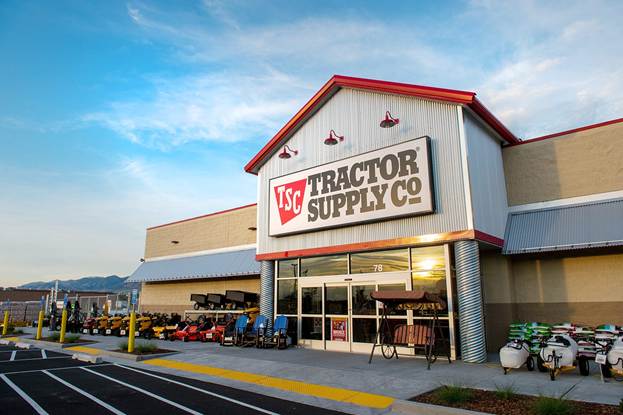
Tractor Supply Company traces its roots back to 1938, when founder Charles E. Schmidt Sr. started a mail-order tractor-parts business from his kitchen table in Chicago. By 1940, the business had grown into its first retail store in Minot, North Dakota. Today, Tractor Supply is the largest rural lifestyle retailer in the United States, with 2,463 stores across 49 states as of June 27, 2026.
(Source)
The company has also made a number of moves in the pet care market, acquiring Petsense, Allivet and, more recently, VIP Petcare. Still, what I find most interesting about Tractor Supply is the niche it has carved out for itself in the retail industry. Three things help separate it from larger retailers: its rural-first footprint, its recurring needs-based demand and its specialized ecosystem. I will return to each of these in greater detail later in the article.
At the time of writing, TSCO is trading at approximately $33.50 per share, giving it a market capitalization of roughly $17.5 billion. The stock is valued at around 16.75 times forward earnings, well below its historical average of approximately 23.5 times. So, why is the market offering investors such a large discount on a company with a strong retail niche? The answer lies in its recent earnings and the challenges facing its customers.
Q2 Earnings
TSCO reported second-quarter results in late July, and the numbers confirmed what much of the Street was expecting: a negative quarter. Revenue came in at $4.54 billion, about $100 million short of estimates, and the company missed on both adjusted and GAAP EPS. Comparable store sales and revenue growth both trended lower. To my surprise, the stock actually rose about 3.3% on the news, which tells me most of the bad news was already priced in.
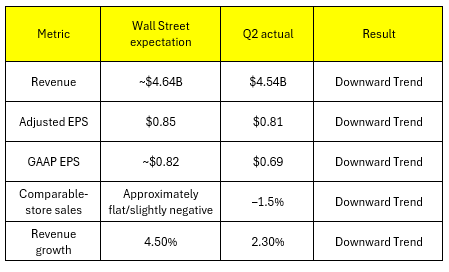
Management didn't give investors much to feel good about when it came to guidance for the rest of the year, cutting every key metric. Net sales growth, previously projected at 4-6%, was cut materially to 2.5-3.5%, and comparable store sales now look likely to finish the year somewhere between flat and down 1%.
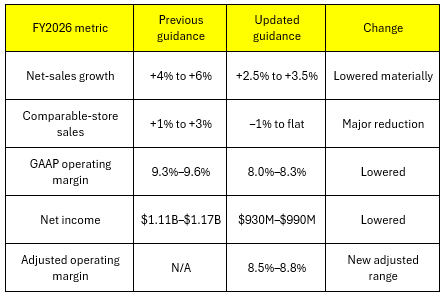
Net income was also lowered, with both adjusted and GAAP margins being significantly lower than previous estimates. Management defended the quarter by highlighting that the lack of growth and the downward revisions across all categories were attributable to fuel price hikes during the critical spring season, along with the effects of drought in southeastern U.S. markets. As the geopolitical arena remains hot, management provided anecdotal evidence that many customers were forgoing big-ticket purchases, causing same-store comparable sales to come in significantly below earlier guidance.
Business Valuation - Growth
The company is currently trading at 16.75 times forward P/E, which is approximately 7 % lower than the peer median (includes Home Depot (HD), Costco (COST), Lowe’s (LOW) and Ollie’s (OLLI)) and around 22% below the specialty retail benchmark. TSCO has historically traded at 23.5x, meaning the company is trading at almost a 30% discount to its historical average. On the EV/EBITDA side as well, the company is trading at 12.2x versus 14.1x for the peer median. Lowe’s is one of the large retailers trading at a lower multiple than TSCO, but that is due to its inherent exposure to the housing and renovation cycle, which has taken a beating in the current high-interest-rate environment.
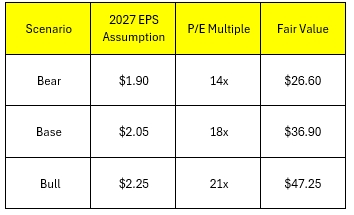
As per my fair value estimates, applying the median sector multiple and guidance estimates, the stock offers a 10%+ upside compared to its current value, with a projected base price of $36.90. In the most optimistic projection, my calculations put the bull price estimate in the $47.25 range. However, if Q3 sales come in below guidance, the stock could break its YTD lows and trade in the $26–$27 region, as per my estimates.
However, I am more optimistic about the company than regular investors for a couple of reasons — one of which is its unique connection with its customers. The company has been an integral part of rural life, and most of its stores are located in areas that have traditionally been underserved by big retailers. The product mix carried by TSCO, with its primary focus on serving the rural lifestyle, significantly separates it from larger retailers like Walmart (WMT) or Costco, which are built around everyday consumer demand.
The company has also made significant capital allocations in recent years by acquiring pet-related companies to further vertically integrate the business, alongside management’s target of opening 100 new TSCO stores in 2026. The company also started Project Fusion — a multi-year effort to modernize existing stores and make them more productive through improved store layouts, expansion of key categories such as pet food and workwear, and the incorporation of garden centers and veterinary services. So far, management has already rolled out Project Fusion across more than half of its stores, with more than 550 garden centers completed. This strategic growth initiative should provide meaningful results in the years to come.
The other reason for my bullishness on the company is its recurring demand and specialized ecosystem. The company offers a large variety of necessities rather than discretionary purchases — livestock feed, animal health products, fencing and maintenance products. These are items that will always have recurring demand, irrespective of the economic realities.
As of May 2026, the company also made a strategic investment by acquiring VIP Petcare for approximately $130 million. VIP Petcare already operates clinics in roughly 1,700 Tractor Supply locations, or nearly 70% of TSCO’s store base, while its broader network reaches approximately 2,700 retail locations across 39 states. This gives Tractor Supply an established veterinary-services platform with room to expand further across its own rural footprint.
This strategic approach should help differentiate it from other retailers such as Walmart, Costco or Chewy (CHWY), which are increasingly competing with TSCO in the animal and pet food industry.
Also, the company has been prudent in repurchasing shares and creating long-term value for shareholders. The company has approximately $232 million in cash and equivalents, with first-half cash flow of around $217 million. It has also grown its dividend consistently for the past 17 years, along with having no major debt maturity until 2029.
Although the company increased its capital expenditures by 29% YoY, most of the spending has gone towards store modernization and expansion of its future footprint. Management has also reaffirmed the notion that the stock is undervalued, with CEO Hal Lawton purchasing approximately $500K worth of stock on the open market at an average price of around $32.15.
Risks
No matter how big or unique the moat is, there are always inherent risks involved with any business. With TSCO, there are multiple challenges coming from all directions, which have overwhelmed the company and affected its stock price.
The primary risk to my bullishness is the negative impact of current fuel prices and the broader geopolitical quagmire. With the U.S.-Iran war showing no end in sight, fuel prices have been on a roller coaster, while headline inflation and Treasury yields have increased substantially over the course of the year.
Rural consumers and farmers, especially, have had to bear the brunt of these pressures, and it has shown up in spending, with same-store sales essentially flat or negative. Any further negative developments in the broader economic or geopolitical environment could further reduce foot traffic to stores and create additional pressure on revenue.
Another risk is management’s prudence around financial management and capital allocation during these uncertain times. The company acquired Petsense in 2016 for approximately $145 million in cash, and at the time, Petsense was operating 136 small-format pet stores. Management’s initial plan was to grow the store count annually by 15–20%, but that thesis never materialized.
The acquisition has since become a drag on the overall economics of the business and has remained structurally unprofitable, with management deciding in the most recent quarter to close approximately 36% of its current stores. One of the main reasons for its underperformance was that Petsense never meaningfully differentiated itself from competitors such as Chewy, Walmart or Amazon (AMZN), especially with pet food remaining one of its primary revenue drivers.
The restructuring is costly for TSCO as well, with management recording approximately $71.7 million in impairment and other related charges. With management making another move in the pet category through the acquisition of VIP Petcare, the jury is still out on whether this investment will be accretive to the top and bottom line.
Any further mishaps or prolonged unprofitability in this segment could work significantly against the company and weigh on future shareholder returns.
Lastly, margins are coming under pressure, especially in the pet care segment, from competitors such as Walmart, Chewy and Amazon. With these retailers offering frequent discounts, TSCO has to compete more aggressively on pricing and provide better value for money.
Online and big-box retailers also have significant advantages in pricing and delivery, meaning TSCO must work harder to retain regular consumers who are increasingly focused on value. Management itself mentioned that price competitiveness remains a priority in the pet care segment, which clearly suggests that it is seeing pressure build on margins.
Any further deterioration in the animal care segment could put additional pressure on both the company’s profitability and management’s ability to execute.
Technical Set-up
As with any stock, the technical chart pattern often dictates stock movement over the short- to long-term outlook. Currently, the TSCO daily chart shows support being tested in the $32.50–$33.00 range, close to its 50-day moving average. Any break below this range would bring $32 into play, with a more significant support base established in the $29–$30 range between May and July.
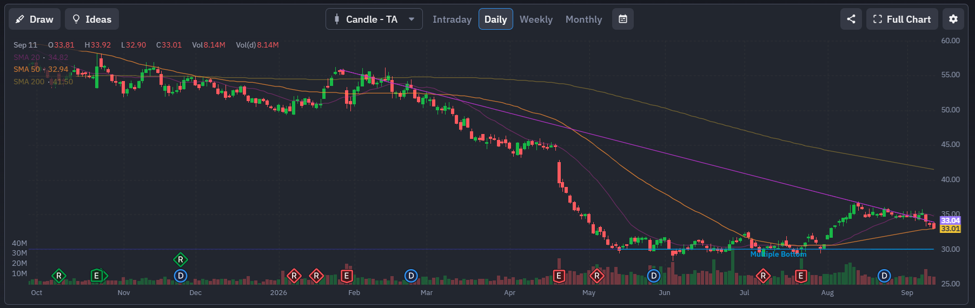
On the flip side, if the stock reclaims momentum and breaks above its 20-day moving average at $34.82, followed by resistance around $35.50–$36.50, a recovery is possible over the medium term. However, the longer-term trend remains bearish, with the stock trading below its 200-day moving average near $41.50, which represents a major hurdle.
My preferred entry, based purely on the technical set-up, would be around $29.50 near the base support zone. However, a break below this level on strong volume could significantly weaken the technical case.
Takeaway
Tractor Supply Company has built a unique identity and consumer base due to the variety of its offerings. The company operates most of its stores in rural areas of the country, serving a consumer base that has remained loyal for decades.
The company is facing significant external challenges in the near term due to oil price volatility, weather-related droughts and economic uncertainty. However, some of its self-created problems, including poor acquisitions and eroding margins, have compounded the downward spiral.
Still, most of these problems seem solvable, with the company having enough in the tank to reverse its downward trend. As a result, I would consider the stock a contrarian buy around $28.50-29.50 range. My target entry price is lower than the current value because the geopolitical environment still remains hot, and with the 10-year Treasury yield approaching the 5% level, consumer spending and inflation could have a significant impact on the broader stock market. As a result, I am giving myself a margin of safety in the event that the general market goes through a significant correction.
For myself, I believe the uniqueness of this company, coupled with improving economic conditions over the medium term, will create significant value for its shareholders. The company and its stock price may still face some bumpy roads ahead, but I believe Tractor Supply Company will eventually steer through them and return to a clearer path of long-term growth.



Comments
Log in or sign up to join the conversation.