

In real life, as accurately depicted in the movie Apollo 13, the mission began with one goal—land on the Moon. Following two successful lunar landings, public interest in the Apollo program had started to fade. However, when an oxygen tank exploded and threatened the spacecraft’s life-support systems, the focus at Mission Control in Houston quickly changed from landing on the Moon to bringing the astronauts home safely. A lot of troubleshooting, improvisation and pioneering work was required to save the crew, creating a lasting impression on the public.
The pioneering ability to collect telemetry from a spacecraft and transmit it back to Earth—even under abnormal conditions—showed the true might of American ingenuity. One of the companies whose technology contributed to the Apollo missions was Radiation Inc., whose legacy lives on today inside a company called L3Harris Technologies (LHX), or LHX.

The roots of L3Harris go back well before the Apollo missions. Following multiple mergers and acquisitions—including the purchase of Aerojet Rocketdyne in 2023—the combined company was supposed to become one of America’s strongest aerospace and defense businesses. However, as Murphy’s law tells us, anything that can go wrong will go wrong. L3Harris has faced integration issues, weaker margins, higher debt and inconsistent cash flow, all of which have prevented the company from reaching its full potential.
So, is the current weakness simply a temporary detour in the company’s growth trajectory, or has the mission permanently changed course? In this article, I will cover the history of L3Harris, its latest earnings, growth opportunities and associated risks, valuation, technical breakdown—and ultimately determine whether the company can successfully accelerate out of its current downtrend.
Business Overview
L3 Communications and Harris Corporation merged in 2019 and created L3Harris, which started trading under the ticker LHX. Since then, the company has been gradually compounding and, with its addition of Aerojet Rocketdyne in 2023, is increasingly viewing itself as a prime defense contractor. As of the time of writing, the company trades at $239, giving it a market capitalization of $44.7 billion, with a trailing P/E of 20x and a forward 2027 P/E of 18x consensus earnings. The company reports its financial metrics in three segments - Space & Mission Systems, Communication & Spectrum Dominance and Missile Solutions. To briefly summarize the segments,
Space & Mission systems - This segment provides satellites, missile-warning systems, including avionics, maritime systems and intelligence platforms
Communications & Spectrum Dominance - This unit is bread and butter for LHX with the segment providing secure tactical radios, resilient communications, electronic-warfare systems and night vision.
Missile Solutions - This is the main growth driver and develops rocket propulsion, solid-rocket motors, hypersonic technologies and other advanced missile and munitions components
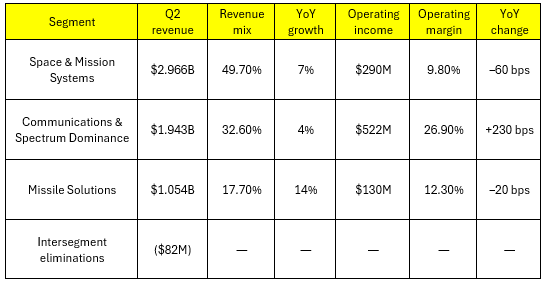
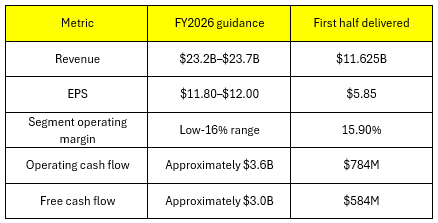
For the segment-wise breakup, the majority of revenue came from Space and Mission Systems, contributing approximately 50% of the total revenue, but the operating margin was in the high single digits, with much of the load carried by Communications & Spectrum Dominance (CSD). The Missile Solutions segment, which is its growth driver (after the acquisition of Rocketdyne), posted $1.05 billion in revenue with a 12.3% operating margin. On the last quarterly call, management did raise guidance for the remainder of the year, indicating that growth should accelerate compared to the first half of the year. Also, important to note that I added intersegment revenue eliminations to ensure the revenue was not double counted in overall metrics. However, the main metric in my eyes is free cash flow, with the company expecting to achieve $3 billion for the year, whereas only $584 million has been achieved so far in the first six months.
The book-to-bill ratio came in strong at 1.2x, meaning more orders are coming in than the company is recognizing as revenue. The backlog was also impressive at $42 billion in revenue opportunity, with Q2 alone bringing in $7.3 billion of demand. So, why is the stock in a downtrend if all the baseline metrics are looking healthy? The answer lies in management's execution on several fronts.
Go for Launch – Growth
At present, the market is whiplashing the majority of defense stocks. Whether this is due to confusion over the ongoing war or US Treasury yields inching higher, the conventional wisdom of defense stocks doing better in a war has not come to fruition. However, a company like LHX has much going for it, even though the market doesn’t recognize this or give it appropriate credit. The main growth driver for the company is the Missile Solutions segment, which, as seen from the quarterly results, is growing at double digits (14%) YoY, with approximately $10 billion in backlog out of the $42 billion for the whole company. Also, the US government invested $1 billion in the company to potentially unlock value and ramp up propulsion and technology solutions for products such as PAC-3, THAAD and Tomahawk. In the past few weeks, the company also received a $4.7 billion award for PAC-3 MSE propulsion, which entails making propulsion and related components for the missile segment enhancement interceptor.
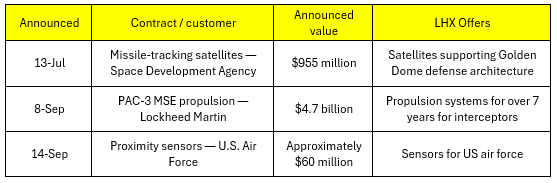
The other two segments, Space & Mission Systems and CSD, have also shown consistent revenue while providing missile tracking satellites, surveillance technologies and electronic warfare capabilities that are critical to the defense and security. The company announced multiple critical contract wins (earlier in the year), including an airborne warning contract with the South Korean military. The deal is valued at $2.26 billion, and management expects this opportunity to open further revenue streams in the Middle East as well as Asia Pacific.
Also, with its legacy knowledge of electronic and tactical warfare, the company secured additional business and is ramping up its VAMPIRE counter-drone systems for the government and its allies. Earlier in the year, the Army placed an order worth up to $106 million, with the Navy now also joining and placing an additional order for an undisclosed amount.
Heading for Turbulence - Risks
As with any business, there are also inherent risks that are dragging the stock downwards and mainly have to do with management’s execution.
When the company acquired Aerojet Rocketdyne, it had a clear goal in mind: to become a prime rocket-propulsion contractor for the U.S. government. By combining L3Harris’s legacy assets with Aerojet’s capabilities, the company gained a new growth lever that could create significant value for shareholders.
Based on the latest quarterly results, Missile Solutions recorded the highest year-over-year growth among the three segments. However, its operating margin was 20 basis points lower than in the comparable quarter last year. A similar situation was seen in Space & Mission Systems, where the margin declined by 60 basis points. CSD was the only segment that delivered meaningful margin expansion during the quarter.
In defending the performance, management pointed out that the company-wide segment operating margin still increased by 10 basis points. Management also explained that the year-over-year comparisons were distorted by one-time items. The prior-year Space & Mission Systems margin included a gain from an asset sale, while Missile Solutions benefited from a favourable contract resolution. These items muddied the underlying comparison.
Even with that explanation, investors should still ask whether L3Harris can meaningfully expand margins within Missile Solutions, especially while demand remains strong.
The other execution challenge faced by management is the free cash flow for the year has been inconsistent at best for the company. For the first half of the year, the company only managed to achieve 19% of its original FCF target, with the remaining 81% needed in the latter half of the year. Although this is possible, it does put management in a tight bind if it ends up lower than expected or management revises the target in upcoming earnings. The main reason given by management for the lower FCF in the first half was related to accounts payable and receivable, citing the timing of billings and collections as the main factor.
In terms of debt, L3Harris has approximately $11 billion in gross debt compared with $1.52 billion of cash on hand. Although the debt balance is trending downward—declining approximately 3% quarter over quarter and 9% over the past year—the company still carries a significant amount of leverage.
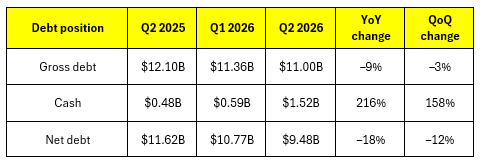
This could limit its financial flexibility, particularly because approximately $1.82 billion of debt is due between December 2026 and January 2027. Any partial or full refinancing in today’s higher-rate environment could increase the company’s interest expense and put further pressure on its bottom line.
Finally, one of the important reasons why I feel that Wall Street has soured on the stock is the potential delay of the planned IPO of Missile Solutions. The company originally targeted the potential spin-off, trading under the name AXYV, to take place in 2026, but in the recent earnings call, management mentioned that, due to less-than-desirable market conditions, the IPO is postponed until mid-2027. L3Harris disclosed that it will still have a controlling stake and more than 80% ownership in the newly traded company, with the government also having an undisclosed stake in the new entity. LHX will still report the financial results on a consolidated basis in its earnings, and thus the market wants the company to unlock value in the missile segment and further increase shareholder value for the parent company.
Note: I am not assigning significant risk to the recent CEO change. Although the sudden departure gave investors some jitters, management clearly communicated that the decision to part ways was not related to any financial wrongdoing or mismanagement of funds. The company also reiterated its financial guidance. Therefore, I do not currently view the leadership change as a major risk to the investment thesis.
Valuation
At the time of writing, L3Harris is trading at approximately $239 per share, giving it a forward P/E of roughly 18x based on 2027 consensus earnings. This is somewhat higher than the peer median; however, the company appears undervalued across the other key metrics in my comparison.
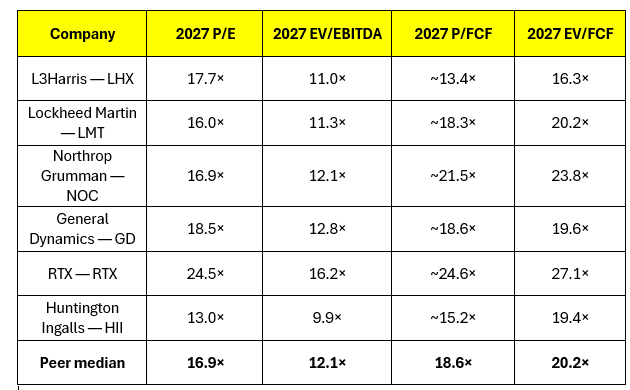
Based on 2027 estimates, L3Harris trades at approximately a 9% discount to the peer median on EV/EBITDA and a 19% discount on EV/FCF. Some peers, particularly HII and Lockheed Martin (LMT), also trade below the peer median, but both face company-specific issues. HII has been dealing with weaker margins in the highly concentrated shipbuilding industry, where projects are complex and cash conversion takes longer to materialize. Lockheed Martin, despite having a significant F-35 backlog, is experiencing lower-than-expected growth and continues to face risks from fixed-price contracts across some of its other programs.
Based on my valuation model, L3Harris is currently trading at approximately a 9% discount to my base-case value. The key assumption behind this valuation is that the company achieves its consensus EBITDA and delivers the expected margin improvement.
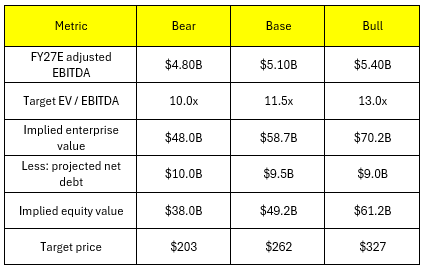
In my bear-case scenario, the stock could fall to approximately $203, representing about 16% downside from its current price. This could happen if L3Harris misses its cash-flow target or if margins remain weak in Space & Mission Systems or Missile Solutions.
On the other hand, if the company delivers strong cash conversion and raises its revenue estimates, the stock could command a multiple of approximately 13x EV/EBITDA. That would support a bull-case target of $327, representing roughly 36% upside from the current price.
The main caveat is that these projections will need to be recalibrated once the separation of AXYV, currently the Missile Solutions business, is finalized. My current valuation model is based on the financial profile of the combined company.
Technical Breakdown
As with any investment, often the chart tells a simple story that any average investor can interpret easily and decide whether it is the correct time to initiate a position or not. In the case of LHX, the chart is not especially good.
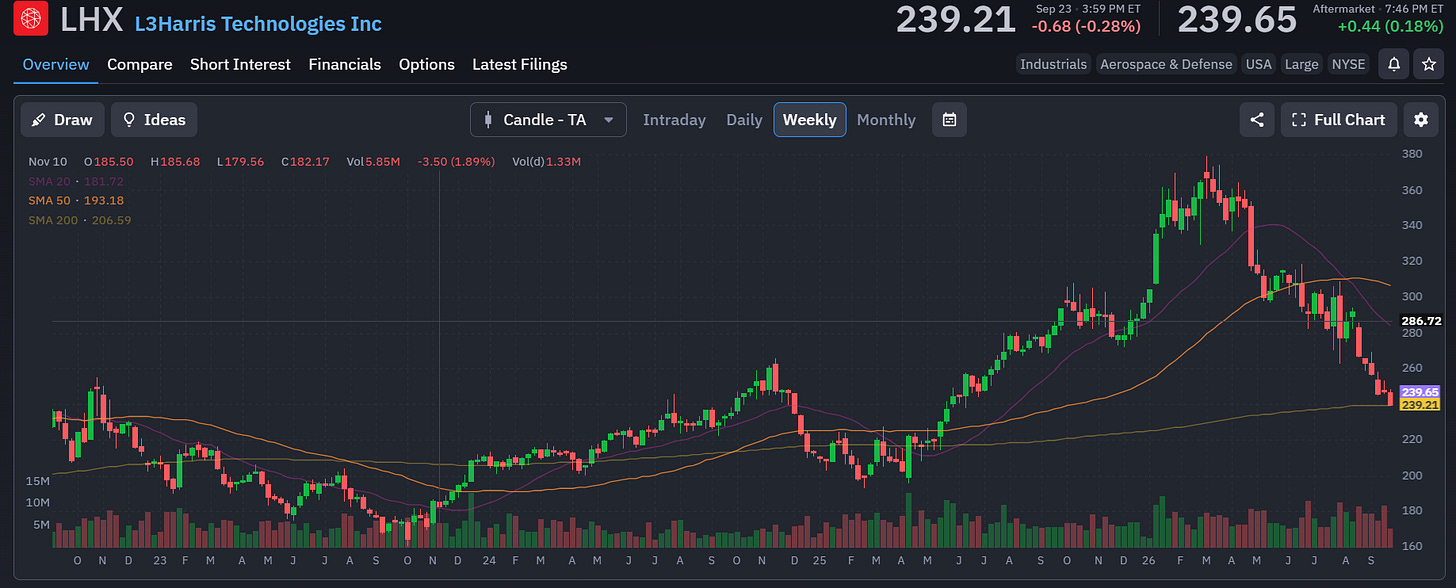
The company’s weekly chart has weakened since it peaked near $379 in the early part of the year. The shares continue to make lower highs and lower lows, with a recent slide from $280 to $250, and are currently trading around $239. The chart shows that it is trading around its 200-week moving average of $239–$240, so it is very crucial that this support holds.
Any break and close below this level will bring the stock to the next support zone of $220, followed by another critical support zone around $200–$205. It is important to note that if buyers return to this stock, the upside resistance is around $250–$260, after which reclaiming the 20-week moving average around $287 is critical for reversing the downtrend.
Takeaway
L3Harris Technologies is a legacy company that has been around in one form or another since before man landed on the moon. The company is going through some issues, especially regarding management execution, and has recently won a number of contracts that can further assist its future growth. With a backlog of $42 billion and a planned IPO of its growth segment in the works, the company is positioned to create significant value for patient investors.
Although the current price offers a reasonable valuation, as a Warren Buffett disciple, I try to be greedy and want the shares lower, to around the $220–$225 range, for initiating a position. It is not to say that the current price is not compelling, but I want an additional safety net just because of the high interest rate environment and the 10Y Treasury offering a greater than 5% return.


Comments
Log in or sign up to join the conversation.