

Photo by PiggyBank on Unsplash
Just as a physician is admonished not to do any harm to the patient, so , too, are central bankers warned in a similar vein. On March 18th the Bank of Canada will announce its latest policy rate, amidst tremendous turmoil in the international energy markets and, the knock-on effects, to the global economy of the war in the Middle East.
The Bank has not had such a confluence of issues to contend with, perhaps, since the 2008 financial crisis south of the border. Just count them:
Inflation rates, prior to the start of the Middle East wars, was decelerating with last month’s CPI coming in at 1.8% , well within Bank’s target range of 1%-3% ; the Bank would have felt comfortable and would likely standstill; now, the surge in oil prices makes everything less comfortable, and past inflation forecasts have been thrown into some considerable doubt;
Job losses continue to plague the nation. Canadians cannot shake off the uncertainty regarding U.S. tariff policy and the renegotiation of the continental free-trade agreement ; cumulatively this year, Canada shed 109,000 jobs and the unemployment rate rose from 6.5% to 6.7%; that would normally put the Bank on alert for rate cuts;
Ontario is experiencing a real estate downturn resulting from overbuilding in the Greater Toronto Area, and a fall off in immigration; the oversupply situation continues to affect the credit markets; mortgage rates moved from an all time low of 1.5% in 2020 to today’s rates at 4.5%-5%; lowering borrowing costs would help, but the supply situation dominates residential real estate;
Geopolitical events have forced fuel prices to soar, as oil prices hit $100 bbl and then some more; although a major oil producer, domestic oil production is situated exclusively in western Canada .The two largest provinces, Ontario and Quebec are totally reliant on imports from the U.S. and subject to the escalation in world prices;
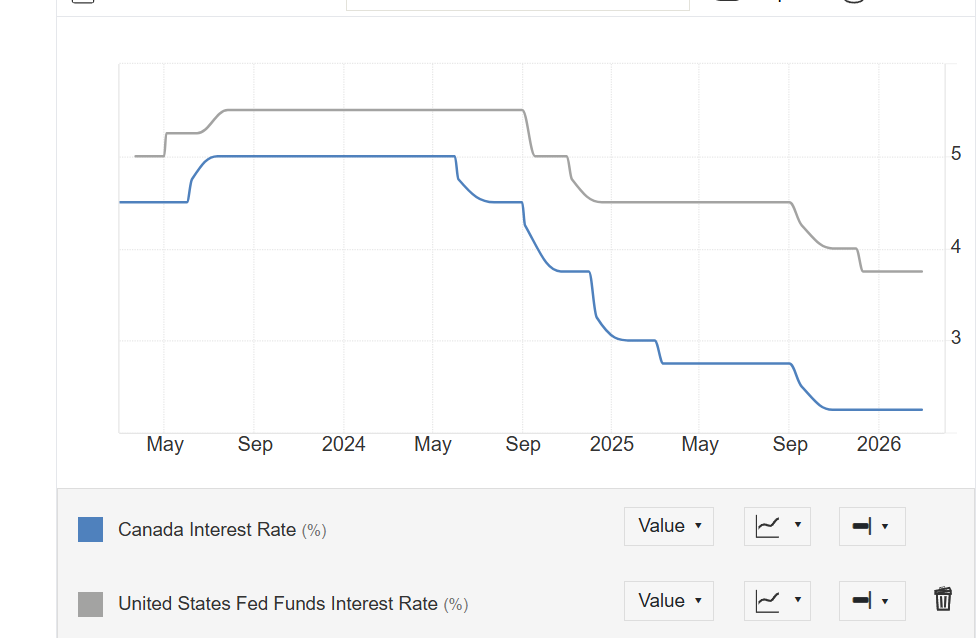
The current bank rate is set at 2.25%, just above last month’s inflation rate, meaning that the ‘real’ rate of interest ( discounted for inflation ) is just above zero. Any further reduction would put that real rate below zero, a condition that the Bank would like to avoid because it discourages savings at the expense of speculation in asset prices.
The sudden surge in oil prices makes the Bank’s task even more difficult. From one perspective, the inflationary effects will force the Bank to raise rates to moderate the inflation. Yet from another perspective, the rise in oil prices forces consumers to cut back on non-energy consumption items, often referred to as deflationary effects; that is, a reduction in overall consumer expenditures and hence a drop in GDP. A prolonged period of rising and high energy prices will eventually sap the consumer of some purchasing power.
Unlike the Federal Reserve which has a dual mandate to achieve low unemployment and price stability, the Bank of Canada has only one policy target, namely to create price stability. Nonetheless, tackling inflation could well result in greater job losses and a fall off in growth. At this moment, the effects of the geopolitical events are too new, too raw and too difficult to forecast. Doing nothing is a good position to take.


Comments
Log in or sign up to join the conversation.