


Yesterday’s article caused quite a stir.
By quick way of review, I outlined the fact that Money Printers (Governments and Central Banks) have crossed the “point of no return.” The key points were:
The pandemic and economic shutdowns opened the door to the greatest fiscal spending in the history of the world outside of World War II. And since crossing that threshold, governments have been unable to return to pre-pandemic levels of spending. Put another way, the world is now in a new era of fiscal dominance: one in which the kind of fiscal spending that is normally reserved for recessions has become the norm.
Central banks have abandoned any pretense of ending inflation and are already back in “easing mode.” The Fed has cut rates (six times), the European Central Bank (ECB) has cut rates eight times, the Bank of England (BoE) has cut rates seven times, and the Swiss National Bank (SNB) has cut rates six times. The Fed has also launched a new $40 billion per month open-ended QE program (that’s $480 billion in money printing per year).
Put simply, the two most powerful financial entities in the world (governments and central banks) have committed to a “new normal.” And that new normal has one primary beneficiary:
Hard assets.
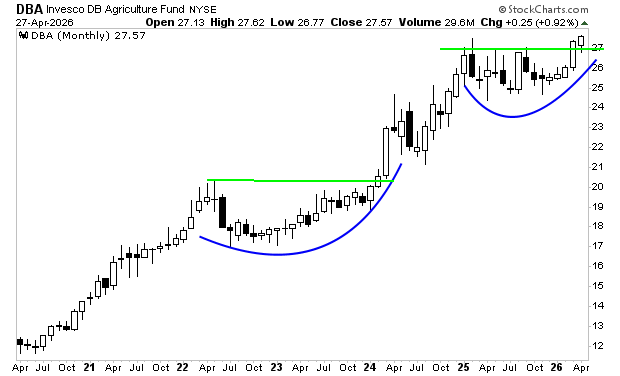
It is not coincidence that gold is erupting higher priced in every major currency, nor is it coincidence that commodity prices have broken out of a 15+ year downtrend. Most concerning of all, agricultural commodities are breaking out to new highs in the context of a multi-year bull market (the Fed’s own research has revealed that food inflation is the single best predictor of future inflation).
There’s actually another major driver creating a “once in a lifetime” opportunity in the hard asset/ natural resource space.
The AI revolution.
Collectively, tech companies are committing over $600 BILLION per year to building out AI infrastructure. It is critical to note that this spending will occur regardless of whether or not AI delivers on its potential.
Think of it this way… A homebuilder HAS to buy lumber, cement, nails, wires, etc. regardless of whether the home sells or not. The same is true for the current AI buildout. The only difference is the “homebuilder” in for AI is Uncle Sam/ Big Tech, who have the DEEPEST pockets in the world.
And all of this will require a truly staggering amount of hard assets/ natural resources. A single 100 MW Hyperscale AI Data Center requires:
Copper: ~2,200 tonnes for wiring, cooling loops, and power distribution — 3-4x more than a conventional data center
Iron/steel: up to 14,000 tonnes for structural framework, transformers, generators
Aluminum: ~1,200 tonnes — busbars, enclosures, cooling components
Graphite: ~290 tonnes — backup power systems and UPS units
Lead: ~240 tonnes — backup battery systems
Nickel: ~220 tonnes — backup power and battery systems
Cobalt: ~40 tonnes — backup batteries and UPS systems
Lithium: ~30 tonnes — battery backup systems
Water: up to 5 million gallons per day, ongoing — equivalent to a city of 50,000 people
Power draw: 100–500 MW continuous, 24/7/365
And remember, this is happening regardless of how AI turns out. Big Tech/ the U.S./ China are fully committed to this process to the tune of $600+ BILLION per year.
All of this is fuel for a “once in a lifetime” opportunity in the hard asset/ natural resource space.



Comments
Log in or sign up to join the conversation.