


Last week I told my private clients the options market was pricing a deal with Iran. Call buying in the airlines had picked up, the administration had said the war ends after the midterms, and I was not going to put them into an oil producer at the highs while Washington was working toward a ceasefire.
Five trading days later, oil has fallen five sessions in a row. And the bond market has not moved an inch.
Here is the number to hold onto this week. Even after the Fed hiked last Wednesday, the 2-year Treasury yield sits roughly 80 basis points above the federal funds rate. That is the market pricing three more hikes on top of the one just delivered, through a week in which the war supposedly started ending. Stocks celebrated. The bond market did not change its mind.
The sequence went like this. Reports surfaced Tuesday that Iran had offered to reopen the Strait of Hormuz within seven days. Fars, Iran’s semi-official news agency, called the reports untrue, and nobody has confirmed them. It did not matter. Traders sold oil. Reuters reported the same morning that Saudi Arabia had already restarted the East-West pipeline and could resume exports from Yanbu within days, less than two weeks after officials said repairs would take a month or more. Then Trump told the UN General Assembly he believes he can reach a deal with Iran after the midterms, and sat down with Gulf leaders that night.
The stock market did what stock markets do with that kind of week. The Nasdaq closed at its first record since June. The 10-year yield dipped to 4.92% from 5.04% a week earlier. The names that had been priced for a 5% world got a day of relief.
Then this morning yields turned around.
The 10-year is climbing again as I write this, the dollar with it, on a PMI print that came in hot. Gold did not wait for the bond market. It is up nearly 4% today, silver more than 7%, and copper is within reach of a record, on a morning when oil fell 4%. The metals are not trading the ceasefire. They are trading what comes after it.
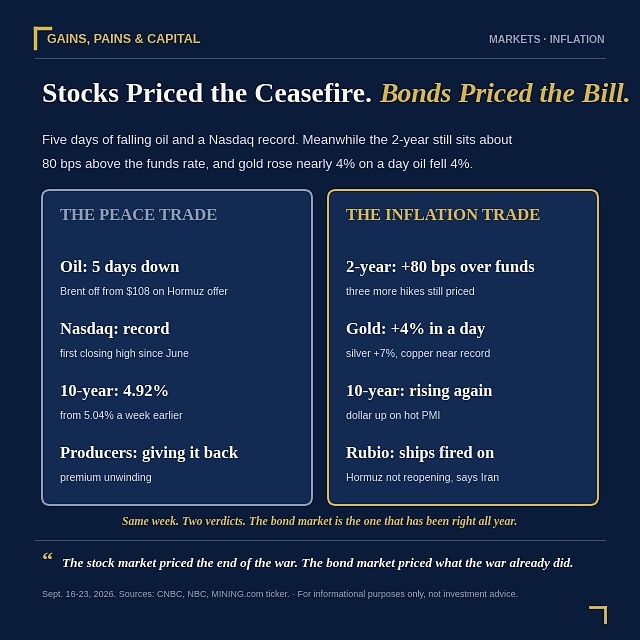
And at 10:25 this morning, Rubio told reporters that Iran had fired on commercial ships in the strait overnight. The same government that, according to the reports the market rallied on Tuesday, had offered to reopen Hormuz within seven days. An hour earlier, Iran’s Major General Rezaei had said Hormuz would stay closed until Tehran’s conditions are met and there would be no negotiations. Rubio’s response was that the U.S. will keep the strait open, that the President has military options, and that any deal “is going to involve hard work over a period of time.” Explosions were reported in Jizan, in southern Saudi Arabia, the same hour.
Read that sequence with Tuesday’s rally in mind. The offer, if it exists, came through a Qatari mediator. The gunfire came from the Revolutionary Guard. Tehran does not have to choose between them. It negotiates at the table and shoots in the strait, because the shooting is what gives the offer its value.
Here is the point I want you to take from this week, because it is bigger than whether a deal gets signed.
The inflation is already in the system. A ceasefire does not take it out.
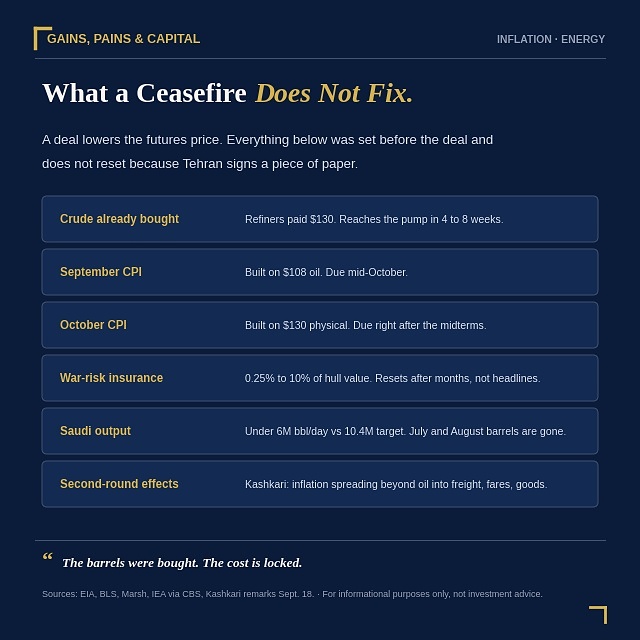
Start with the energy that has already been bought. Refiners paid $130 for physical crude last week. That crude is being turned into gasoline, diesel, and jet fuel right now, and it reaches the pump in four to eight weeks. August’s CPI was built on $95 oil and still came in hot enough to get the Fed to hike. September’s report, due in the middle of October, will be built on $108. October’s, due right after the midterms, will be built on $130. None of those numbers change because Brent fell five days in a row. The barrels were bought. The cost is locked.
Then the costs that do not reset on a headline. War-risk insurance for a Hormuz transit went from a quarter of a percent of a ship’s value to as much as ten percent over six months of attacks. Underwriters do not cut that because a news agency reports an offer. They cut it after months of ships passing without incident, and this morning ships did not pass without incident. Saudi Arabia produced under 6 million barrels a day in August against a 10.4 million target. Restarting a pipeline does not refill that gap. Fields that were shut in take weeks to come back, and the barrels that were not produced in July and August are gone.
Then the spread. Kashkari said on Friday that inflation is moving beyond the oil shock into the broader economy. That is the Minneapolis Fed president telling you the second-round effects have started: freight, airfares, packaging, anything that moves by truck or ship. Those prices went up because the input went up. They do not come down because the input stopped going up. They come down slowly, if at all, and only after the input actually falls for a sustained period.
And then the part almost nobody is saying out loud. This inflation is policy.
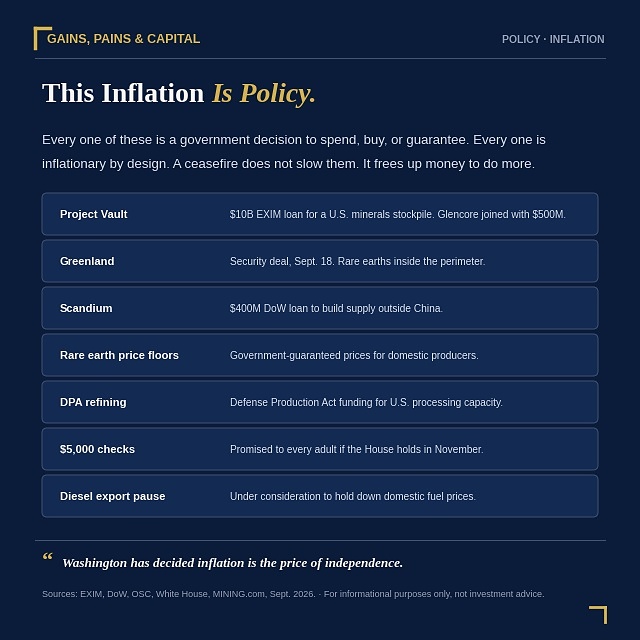
Look at what was announced this morning, on the same day the market was pricing peace. Glencore, the largest commodity trader on earth, signed on to build a U.S. critical minerals reserve with a $500 million commitment from the Export-Import Bank. It joins Hartree, Mercuria, and Traxys in VaultCo, the public-private partnership carrying out Project Vault, for which EXIM has approved a direct loan of up to $10 billion to buy and store raw materials at facilities across the United States. The executive chairman’s words were “mineral security is national security.” Add that to the Greenland security deal, the $400 million scandium loan, the rare earth price floors, the refining capacity funded under the Defense Production Act, and the $5,000 checks the President has promised if his party holds Congress. This morning the President was reportedly weighing a pause on diesel exports to hold down domestic fuel prices, which is the same instinct applied in the other direction: manage the price rather than accept it.
Every one of those dollars is inflationary, and every one is deliberate. A $10 billion government buyer stepping into the copper, cobalt, nickel, and lithium markets does not lower prices. It raises them, on purpose, because the alternative is depending on supply that a militia or a ministry in Beijing can cut. The administration has looked at the choice between a hot economy with 3.5% inflation and a cold one with secure supply chains still on the drawing board, and it has chosen hot.
A ceasefire does not slow that spending. It accelerates it, because the war just proved why it was necessary. Nobody in Washington is going to look at six months of Hormuz closed, a pipeline burning, and a missile at Riyadh, and conclude the answer is to spend less on domestic supply. The lesson they drew is the opposite. The money is coming faster, and it is coming regardless of what Tehran signs.
The bond market understands all of this. That is why the 10-year gave back one day of relief and is climbing again this morning. That is why the 2-year is still 80 basis points above the funds rate. That is why gold is up 4% on a day oil fell. Nothing about a deal in Doha changes 6% deficits, a Treasury that has committed to buying its own long bonds, a Fed with another hike penciled in, or a government that has decided inflation is the price of independence.
Put simply, the stock market has priced the end of the war. The bond market and the metals have priced what the war already did, and what Washington has decided to do about it. They are right.
What this means for your money is simple.
The relief in tech is a trade, not a trend. The multiples on the biggest names in the index are still priced for a 4% 10-year, and the 10-year is not going back there while the inflation from this summer is still working its way through the CPI and the government is adding to it on purpose. Enjoy the bounce. Do not mistake it for the all-clear.
The energy positions that get paid on volume and contract rather than on the spot price are doing exactly what they were built to do. They did not need $130 crude to work, and they do not need the war to continue. They need the world to keep buying supply from inside safe borders, and this morning’s gunfire in the strait is a reminder of why it will.
The producers that captured the geopolitical premium are giving it back this week. Somewhere below here they become the trade my private clients have been waiting for: supply no militia can reach, bought after Washington handed us a discount on it. The discount is arriving on schedule.
And the critical minerals trade is untouched by any of it. A $10 billion federal stockpile just got its largest supplier. Nothing that gets said in Doha, or in the room where Trump meets Xi this week, reverses a single mine the government has already decided to fund. If anything, a deal frees up the attention and the money to build them faster.
A deal lowers the oil price. It does not lower the inflation that oil already created, and it does not stop the spending Washington has decided to do. Position for the second and third, and let the headlines argue about the first.
Which brings me to the part that matters for your money.
Gold is up 4% today. Silver is up 7%. Copper is closing in on a record. All of it on a morning when oil fell and the stock market was still celebrating a ceasefire that Tehran says is not happening. The metals are not confused. They are pricing the inflation that is already in the pipeline, plus the inflation Washington has decided to add on top of it.
Put simply, this is an inflationary storm the Fed cannot hike its way out of and a deal cannot sign its way out of, because half of it is already bought and the other half is government policy.

Comments
Log in or sign up to join the conversation.