

Executive Summary
AI Earnings Reckoning: Strong results from companies like Advanced Micro Devices (AMD), NVIDIA (NVDA), Corning (GLW), and Amazon (AMZN) reinforced the market’s belief that AI infrastructure spending remains in a powerful expansion phase, despite growing concerns around valuation and capital intensity.
Software Strikes Back: Investors rotated aggressively into software and cybersecurity stocks following strong earnings reports from Fortinet (FTNT), Twilio (TWLO), Datadog (DDOG), and Akamai Technologies (AKAM), signaling renewed confidence that select SaaS and cybersecurity firms can monetize AI rather than simply be disrupted by it.
The Economy Is Sending Mixed Signals: Economic data painted a picture of a U.S. economy losing momentum without fully rolling over, as softer labor trends, weak consumer sentiment, and slowing real wage growth contrasted with resilient manufacturing activity and stable jobless claims.
AI Earnings Reckoning Arrives
This week’s earnings season reinforced one dominant theme driving financial markets in 2026: artificial intelligence spending continues to overwhelm nearly every other macro concern. Investors entered the week questioning whether the market could continue justifying massive AI-related capital expenditures. By Friday, many of those doubts had been pushed aside by a wave of earnings reports, guidance increases, and infrastructure announcements that collectively suggested the AI buildout is still accelerating rather than slowing.
The biggest market-moving report of the week came from Advanced Micro Devices (AMD). AMD surged nearly 19% on Wednesday after delivering stronger-than-expected guidance driven by explosive demand for server CPUs tied to agentic AI deployment. CEO Lisa Su projected the server CPU market could reach $120 billion by 2030, reinforcing the idea that AI demand is evolving beyond just graphics processors and into the broader compute stack. The rally spread quickly across semiconductors, lifting names like Arm Holdings (ARM) and Intel (INTC) while helping push the PHLX Semiconductor Index sharply higher.
Just as important was the market’s reaction to infrastructure bottlenecks. One of the most significant developments came from the partnership announced between Corning (GLW) and NVIDIA. Corning said it would build three new optical manufacturing facilities to expand domestic fiber optic capacity tenfold. The move highlights how AI infrastructure is increasingly shifting from a pure chip story toward a systems-level story involving power management, networking, optical transmission, cooling, and memory bandwidth.
That shift became even more apparent in memory markets. SanDisk (SNDK) and Micron Technology (MU) continued their parabolic moves higher after recent earnings beats and bullish commentary surrounding long-term memory supply agreements. Investors are beginning to recognize that AI clusters require enormous amounts of high-bandwidth memory, and the industry may be entering a prolonged supply shortage cycle similar to what GPUs experienced earlier in the AI boom. Bernstein raising its price target on SanDisk to $1,700 underscored just how aggressively Wall Street is repricing the memory trade.
The week also highlighted how AI spending is increasingly benefiting industries outside traditional semiconductors. Cummins (CMI) rallied after reporting strong demand for backup generators used in data centers. Rockwell Automation (ROK) cited accelerating orders tied to semiconductors, automation, and reshoring trends. Even industrial gas giant Linde (LIN) received multiple price target increases after reporting strong fundamentals tied partly to advanced manufacturing demand.
Meanwhile, the software side of the AI trade delivered a more mixed picture. Fortinet (FTNT) exploded higher after a strong cybersecurity earnings report, while companies like HubSpot (HUBS) and Cloudflare (NET) sold off sharply after discussing transitions toward AI-first operating models that included layoffs and margin pressure. The divergence reinforced a growing market debate: while AI infrastructure demand remains extraordinarily strong, monetization across software applications is proving less uniform.
Even outside earnings, AI spending dominated headlines. Reports that Anthropic committed roughly $200 billion over five years to Alphabet (GOOGL)’s (GOOGL) Google Cloud highlighted the unprecedented scale of compute demand now flowing into hyperscalers. That spending arms race is becoming one of the defining investment themes of this cycle.
Investment implication: Markets continue rewarding companies directly tied to AI infrastructure expansion, but leadership is broadening beyond GPUs into networking, optics, power systems, memory, and industrial automation.
Software Strikes Back
For much of 2026, software stocks have lagged behind semiconductor and hardware companies as investors questioned whether artificial intelligence would compress margins, reduce seat-based pricing power, and commoditize large portions of enterprise software. This week, however, earnings results from several major SaaS and cybersecurity firms suggested parts of the software industry may be entering a new phase of AI-driven monetization rather than disruption.
The strongest signal came from Fortinet (FTNT), which surged more than 20% after delivering what analysts described as an “outstanding quarter.” The cybersecurity company benefited from strong firewall demand, improving enterprise spending trends, and growing recognition that AI adoption may actually increase cybersecurity complexity rather than simplify it. BTIG upgraded the stock following earnings, while the rally spread across the broader cybersecurity sector, lifting peers like CrowdStrike (CRWD) and Palo Alto Networks (PANW).
Investors also rotated aggressively into cloud and infrastructure software names after Twilio (TWLO) delivered stronger-than-expected results and improving guidance tied to AI-enabled customer engagement tools. The market reaction reflected growing optimism that companies with strong customer data platforms and communications infrastructure may become key beneficiaries of enterprise AI deployment.
The move extended into observability and analytics software as Datadog (DDOG) surged more than 30% following earnings. Investors rewarded the company’s ability to integrate AI monitoring, cloud optimization, and infrastructure visibility into broader enterprise workflows. The earnings report became another indication that companies helping enterprises manage increasingly complex AI environments may command premium valuations again.
Akamai Technologies (AKAM) also became one of the week’s standout performers after announcing that a major frontier AI model provider committed roughly $1.8 billion over seven years for cloud infrastructure services. The deal reinforced the growing overlap between cybersecurity, edge computing, and AI infrastructure deployment. Investors increasingly appear willing to reward software firms that own critical internet infrastructure rather than purely application-layer tools.
At the same time, earnings reactions across software remained highly selective. HubSpot plunged more than 20% after issuing a mixed outlook and warning about execution risks tied to transitioning toward an AI-agent-first operating model. Cloudflare also sold off sharply after announcing layoffs affecting roughly 20% of its workforce as part of its own AI-first transition. The market interpreted both reports as evidence that AI could pressure traditional SaaS pricing models before new revenue streams fully mature.
This divergence highlighted a major shift underway inside technology markets. Earlier in the AI cycle, investors overwhelmingly favored hardware, chips, and infrastructure. This week suggested capital may slowly be broadening toward software companies capable of demonstrating measurable AI monetization, recurring enterprise demand, and mission-critical infrastructure positioning.
Investment implication: Investors are beginning to differentiate between software companies vulnerable to AI disruption and those capable of using AI to strengthen competitive positioning, improve enterprise value, and accelerate recurring revenue growth.
The Economy Is Sending Mixed Signals
This week’s economic data reinforced the idea that the U.S. economy is slowing gradually rather than collapsing outright. The reports collectively showed moderation in labor markets and consumer activity while manufacturing and housing data remained more resilient than expected.
The most important release came Friday with the April employment report. Nonfarm payrolls increased by 115,000 while the unemployment rate ticked up to 4.3%. Wage growth continued slowing, and the labor force participation rate declined. Perhaps most concerning was the rise in the broader U-6 unemployment rate, which includes underemployed workers.
Real wage growth remains extremely weak once adjusted for inflation. Average hourly earnings rose 3.6% year-over-year, but after accounting for inflation, real income growth was nearly flat. That dynamic raises concerns about the sustainability of consumer spending without greater reliance on debt.
Those concerns appeared elsewhere in the data. Consumer credit surged by nearly $25 billion in March, marking the largest increase in a year. Revolving credit growth suggested households may increasingly be leaning on credit cards to offset rising living costs, particularly after the spike in energy prices tied to Middle East tensions.
Consumer sentiment data reinforced those worries. The University of Michigan Consumer Sentiment Index fell to 48.2 in May, reflecting persistent anxiety over inflation and purchasing power. Consumers appear increasingly pessimistic about their ability to keep pace with rising costs.
At the same time, portions of the economy showed resilience. Factory orders rose 1.5% in March, far above expectations, with strong gains in nondefense capital goods suggesting continued business investment. Construction spending also surprised to the upside, driven largely by single-family residential construction. New home sales exceeded expectations as lower-priced homes improved affordability conditions for buyers. Home Depot (HD) also benefited from renewed optimism that lower rates later in the cycle could support housing-related demand.
Meanwhile, weekly jobless claims remained relatively stable, suggesting labor market deterioration remains gradual rather than disorderly. Productivity data disappointed, but unit labor costs decelerated enough to calm fears of renewed inflation acceleration.
The overall message from this week’s data was nuanced. Economic growth is slowing, consumers are under pressure, and labor markets are softening incrementally. Yet the economy continues showing enough stability to avoid immediate recession fears.
Investment implication: Markets are increasingly balancing slowing growth risks against the possibility that moderating inflation pressures could eventually create a more supportive backdrop for monetary policy later in the cycle.
Chart of the Week
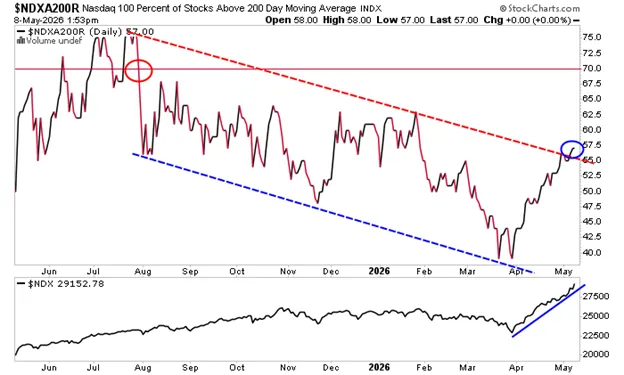
One of the most important technical charts in the market right now is the percentage of Nasdaq stocks trading above their 200-day moving average. While the Nasdaq Composite continues pushing to fresh all-time highs, underlying breadth has not fully confirmed the breakout. That divergence suggests market leadership remains heavily concentrated in AI infrastructure, semiconductor, and selective software and cybersecurity names rather than reflecting broad participation across the entire index. In other words, a smaller group of stocks continues driving a disproportionate share of the gains beneath the surface. If the percentage of Nasdaq stocks above their 200-day moving average begins rising alongside the index itself, it would signal healthier market internals and broader participation in the rally. However, if breadth continues weakening while the Nasdaq climbs higher, it could indicate an increasingly narrow and potentially more fragile advance.
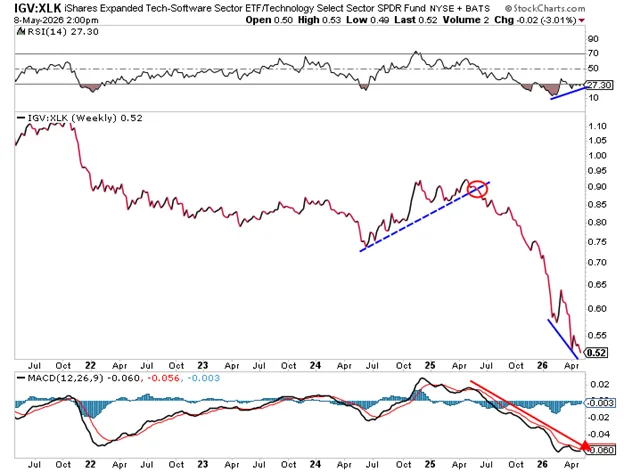
One of the more interesting technical developments in technology is the improving relative strength setup forming in software stocks versus the broader Technology Select Sector SPDR (XLK), which continues to be heavily driven by semiconductor leadership. While AI infrastructure and semiconductor stocks have powered the market higher, many names now trade at increasingly extended valuations after massive rallies. Software stocks, by contrast, have lagged as investors worried AI could disrupt traditional SaaS business models. However, strong earnings reactions in companies like Fortinet (FTNT), Datadog (DDOG), Twilio (TWLO), and Akamai Technologies (AKAM) suggest investors are beginning to rotate back into software and cybersecurity names that can monetize AI demand. The bullish divergence developing in IGV relative to XLK may signal improving risk/reward in software stocks if leadership begins broadening beyond semiconductors.
Bottom Line
This week reinforced that the market’s leadership is beginning to broaden beyond just semiconductors and hyperscale infrastructure spending. While Advanced Micro Devices, NVIDIA, Micron Technology, and Corning continued driving the AI infrastructure narrative, investors also rotated aggressively into software and cybersecurity firms showing evidence of real AI monetization and resilient enterprise demand.
Strong earnings reactions from Fortinet, Datadog, Akamai Technologies, and Twilio suggested investors are becoming more willing to reward SaaS and cybersecurity companies capable of embedding AI into revenue growth rather than simply defending against disruption. At the same time, weak reactions in companies like HubSpot and Cloudflare showed the market remains highly selective and intolerant of execution risk during this transition period.
Meanwhile, economic data continued to point toward a slower-growth environment rather than an outright contraction. Employment growth is moderating, consumer sentiment remains weak, and real wage growth is barely positive after inflation, yet manufacturing activity, housing demand, and business investment still show pockets of resilience.
For now, markets continue rewarding earnings growth, AI infrastructure leadership, and companies tied to long-term secular investment themes. The key question moving forward is whether that earnings momentum can remain strong enough to offset elevated valuations and signs of slowing economic activity beneath the surface.



Comments
Log in or sign up to join the conversation.