"The great merit of gold is precisely that it is scarce; that its quantity is limited by nature; that it is costly to discover, to mine, and to process; and that it cannot be created by political fiat or caprice." —Henry Hazlitt
“Gold is money. Everything else is credit.” —J.P. Morgan
“Although gold and silver are not by nature money, money is by nature gold and silver.” —Karl Marx, Das Kapital
In financial markets, price volatility often blinds investors to structural reality. The current market environment has been a stalemate between strong structural growth led by AI investment and the macro headwinds of energy-driven inflation, hawkish central banks, and geopolitical friction coming from the war with Iran and Ukraine. For precious metals investors it has been an exhilarating ride since 2024 only to be followed by a gut-wrenching reversal since the war with Iran began in February. In the short term, things look dismal, but the long-term trend looks to be intact. I believe this correction looks more like a classic cyclical cooldown driven by high real yields, a stubborn U.S. dollar, and a hawkish Federal Reserve.
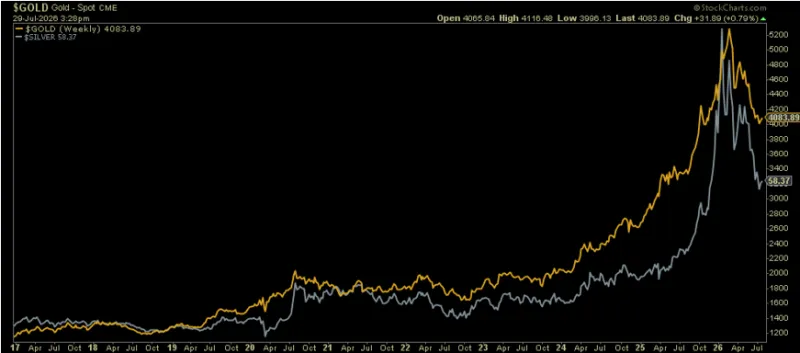
Amid the constant drumbeat by the financial press over tech and AI, the bigger picture is completely being ignored by investors. Before the recent pullback, gold prices were up 385% from the lows reached in 2016 and the price of silver had risen over 660%. Even with the recent steep correction, silver is up 277% and gold is up 256%.
So, what caused the decline? The dynamics currently suppressing gold and silver—and the macro forces that could push them higher—come down to a tug-of-war between short-term monetary mechanics and long-term structural supply/demand fundamentals.
Understanding why they are pulling back requires looking at liquidity, interest rates, and positioning, while recognizing that the next leg up is likely to come from debt, inflation, and physical deficits.
The first significant factor has been a rise in global interest rates, especially in the US and an accompanying strong dollar. When yields rise, they become an attractive competitor to precious metals, which pay no interest and are dependent on price appreciation for returns. This increases the opportunity costs of holding bullion. When interest rates rise, capital tends to rotate toward yield-bearing investments.
In addition, because precious metals are globally priced in US dollars, a strong dollar creates a mechanical headwind. It makes gold and silver more expensive for international buyers in local currency terms (e.g., in China, India, or Europe), muting physical demand and often leading institutional desks to short or trim futures positions.
The third factor driving metals prices lower was triggered by volatility spikes, which can lead to the unwinding of positions and margin calls. The physical metals markets are driven by the paper markets, which are heavily leveraged. When you are leveraged by 10-1 or more, a serious price drop can trigger margin calls and cause a sudden swoon of forced selling as witnessed in February and March of this year. In the case of silver, concerns over a slowing economy and global growth led to worries over industrial demand. Since silver has a dual identity (monetary and industrial), it suffered a double blow. Because silver’s market size is a fraction of gold’s, speculative liquidation causes sharper, amplified downside moves.
Finally, consider the size of the precious metals markets compared to the markets for bonds and equities:
Global Debt/Bond Market ($135T-$140T), $1.0T-$1.2T traded daily
Global Equity Market ($115T-$125T), $800B-$900B traded daily
Source: Bloomberg, The World Gold Council, The Silver Institute
The market for precious metals is dwarfed by the market for bonds and stocks. When investors rotate in or out of precious metals, given the leverage involved, there can be outsized swings in either direction. This is clear in the price of gold and silver since the beginning of this decade.
Despite this recent downdraft, I believe the macro picture that has driven metals prices higher this decade has not changed and has become even stronger. While cyclical fluctuations are driven by short-term sentiment, interest rate moves, and currency swings, a true secular metals bull market is powered by deep structural shifts that compound over a decade or more.
Unlike previous cycles—such as the 2000s "China buildout" era—today’s metals market is driven by a unique convergence of supply constraints, fiscal dominance, and a multi-front industrial race.
Sovereign Debt Saturation & Fiscal Dominance: With US federal debt above 120% of GDP and structural deficits of 6–7% annually, major developed economies (Japan, the UK, France) are trapped. Central banks may ultimately be forced to cap yields to keep government interest payments sustainable, keeping long-term real rates deeply negative or artificially suppressed.
Irreversible Central Bank De-Dollarization: Central bank buying has structurally shifted. Emerging economies like China, Brazil, and India still hold under 10% of reserves in gold (versus 60–70% in many Western nations). Steady diversification away from the USD appears to provide a continuous floor for global gold demand.
Severe Under-Allocation by Western Portfolios: Despite recent price action, macro wealth managers and retail investors remain drastically underweight in hard assets. Historically, during regime shifts, even a 1-2% rotation of institutional capital into gold ETFs or mining equities creates massive upward price asymmetry given the physical market's extreme illiquidity.
Supply Constraints & Rising Marginal Costs: The mining industry faces structural supply limits, as high-grade, accessible deposits are largely depleted. Combined with rising ESG costs, deeper extraction, and sticky energy inflation, the marginal cost of production has shifted permanently higher, raising miners' break-even price floor.
The first three drivers operate mostly on the demand side of the equation. Let’s now look at the fourth driver in more detail.
The Real Story: Structural Supply Deficits
While the macro environment is a critical factor on the demand side in driving precious metals higher, the most powerful driver of any commodity supercycle sits on the supply side. You cannot print physical silver or gold. I believe the single most critical factor that creates and sustains a commodity bull market is the structural lag in the capital expenditure supply response. Fundamentally, it becomes a story of supply discipline forced by years of underinvestment. When the supply deficits become critical, it leads to a harsh realization that ramping up supply can take 16 years or more to bring a new mine into production.
Unlike the previous China-driven supercycle of the 2000s, long lead times were primarily engineering and capital hurdles. Today, the supply bottleneck is compounded by numerous structural barriers.
Declining Ore Grades & Deposit Scarcity
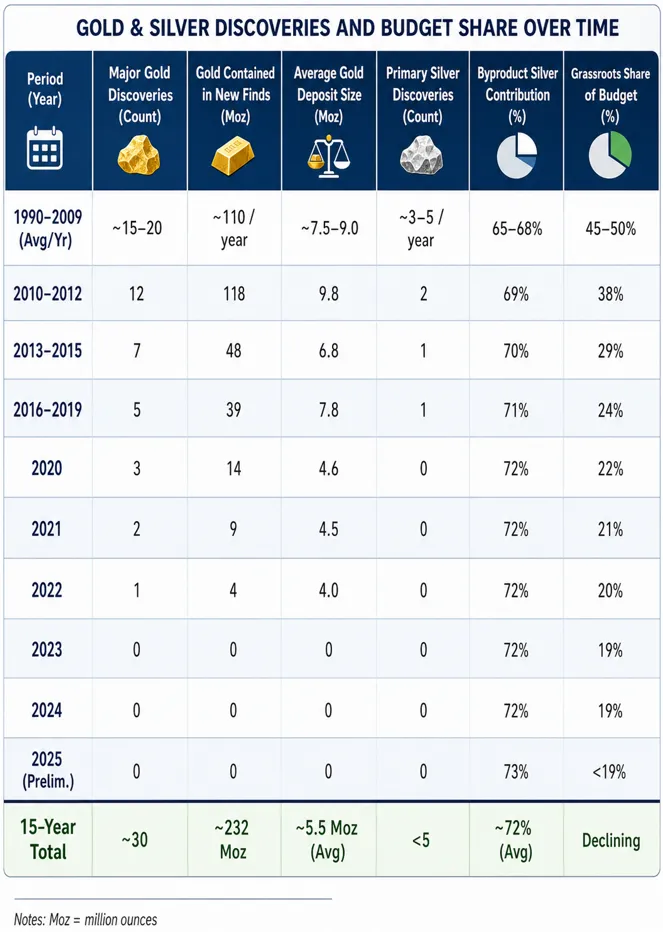
According to S&P Global, the period between 2010-2025 represents one of the most severe discovery droughts in modern mining history for both gold and silver. Despite record historical highs for both precious metals, new greenfield discoveries have collapsed to near zero.
Since 2020, only six major gold discoveries have been made globally, contributing just 27 million ounces of roughly 3 billion in total global major deposit inventories. Most of the new discoveries this decade came from decades-old discoveries.
Source: S&P Global Commodity Insights (Metals & Mining Research) & World Silver Survey.
It is not just the dearth of new discoveries; the average size of new discoveries has fallen by more than 40%. New early-stage exploration budgets fell while capital exploration budgets fell from 50% to 19%. Miners are now focused on brownfield exploration around existing low-risk mines.
This is especially acute regarding silver discoveries. Silver is primarily produced as a secondary byproduct, accounting for 70–75% of total global silver output, extracted from primary copper, zinc, lead, or gold deposits. Standalone primary silver discoveries (where silver accounts for more than 50% of net revenue) have been virtually non-existent over the last decade. In addition, S&P shows that ore grades at primary silver mines have fallen by over 30% over the last 15 years. Unlike gold, silver is consumed and has been declared a strategic mineral.
Regulation, ESG, and Permitting Restrictions
The friction between soaring global demand for physical metals and the regulatory, ESG, and permitting hurdles preventing new supply has reached an unprecedented point. According to S&P Global Market Intelligence, the average lead time to bring a discovered deposit into production has stretched to nearly 18 years globally—and up to 29–30 years for non-operating assets in strict jurisdictions like the United States. What used to be an engineering and capital allocation challenge has now turned into a multi-layered regulatory obstacle course.
Multi-Agency Overlap
Major projects face overlapping federal, state/provincial, and regional jurisdictions. In the US and Canada, a single mine often requires dozens of distinct permits across water rights, air quality, tailings management, and wildlife protection—each subject to separate legal challenges.
Litigation Weaponization
Opponents routinely use judicial review processes to stall projects. Because environmental impact statements (EIS) take 5 to 7 years to produce, even minor procedural flaws exposed in court can force a full restart of the environmental review process.
Capital Erosion
As permitting drags on for a decade or more, holding costs, legal fees, and engineering updates consume vast amounts of capital before a single ton of ore is extracted, drastically lowering the project's Net Present Value (NPV).
There is no better example of these delays than the Resolution Copper Project in Arizona. The Resolution Copper project in Superior, Arizona—jointly owned by Rio Tinto (RIO) (55%) and BHP (BHP) (45%)—is perhaps the definitive case study of extreme permitting lead times. From initial discovery to commercial production, the project is tracking toward a 35- to 40-year total timeline, despite sitting on one of the world's largest undeveloped copper deposits (capable of supplying up to 25% of US demand).
Permitting delays are now cited by S&P as the number one operational cause of project postponements and cancellations. This convergence of regulation, ESG demands, and permitting friction creates a structural supply chokepoint.
While policymakers worldwide mandate aggressive targets for the energy transition, grid modernization, and domestic supply chain security, the regulatory apparatus required to approve raw material extraction remains tied to decades-old, slow-moving administrative frameworks. The result is a growing structural deficit that cannot be rapidly resolved, even by major spikes in commodity prices.
Mining Capital Discipline
Following the commodity bear market, major producers shifted to share buybacks, debt reduction, and dividends to shareholders. Capex remained far below its peak in 2012.
Demand shocks make headlines, but the structural delays in bringing new low-cost supplies to the market are what defines the supercycle. This deficit will remain in place until capital expenditure exceeds previous levels and remains there until supply is able to meet demand. Contrary to market narratives, I do not believe the physical deficit can be bridged by technology alone.
Because of the myriad factors, ranging from macro to the fundamentals of supply and demand, it is my belief that the commodity supercycle is still in its beginning stages. The demand that is coming from de-dollarization and central bank reserve accumulation to reindustrialization and electrification will outstrip supply due to the constraints now in place in the mining sector.
Given basic economics, the only resolution to balance supply and demand is higher prices. Several prominent forecasters have projected gold and silver prices rising to new records by the end of the decade and beyond.
Summary Conclusion
Financial markets are currently trapped in a classic optical illusion: short-term monetary mechanics have masked a generational structural realignment. While headline volatility, leveraged margin liquidations, high real yields, and the geopolitical shockwaves of the war with Iran have induced a sharp cyclical cooldown in precious metals, I believe the underlying bullish thesis has not merely remained intact—it has intensified.
The friction in today’s market sits at the intersection of unyielding macro demand and an unprecedented supply bottleneck:
The Short-Term Noise: High opportunity costs from elevated real yields, a persistent US dollar, and paper market leverage (where a 10:1 ratio amplifies speculative liquidations) have created temporary pricing disconnects, particularly in silver due to its dual monetary-industrial identity.
The Long-Term Imperative: Central bank de-dollarization, fiscal dominance, and non-negotiable electrification mandates are creating a structural demand floor. Yet, as S&P Global data demonstrates, the supply side is completely incapable of responding. Greenfield discoveries have collapsed to near-zero, average deposit grades have plummeted over 40%, and multi-agency regulatory overlap has extended lead times to 18-30+ years (as highlighted by Resolution Copper's 40-year horizon).
You cannot print physical gold or silver, nor can capital expenditures bypass a 15-year long permitting and engineering process. Because the paper markets dwarf physical floating stock, even a minor capital rotation out of the $140T global bond market or $125T equity market into precious metals will act like a tidal wave in a small pond. With supplies structurally frozen, I believe that higher prices are the only economic mechanism left to balance the market.
Investment Conclusions
Given the macro drivers for precious metals and the supply constraints, which will not be solved for more than a decade, the metals markets, and especially silver, offer an unprecedented opportunity to investors in my view. It is my belief that the metals markets are close to a bottom, and the select miners are a strong buy as I expect robust earnings reports as miners report Q2 earnings over the next six weeks.
Where suitable, my firm and the portfolios I manage maintain a favorable weighting toward commodities, particularly metals and oil. It is my firm belief this supercycle will last well into the next decade due to the major supply constraints and the global trend towards de-dollarization and central bank gold reserve accumulation. Some of the strategies I am pursuing:
Overweight Permitted, High-Grade Developers (The M&A Target Zone)
Overweight Physical Silver Relative to Gold (Asymmetric Ratio Play)
Focus on "Value-Over-Volume" Senior Producers
We may not be at the exact bottom, but I believe we are close. Hazlitt reminded us that gold's great merit is precisely that it is scarce, that it cannot be created by political fiat or caprice. In a world drowning in debt that can be created at will, the one asset that cannot be printed—dug from ore grades that shrink each year and mines that take two decades or more to permit—is exactly where I want exposure as we position for the longer term.
Disclaimer:
Content is for informational purposes only and does not constitute financial, investment, legal, or other advice.
The strategies and concepts discussed, such as portfolio rebalancing, asset allocation, or diversification, are general in nature and may not be suitable for every investor.
Investment decisions should be made based on an individual's specific objectives, financial situation, risk tolerance, and investment time horizon.
Past performance is not indicative of future results, and all investing involves risk, including the possible loss of principal.
Forward-looking statements are based on assumptions that may not materialize and are subject to risks and uncertainties.
Any mention of specific securities or investment strategies is not an endorsement or recommendation.
Advisory services offered through Financial Sense® Advisors, Inc., a registered investment adviser. Securities offered through Financial Sense® Securities, Inc., Member FINRA/SIPC. DBA Financial Sense® Wealth Management.





Comments
Log in or sign up to join the conversation.