


We continue to maintain a defensive investment posture, with overall asset allocations below neutral targets and cash reserves above normal levels. This positioning does not reflect a belief that investors should abandon the markets or that attractive long-term opportunities have disappeared. Rather, it reflects our assessment that three unusually consequential uncertainties remain unresolved: the expanding conflict between the United States and Iran, the direction of inflation and Federal Reserve policy, and the sustainability of the extraordinary capital-spending cycle associated with artificial intelligence.
Each issue has the potential to influence economic growth, interest rates, corporate earnings and market valuations. More importantly, these risks are interconnected. A prolonged disruption to Middle Eastern energy supplies could keep inflation elevated, complicate the Federal Reserve’s policy decisions and raise financing costs just as technology companies are committing unprecedented amounts of capital to AI infrastructure.
Until the range of potential outcomes narrows, we believe maintaining liquidity and preserving investment flexibility provide a better risk-reward tradeoff than fully deploying capital into markets that have already priced in a considerable amount of favorable news.
US-Iran Conflict: An Economic Risk, Not Merely a Geopolitical One
The conflict between the United States and Iran remains the most immediate source of uncertainty. The tentative progress toward a ceasefire has broken down, maritime conditions around Iran remain highly unsettled and military activity has intensified. Recent developments have reinforced the possibility that the conflict could become a prolonged exchange rather than conclude through a quick diplomatic settlement.
For investors, the principal transmission mechanism is energy.
The Strait of Hormuz is one of the world’s most important energy corridors. Even when vessels are not completely prevented from passing through it, impaired traffic, higher insurance costs, military risk and uncertainty surrounding future shipping conditions can create substantial volatility in oil and refined-product prices. The Federal Reserve has already identified constrained shipping through the Strait and related damage to regional energy infrastructure as important contributors to this year’s increase in energy prices and inflation.
The potential economic effects extend well beyond gasoline prices. Higher energy costs can reduce household purchasing power, compress corporate profit margins, increase transportation and manufacturing expenses, and weaken consumer confidence. A sustained increase in crude oil could therefore produce an uncomfortable combination of slower economic growth and persistent inflation.
There is also a meaningful risk that the conflict spreads geographically. Renewed threats to shipping routes near the Red Sea or attacks on regional energy and civilian infrastructure could complicate the effort to restore reliable oil flows. Our internal assessment is that markets may be underestimating the possibility of a drawn-out, volatile confrontation in which periods of diplomatic progress are repeatedly interrupted by military escalation.
Because the range of potential oil-price outcomes remains unusually wide, we do not believe this is an environment in which investors are being adequately compensated for assuming maximum portfolio risk.
Inflation and the Federal Reserve: Policy Path Remains Unsettled
The second uncertainty is the direction of inflation during the remainder of 2026 and, consequently, the Federal Reserve’s next policy move.
There are legitimate reasons to expect inflation to moderate. Some earlier tariff effects should gradually fade, selected goods-price pressures may normalize, and portions of the economy are beginning to experience slower demand. Furthermore, owner’s equivalent rent, the largest component of the Consumer Price Index, is expected to slow for the remainder of the year and will likely depress inflationary trends. A durable improvement in energy supplies would also provide meaningful relief to headline inflation.
However, the available evidence is not yet conclusive. The Federal Reserve reported that total personal consumption expenditure (PCE) inflation reached 4.1% over the 12 months through May, while core PCE inflation was 3.4%—both materially above the Fed’s 2% objective. The central bank specifically cited energy disruptions, tariffs and increased demand for certain AI-related technology products as contributors to the renewed inflation pressure.
Inflation expectations also deserve attention. The Federal Reserve Bank of New York’s June survey showed that median one-year inflation expectations increased to 3.7%, even as expectations for gasoline-price growth declined. This divergence illustrates why the inflation outlook cannot be reduced to a single energy forecast.
The Federal Reserve has maintained the federal-funds target range at 3.50%–3.75%, but the June projections indicated a substantially more restrictive policy outlook than in March. Policymakers remain divided over whether inflation will cool sufficiently without additional tightening.
That leaves several materially different paths open:
Inflation could decelerate, allowing the Fed to remain on hold.
Energy prices could stay elevated and force the Fed to maintain restrictive policy for longer.
Broader inflation could remain sticky enough to require renewed rate increases.
Economic growth could weaken while inflation remains elevated, significantly limiting the Fed’s ability to support the economy.
These outcomes would have very different implications for Treasury yields, credit markets, equity valuations and the US dollar. Until the policy path becomes clearer, duration-sensitive investments and richly valued growth assets remain vulnerable to rapid repricing.
Precious Metals and the Dollar
We continue to view precious metals as strategically valuable within a diversified portfolio, particularly as a potential hedge against monetary instability, geopolitical risk and declining confidence in fiat currencies as sovereign debt levels move higher. Nevertheless, entry price and policy timing matter.
The next significant move in gold and other precious metals is likely to be influenced not only by inflation itself, but also by real interest rates and the direction of the US dollar. A more hawkish Federal Reserve could support the dollar and pressure metals, while a clearer shift toward easier policy could weaken the dollar and create a more favorable environment for precious-metals exposure. Additionally, the Japanese Yen recently reached multi-decade lows, and the Bank of Japan (BOJ) may need to intervene to strengthen the currency relative to the USD which would weigh on the widely followed USD Index.
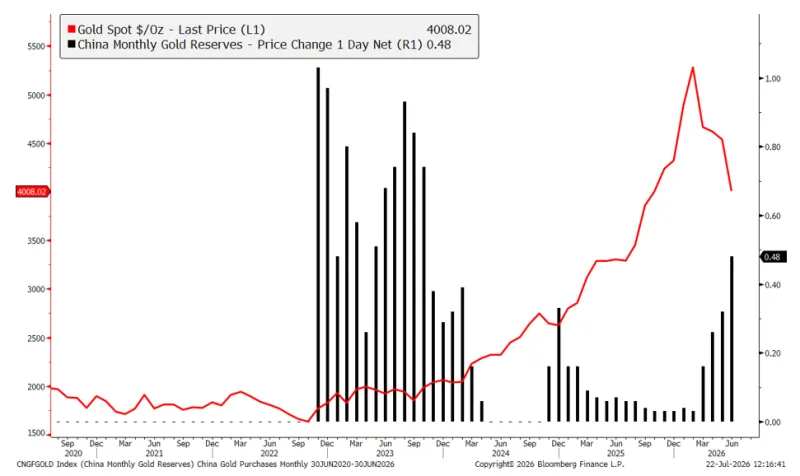
Beyond the influence of the Federal Reserve and the Bank of Japan on currency movements, China remains a dominant force in the gold market and has historically demonstrated strong market timing, increasing purchases near cyclical lows and moderating buying activity closer to market peaks. It is noteworthy that China has ramped up purchases of gold (monthly purchases shown below in black, gold in red) by increasing amounts ever since March of this year, indicating China views gold near $4000/oz as an attractive entry point.
Source: Bloomberg
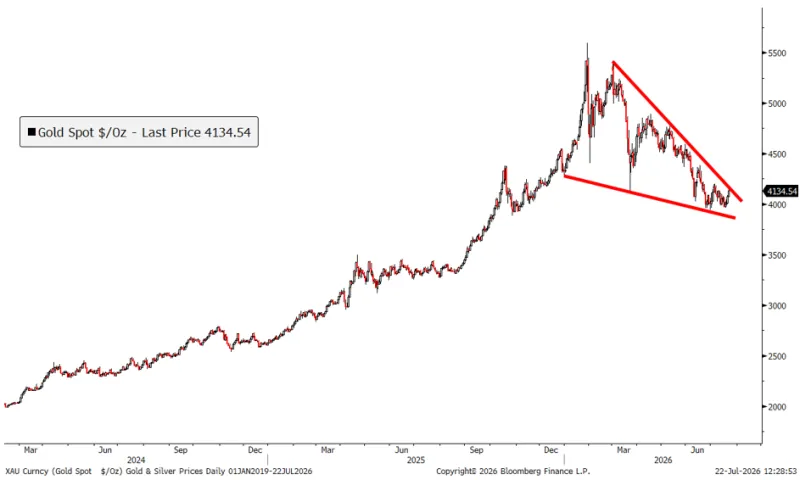
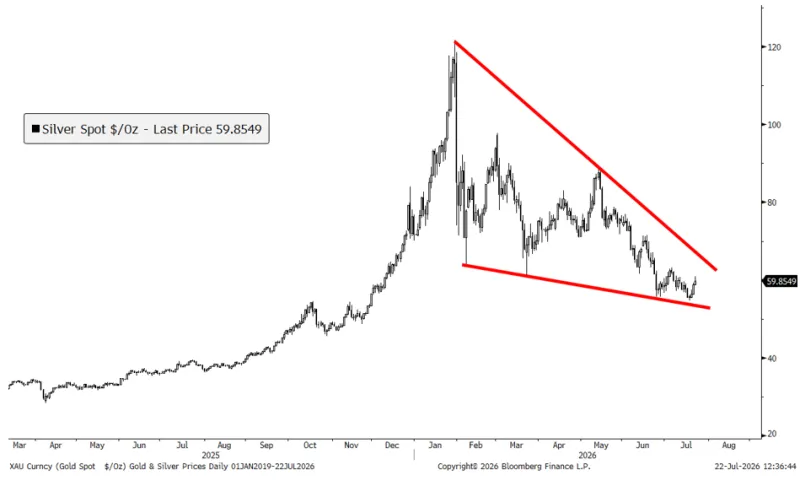
We are looking for another re-entry point into precious metals and are watching the price action closely as there appears to be a bullish wedge formation forming in both gold and silver shown below. A breakout in both would likely indicate that the corrective period in precious metals is over.
Source: Bloomberg
Source: Bloomberg
AI Capital Spending: A Powerful Trend Facing a Financial Test
The third uncertainty concerns the extraordinary AI capital-expenditure cycle.
We remain constructive on the long-term economic potential of artificial intelligence. The issue is not whether AI will continue to be adopted, rather the more immediate investment question is whether the current pace of infrastructure spending and the valuations attached to its principal beneficiaries can be sustained without interruption.
The largest cloud and technology companies have committed enormous sums to data centers, advanced semiconductors, networking equipment, power infrastructure and related construction. Semiconductor manufacturers and other suppliers have received much of this spending, while the hyperscalers (the massive cloud service providers like Amazon (AMZN), Microsoft (MSFT), and Google (GOOGL)) have been writing the checks.
That distinction is increasingly important.
Wall Street research notes the possibility that capital expenditures could consume nearly all of the hyperscalers’ aggregate operating cash flow, requiring greater reliance on debt markets and placing additional pressure on free cash flow. As financing requirements rise, investors are likely to demand clearer evidence that AI investments are producing sufficient incremental revenue and acceptable returns on invested capital.
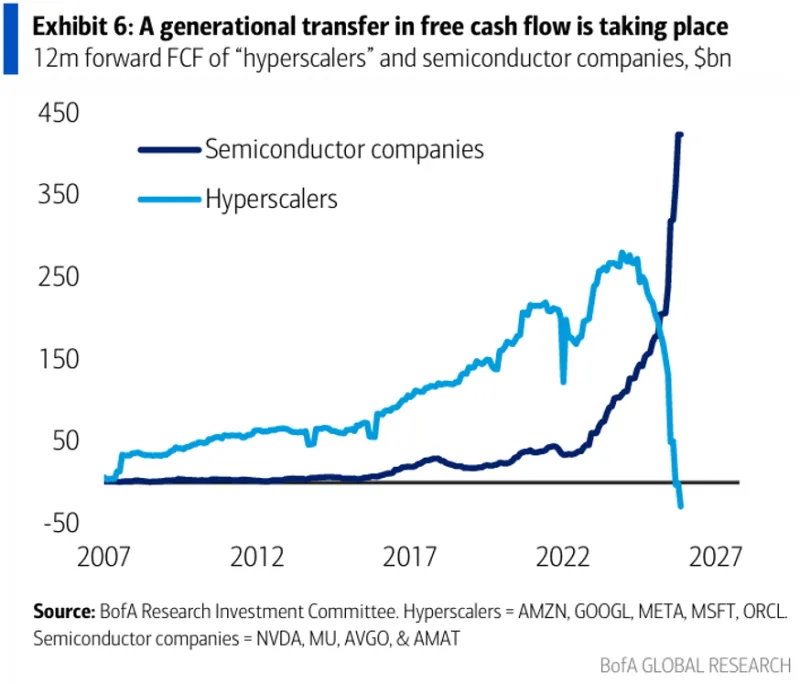
The primary risk is therefore not that AI demand disappears. It is that the spending cycle encounters financial discipline. Shown below is the estimated free cash flow for the five major hyperscalers relative to the free cash flow for the four major semiconductors. Of note is that the hyperscaler cash flow is expected to turn negative over the coming year.
Source: Zerohedge
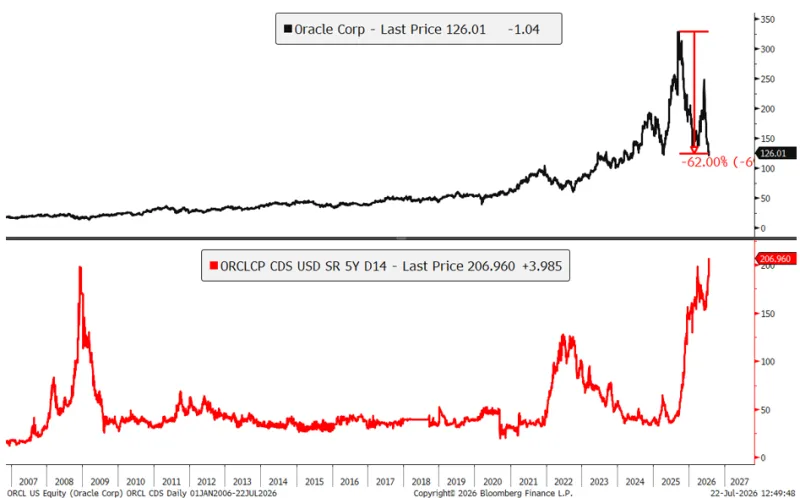
With free cash flow turning negative for the major hyperscalers, it raises questions about how long this situation can continue. Typically, when bond investors start expressing concerns, the stock market tends to react as well. Take the current poster child, Oracle (ORCL). Their stock has fallen 62% from its highs as its credit default swaps—the cost of insuring against default on its debt—has risen to levels higher than the peak of the financial credit crisis in 2008 (red line, bottom panel below).
Source: Bloomberg
If one major hyperscaler announces that it intends to slow the growth of capital expenditures, optimize existing capacity or prioritize free cash flow, its shares could be rewarded by the market as some sanity is restored regarding the health of their balance sheets. That reaction could place pressure on competing management teams and boards to follow a similar path. We describe this as a potential “first to blink” dynamic: once one company is rewarded for capital discipline, others may be encouraged to moderate their own spending plans.
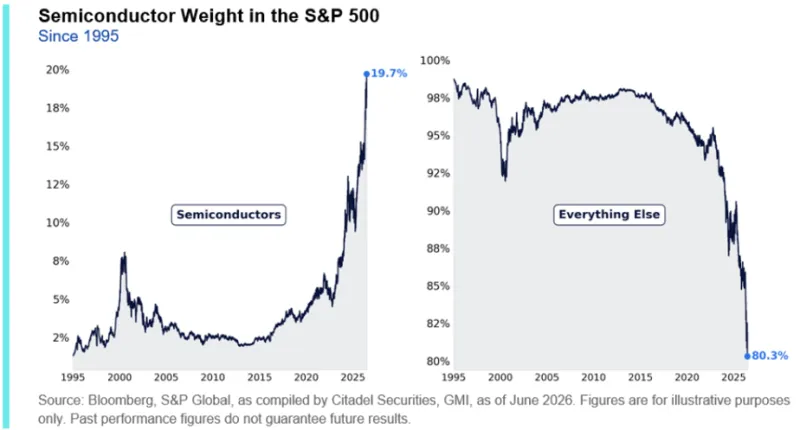
Such a change would be particularly important for semiconductor and hardware companies whose valuations assume a long and largely uninterrupted expansion in AI infrastructure investment. Even if near-term earnings remain strong, a peak in the rate of capex growth could lead investors to assign lower valuation multiples to those earnings. The explosive returns in the semiconductor sector has caused its weight in the S&P 500 to explode to more than double the peak seen at the height of the tech bubble in 2000. Its meteoric rise is reminiscent of past investment bubbles as made clear in the figure below:
Source: Citadel
This is a classic distinction between the level of spending and its rate of change. Capital expenditures do not have to decline outright for AI-related equities to experience a correction. Spending merely needs to grow more slowly than the market currently expects.
Why We Are Maintaining Elevated Cash
Against this backdrop, we believe cash serves an active portfolio-management purpose.
Cash reduces near-term volatility, limits forced selling and provides the ability to respond quickly when securities become attractively priced. It also generates meaningful income at current short-term interest rates, reducing the opportunity cost traditionally associated with defensive positioning.
Our present allocation should not be interpreted as a permanent bearish view. We are waiting for better visibility and more favorable entry points. Those opportunities could emerge from several developments:
A credible and durable reduction in Middle Eastern hostilities.
Greater stability in oil and global shipping conditions.
Clear evidence that inflation is moving sustainably lower.
A more predictable Federal Reserve policy path.
A valuation reset in AI, semiconductor or other growth-oriented investments.
Improved market breadth and more attractive opportunities outside the most crowded trades.
Markets rarely wait until every uncertainty has been resolved. We therefore do not expect to identify a perfect moment at which all risks disappear. Instead, we are looking for an improvement in the balance between prospective return and potential downside.
Conclusion
The investment environment remains defined by unusually consequential crosscurrents. The US-Iran conflict could affect oil supplies and economic growth. Inflation remains too elevated for the Federal Reserve to declare victory, leaving the future direction of interest rates and the dollar uncertain. Meanwhile, the AI investment boom is approaching a point at which shareholders may begin demanding stronger free cash flow and greater capital discipline from the companies funding it.
Any one of these risks could create market volatility. Together, they justify a more measured approach.
For now, we believe maintaining allocations below neutral levels and holding elevated cash is prudent. This positioning preserves capital, earns current income and—most importantly—provides optionality. As the geopolitical, monetary and technology-spending outlook becomes clearer, we intend to put that liquidity to work selectively and decisively when prospective returns more adequately compensate investors for the risks being assumed.

Comments
Log in or sign up to join the conversation.