


Executive Summary
Hormuz Reignites the Inflation Trade: Renewed U.S.-Iran hostilities and attacks on commercial vessels sent crude oil sharply higher, pressuring transportation, housing, materials, and other economically sensitive industries.
AI Survives a Violent Gut Check: Semiconductor stocks experienced sharp reversals, but major investments involving SK Hynix, Apple (AAPL), Broadcom (AVGO), Nvidia (NVDA), AMD, and Meta (META) reinforced confidence in the long-term AI infrastructure cycle.
The Economy Bends but Does Not Break: Services activity and labor-market data remained firm, while housing and consumer-credit figures showed that high interest rates are still restraining rate-sensitive parts of the economy.
Hormuz Reignites Inflation Trade
Geopolitical risk returned as a major market catalyst this week after attacks on commercial ships in the Strait of Hormuz led the United States to reinstate sanctions on Iranian oil sales and launch retaliatory strikes against Iranian targets. President Trump subsequently declared that the interim ceasefire was effectively over, although later comments and reports of additional negotiations helped prevent the confrontation from escalating into a full-scale market panic.
The oil market nevertheless reacted forcefully. West Texas Intermediate crude rose 2.8% on Tuesday to $70.48 per barrel, followed by another 4.3% advance on Wednesday to $73.53. Prices had been more than 6% higher intraday before comments suggesting the conflict could be contained pulled crude back from its peak. Reuters reported that four oil and gas tankers turned away from the Strait of Hormuz following the vessel attacks, illustrating the market’s sensitivity to even a temporary disruption at one of the world’s most important energy chokepoints.
The equity-market impact extended far beyond the energy sector. On Wednesday, energy gained 1.5%, but materials fell 2.5% as companies such as Smurfit Westrock faced concerns about higher production and transportation costs. Consumer discretionary stocks declined 1.6%, while the iShares U.S. Home Construction ETF (ITB) dropped 4.0% as rising oil prices were accompanied by higher Treasury yields. Financials, real estate, airlines, cruise operators, trucking companies, and other cyclical groups also weakened.
The reversal on Thursday demonstrated how quickly the oil trade could move in both directions. WTI declined 1.9% to $72.10 per barrel, contributing to rebounds in Norwegian Cruise Line (NCLH), Tesla (TSLA), trucking companies, small caps, and financial stocks. The Russell 2000 and S&P Mid Cap 400 each gained 1.2%, while the energy sector fell 1.6%. By Friday, crude had retreated to roughly $71 per barrel as reports surfaced that the United States and Iran could resume negotiations in Switzerland.
Investment Implication: Persistent volatility around the Strait of Hormuz could keep energy prices, inflation expectations, transportation margins, and interest-rate-sensitive equities unusually responsive to geopolitical headlines. Oil inventories are at historically low levels, but investors are focused on the Strait.
AI Survives Violent Gut Check
Semiconductor stocks entered the week with a strong rebound, but the recovery quickly encountered a test. On Monday, the PHLX Semiconductor Index advanced 2.2%, supported by a 6.6% gain in Advanced Micro Devices after Goldman Sachs (GS) raised its price target to $640 from $450. Broadcom gained 3.7% after expanding its relationship with Apple through 2031, while technology and communication-services stocks helped push the S&P 500 above 7,500 and the Dow above 53,000.
Sentiment reversed Tuesday after Samsung Electronics (SSNLF) released preliminary second-quarter results. Although Samsung’s operating profit increased more than 1,800% from the prior year, the report triggered profit-taking across a group that had already experienced dramatic gains. The PHLX Semiconductor Index fell 4.7%, with Intel (INTC) and Teradyne (TER) each declining nearly 10%. By Wednesday afternoon, however, buyers returned. Nvidia rose 3.6% following reports that China would permit limited purchases of its H200 processors, while Broadcom advanced 4.8%.
Apple supplied one of the week’s clearest examples of continued AI and semiconductor capital spending. The company agreed to spend more than $30 billion on Broadcom chips under an expanded supply arrangement extending through 2031. The agreement is expected to support production of more than 15 million U.S.-made chips and expand Broadcom’s domestic manufacturing capacity.
The enthusiasm became even more visible in the capital markets. SK Hynix priced 177.9 million American depositary receipts at $149 each, raising approximately $26.5 billion in the largest U.S. listing by a foreign company. The offering was more than seven times oversubscribed, and the shares opened at $170 before finishing their Nasdaq debut approximately 14% higher. SK Hynix occupies a critical position in high-bandwidth memory, a technology used to feed data rapidly into AI accelerators supplied by companies such as Nvidia.
Meta Platforms also contributed to the AI narrative. The company introduced new image-generation capabilities and provided additional details about its AI products, helping its shares rise nearly 6% on Friday. Investors increasingly appear to be evaluating whether Meta’s substantial infrastructure expenditures can generate revenue through improved advertising, new AI services, and the potential sale of excess computing capacity.
Investment Implication: The AI investment cycle remains supported by real spending and strong capital-market demand, but elevated valuations and crowded positioning are likely to produce sharper reactions when earnings or guidance merely meet expectations.
The Economy Bends, Does Not Break
Economic data continued to describe an expansion that is slowing in certain areas without showing broad recessionary deterioration. The June ISM Non-Manufacturing Index registered 54.0%, slightly below the 54.2% consensus and May’s 54.5%, but still comfortably above the 50% threshold associated with expansion. The reading was also 0.9 percentage points above its 12-month average of 53.1%. S&P Global’s final U.S. Services PMI came in at 51.2, confirming continued slow growth across the service economy.
The labor market remained a source of stability. Initial unemployment claims totaled 215,000, below the 220,000 consensus, while continuing claims were 1.814 million. The low level of new claims indicates that employers are still reluctant to reduce headcount aggressively, even as elevated financing costs and economic uncertainty restrain hiring in some industries.
The more interest-rate-sensitive data were less encouraging. Existing-home sales declined to an annualized rate of 4.09 million in June, below expectations of 4.20 million and the prior month’s revised 4.19 million. Mortgage applications fell 2.2%, reflecting the continuing effect of elevated borrowing costs. Affordability improved modestly as wage growth exceeded home-price growth across all four regions, but high prices and mortgage rates continued to limit transaction volume.
Consumer credit provided another cautionary signal. Total credit declined by $200 million in May, compared with expectations for an $18.9 billion increase. Revolving credit, which includes credit-card balances, fell by $5.3 billion, while nonrevolving credit rose by $5.1 billion. The decline could reflect more cautious borrowing by households or tighter lending standards after years of higher prices and financing costs.
Treasury yields reflected this mixed backdrop. The two-year yield rose to 4.20% and the 10-year yield reached 4.57% on Wednesday as oil prices climbed and investors reassessed inflation risk. Yields subsequently eased to 4.16% and 4.54%, respectively, following a strong 30-year Treasury auction and the retreat in crude. The June Federal Reserve minutes reinforced a data-dependent approach, with policymakers still attentive to persistent inflation pressures and geopolitical uncertainty.
Corporate results offered similar evidence of economic resilience with important qualifications. Delta Air Lines (DAL) reported adjusted second-quarter revenue of $17.67 billion and adjusted earnings of $1.56 per share, both ahead of expectations. Premium-cabin revenue increased 17%, but higher fuel costs pushed quarterly net income down to $1.6 billion from $2.13 billion a year earlier. Delta projected third-quarter earnings of $2.00 to $2.50 per share and revenue growth in the mid-teens, suggesting that higher-income travel demand remains firm even as operating costs increase.
Investment Implication: Continued services expansion and low layoffs support the economic outlook, but weak housing activity, softer consumer borrowing, and volatile energy costs could sustain wide performance differences among industries and individual companies.
Chart of the Week
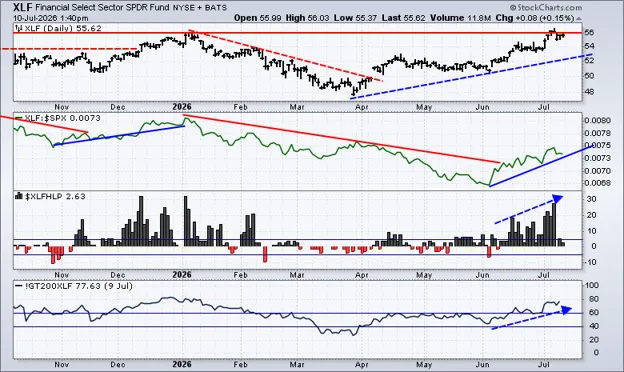
The Financial Select Sector SPDR Fund (XLF) is testing major resistance near $56, the area of its prior late-2025 and early-2026 highs. XLF has advanced strongly from its April low near $48 and remains above a rising trendline, keeping the intermediate-term structure constructive. A sustained breakout above $56 would confirm a new high and strengthen the bullish trend, while failure at this level could lead to a pullback toward initial support near $54 and stronger trendline support around $52.
Relative strength is also improving, with the XLF-to-S&P 500 ratio breaking above its prior downtrend and forming higher lows since June. Momentum remains positive and confirms the recent advance with new highs, although the elevated reading suggests the sector may be somewhat extended in the near term. Overall, the chart is bullish, but confirmation depends on XLF decisively clearing the $56 resistance area. I picked up two financial stocks for my clients in May and June as a result.
Bottom Line
Markets navigated an unusually broad set of crosscurrents this week. Renewed conflict with Iran reintroduced the possibility of an energy-driven inflation shock, semiconductor volatility tested enthusiasm for the AI trade, and economic data showed an economy that remains resilient but increasingly uneven. Despite large swings beneath the surface, the major averages held near record levels as weakness in one area was repeatedly offset by strength elsewhere.
The next phase will depend heavily on whether oil prices stabilize, whether semiconductor earnings justify elevated expectations, and whether inflation data permit Treasury yields to retreat. With earnings season beginning, investors will receive more direct evidence about how higher energy costs, interest rates, AI capital spending, and uneven consumer demand are affecting corporate revenue and profit margins.



Comments
Log in or sign up to join the conversation.