


Executive Summary
Peace Dividend Ignites Risk Appetite: A surprise U.S.-Iran peace framework sent oil prices sharply lower, easing inflation fears and fueling a powerful rally in technology, consumer discretionary, airlines, and other economically sensitive sectors.
Warsh Resets the Fed Narrative: The Federal Reserve held rates steady, but new Chair Kevin Warsh delivered a distinctly hawkish message that pushed Treasury yields higher and forced investors to reassess expectations for future rate cuts.
AI Arms Race Accelerates: Semiconductor, infrastructure, and AI-related companies remained at the center of market leadership as investors focused on growing demand for chips, memory, networking equipment, and data center capacity.
Peace Dividend Ignites Risk Appetite
Markets began the holiday-shortened week with a dramatic shift in investor sentiment after President Trump announced a memorandum of understanding with Iran aimed at ending hostilities, reopening the Strait of Hormuz, and restoring normal shipping flows through one of the world's most important energy corridors.
The immediate market reaction was swift. WTI crude oil fell from roughly $85 per barrel to near $76 by Tuesday, including a 4.7% decline Monday and another 6.0% drop Tuesday. The retreat removed one of the market's biggest concerns: the risk that higher energy prices would reignite inflation and weaken consumer spending.
Investors quickly rotated into sectors that benefit from lower fuel costs and improved economic confidence. Airlines, cruise operators, travel companies, homebuilders, and consumer discretionary stocks all attracted buyers. DoorDash (DASH) surged 11.6% Monday, while cruise lines and travel-related names broadly outperformed throughout the week.
Financial stocks also benefited from the improving backdrop. The financial sector gained 1.5% Tuesday as lower oil prices reduced concerns about economic growth. JPMorgan (JPM) rose 3.7% after reports that it, alongside Morgan Stanley (MS), would help lead a potential $2 billion IPO of Axyv, the missile business being spun out by L3Harris (LHX).
Perhaps most notable was the market's renewed enthusiasm for large-cap technology. After suffering volatility the prior week, investors quickly returned to many of the market's biggest winners. NVIDIA (NVDA) gained 3.5% Monday and reclaimed its 50-day moving average. Memory-chip manufacturers delivered some of the week's strongest moves, with Western Digital (WDC) soaring 16.1%, Micron (MU) advancing 10.8%, and Seagate (STX) climbing 9.4%.
The relief rally extended well beyond traditional technology stocks. Meta Platforms (META) rose 4.7%, Amazon (AMZN) gained 3.2%, and the Vanguard Mega Cap Growth ETF (MGK) advanced 2.8% Monday alone.
Meanwhile, the energy sector became the week's biggest casualty. The sector fell 3.6% Monday as investors adjusted expectations for oil prices and energy company profitability in a less volatile geopolitical environment.
Investment Implication: The week's sharp decline in oil prices reinforced how sensitive market leadership remains to inflation expectations, with lower energy costs quickly improving the outlook for economically sensitive sectors while reducing support for traditional energy stocks.
Warsh Resets the Fed Narrative
The market’s biggest macroeconomic event arrived Wednesday when the Federal Reserve concluded its June meeting—the first chaired by Kevin Warsh.
As expected, policymakers left the federal funds target range unchanged at 3.50% to 3.75%, with no apparent dissents. However, the bigger surprise came from the Fed’s updated “dot plot,” which showed a more hawkish tilt than investors expected. The Committee was split 9-9 between officials expecting steady rates or one cut and those expecting at least one hike, with the median projection pointing to a quarter-point increase later this year.
CNBC noted that Warsh did not submit his own dot, consistent with his long-standing criticism of forward guidance and the current structure of the Summary of Economic Projections. That decision reinforced the sense that the Fed is entering a new communications regime under Warsh, one less focused on guiding markets far into the future and more focused on preserving policy flexibility.
That shift was visible in the Fed’s post-meeting statement, which CNBC reported was only 130 words, far shorter than the 300-plus-word statements investors had grown accustomed to parsing under prior leadership. The message was brief, direct, and centered on price stability.
Warsh also announced the formation of five internal task forces focused on Fed communications, the balance sheet, data sources, productivity and jobs, artificial intelligence and other transformative technologies, and the central bank’s inflation framework. That suggests his leadership may bring not just a change in tone, but a broader institutional review of how the Fed analyzes the economy and communicates policy.
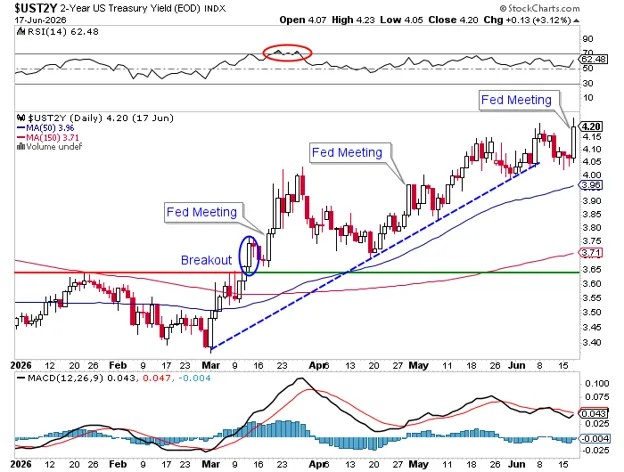
The market’s reaction was swift. CNBC highlighted that Warsh used the phrase “price stability” roughly a dozen times, emphasizing the Committee’s “unambiguous and unanimous” resolve to bring inflation under control. Treasury yields moved sharply higher, with the policy-sensitive 2-year Treasury yield jumping more than 14 basis points as investors reassessed the likelihood of rate cuts.
Equities sold off in response. The S&P 500 fell 1.2%, the Nasdaq Composite dropped 1.3%, and the Dow Jones Industrial Average declined 1.0% after reaching a record intraday high earlier in the session. Rate-sensitive areas of the market absorbed much of the damage, with real estate stocks falling 2.5% and Carvana (CVNA) dropping more than 10%. Homebuilders also came under pressure as higher yields weighed on sentiment toward housing-related businesses.
The economic data released throughout the week presented a mixed but generally resilient picture. Retail sales increased 0.9% in May, well above the 0.5% consensus forecast. Excluding automobiles, sales rose 0.8%. Initial jobless claims came in at 226,000, matching expectations and indicating layoffs remain relatively subdued. Housing data was weaker, with housing starts falling to an annualized pace of 1.177 million, well below expectations of 1.440 million, driven by a 40.2% month-over-month plunge in multi-family starts.
Investment Implication: The Fed’s message shifted from possible easing to renewed inflation discipline, making interest-rate expectations a key driver for housing, real estate, financials, and other rate-sensitive areas of the market.
AI Arms Race Accelerates
While investors spent much of the week focused on geopolitics and monetary policy, the artificial intelligence theme continued to dominate corporate headlines and market leadership.
Semiconductor stocks remained the focal point. The PHLX Semiconductor Index surged 5.5% Monday, gave back those gains Tuesday, and then rebounded strongly later in the week, including a 6.2% rally Thursday.
The underlying story remains unchanged: demand for AI infrastructure continues to outpace supply.
Micron received one of the week's most notable analyst upgrades when Cowen raised its price target to $1,500 from $660, citing expectations that growing demand for AI-related computing workloads will support elevated memory pricing into the second half of 2027.
Broadcom (AVGO) received support from JPMorgan, which described itself as an "aggressive buyer" following recent weakness and pushed back against concerns surrounding Google (GOOGL)'s next-generation TPU deployment.
The infrastructure side of the AI story continued gaining momentum as well. Citi (C) raised price targets on semiconductor equipment leaders Applied Materials (AMAT), Lam Research (LRCX), and KLA (KLAC), citing expectations that wafer-fabrication-equipment spending could reach $250 billion by 2028.
Intel (INTC) emerged as one of the week's biggest winners. Shares jumped more than 10% Thursday after President Trump announced that Apple (AAPL) would partner with Intel to design and manufacture chips in the United States. The company also announced production of its advanced 18A-P manufacturing process, which management says offers 9% higher performance or 18% lower power consumption than the prior generation.
Amazon also generated attention after reports surfaced that it may begin selling its Trainium AI chips to external data-center operators, potentially creating a new challenger to NVIDIA's dominance in AI accelerators.
Beyond semiconductors, investors continued rewarding companies positioned to benefit from AI infrastructure spending. CoreWeave gained nearly 10% Tuesday after highlighting benchmark-leading AI training performance. GE Vernova (GEV) climbed 6.8% Wednesday, while Vertiv (VRT) rose 6.0%, underscoring investor enthusiasm for power generation, electrical equipment, and data-center infrastructure.
Even steelmaker Nucor (NUE) joined the AI narrative after issuing second-quarter earnings guidance of $4.50-$4.60 per share, well above consensus expectations of $4.21. Management cited strength tied to manufacturing reshoring and large-scale infrastructure projects, both of which are increasingly linked to AI-related investment.
Investment Implication: Investor attention continues to broaden beyond AI chip designers toward the full ecosystem of memory, networking, power generation, manufacturing equipment, data centers, and infrastructure providers supporting the next phase of AI deployment.
Chart of the Week
The 2-year Treasury Yield hit fresh year-to-date highs on Wednesday after the FOMC meeting. The 2-year Treasury yield closely follows expectations for Fed policy. The rising rates since March indicate the concern over oil prices and inflation. Rising 2-year yields can pressure growth stocks and other rate-sensitive sectors such as housing and real estate while supporting financial stocks. For bonds, higher yields improve short-term income opportunities but can weigh on bond prices. For commodities, elevated rates tend to strengthen the dollar and tighten financial conditions, which can create a headwind for commodity prices if sustained.
Bottom Line
This week highlighted the three forces currently shaping financial markets: geopolitics, monetary policy, and artificial intelligence. The sharp decline in oil prices provided an immediate boost to growth expectations and consumer-sensitive sectors, while the Federal Reserve reminded investors that inflation remains its primary concern despite improving energy prices. At the same time, the AI investment cycle continued to expand beyond semiconductors into infrastructure, manufacturing, power, and data-center beneficiaries. As the market heads into the second half of the year, investors are increasingly balancing optimism about economic resilience and AI-driven growth against the reality of a Federal Reserve that appears prepared to keep policy restrictive for longer than previously expected.



Comments
Log in or sign up to join the conversation.