


Executive Summary
Nvidia (NVDA) Delivers Again – Big Whoop? NVIDIA once again delivered a blowout quarter, but investors increasingly questioned whether even exceptional results can justify extreme valuations across semiconductors and AI infrastructure.
Sensitive to Oil, Sensitive to Rates – Geopolitics were driving violent swings in oil prices, Treasury yields, airlines, homebuilders, and energy stocks as investors attempted to price the probability of escalation versus a negotiated settlement.
Inflation Getting Harder to Ignore – Weakening consumer sentiment and soft manufacturing surveys collide against stubbornly high yields, rising inflation expectations, and a Federal Reserve increasingly hesitant to ease policy.
The market spent the week caught between optimism surrounding artificial intelligence spending and growing anxiety surrounding oil prices, inflation, and interest rates. Investors repeatedly rotated between risk-on and defensive positioning as earnings, geopolitical developments, and economic releases collided in unusually rapid fashion.
Nvidia Delivers Again – Big Whoop?
This week’s earnings calendar revolved around a single company: NVIDIA. The market entered the week fixated on whether the company could once again exceed towering expectations that have fueled one of the most concentrated rallies in modern market history.
By Monday, investors were already positioning around the report. Semiconductor stocks weakened sharply early in the week as traders reduced exposure ahead of earnings, with the PHLX Semiconductor Index falling 2.5% Monday amid broader pressure across AI infrastructure names. Concerns intensified after comments from Seagate Technology (STX)’s CEO suggested memory capacity expansion may struggle to keep pace with exploding AI demand, adding another layer of uncertainty to a market already questioning sustainability across the AI buildout cycle.
The nervousness surrounding AI spending became increasingly visible across Wall Street research notes throughout the week. Analysts debated whether enterprise software companies could survive the rise of agentic AI, while firms like Salesforce (CRM) faced fresh skepticism regarding monetization pathways and customer growth durability. Meanwhile, cybersecurity firms such as CrowdStrike (CRWD) and Palo Alto Networks (PANW) benefited from growing concerns that increasingly sophisticated AI systems are simultaneously creating new attack surfaces and driving additional corporate security spending.
Wednesday’s session reflected growing optimism heading into Nvidia’s report. Semiconductor stocks surged, with Advanced Micro Devices (AMD) climbing more than 8% and Intel (INTC) jumping over 7% as traders aggressively bought recent weakness. Investors increasingly viewed Nvidia’s earnings as a referendum not only on AI chips, but on the broader capital spending cycle supporting hyperscalers, data centers, optics, networking infrastructure, and power generation.
When Nvidia finally reported Thursday, the numbers were once again exceptional. The company delivered another massive beat-and-raise quarter, authorized an additional $80 billion stock buyback program, and continued to showcase extraordinary revenue growth tied to AI demand. Yet the stock traded lower following the release.
That muted reaction may have been the most important development of all.
The issue was not the quality of Nvidia’s quarter. The issue was that expectations had become nearly impossible to exceed after an extended AI-driven rally pushed shares toward record highs. Investors increasingly appear to be asking whether AI infrastructure spending can continue accelerating at its current pace indefinitely, especially as companies like Alphabet (GOOGL) and Amazon (AMZN) push further into internally developed custom chips.
The week also reinforced how AI spending is spreading well beyond semiconductors. IBM (IBM) surged after announcing plans to build America’s first purpose-built quantum foundry with support from a proposed $1 billion CHIPS award, while utility consolidation accelerated as NextEra Energy (NEE) moved to acquire Dominion Energy (D) in a deal aimed partly at supporting future AI-driven electricity demand.
Even software stocks began showing signs of stabilization late in the week. Workday (WDAY), Zoom Communications (ZM), and other enterprise software firms rallied after earnings as investors cautiously explored areas outside semiconductors that may benefit from AI adoption without carrying the same valuation intensity.
Investment implication: This week suggested the market may be transitioning from indiscriminate AI enthusiasm toward a more selective phase where investors increasingly differentiate between sustainable long-term monetization winners and companies merely benefiting from short-term AI spending momentum.
Sensitive to Oil, Sensitive to Rates
Geopolitical developments involving Iran drove nearly every major macro move this week, repeatedly sending oil prices, Treasury yields, and equity sectors violently higher and lower intraday.
Markets opened the week reacting to conflicting headlines surrounding U.S.-Iran negotiations. Crude oil initially surged Monday before reversing sharply after President Trump indicated planned military strikes had been postponed while negotiations continued. That pattern repeated itself throughout the week: any sign of diplomacy pressured oil lower, while any indication negotiations were deteriorating immediately reignited inflation fears and pushed yields higher.
By Tuesday, traders increasingly recognized an uncomfortable reality: oil prices were reacting asymmetrically. Crude fell only modestly on peace headlines but rallied aggressively whenever geopolitical tensions resurfaced. That dynamic helped keep WTI crude hovering near or above $100 per barrel for much of the week and reinforced fears that persistent energy inflation could destabilize the Federal Reserve’s expected easing path.
Midweek brought more swings. On Wednesday, Trump's comments about being in the "final stages" of talks triggered a sharp $5.96 decline in crude to $98.19, alongside a ten-basis-point drop in the 10-year yield to 4.57%. This relief fueled gains in rate- and oil-sensitive names like cruise lines Norwegian Cruise Line (NCLH) and Carnival (CCL), homebuilders Lennar (LEN) and D.R. Horton (DHI), and airlines United (UAL) and Delta (DAL). Thursday saw renewed tension after a Reuters report on Iran's enriched uranium stance, only for Middle Eastern sources to later signal a possible imminent peace agreement draft, sending oil and yields lower again. By week's end, oil stabilized around the mid-$90s amid lingering uncertainty. Wednesday’s trading was a good look at what could happen in the markets if a more agreeable resolution is found between the U.S. and Iran.
But the optimism proved fragile.
Thursday brought another reversal after reports emerged that Iran’s Supreme Leader insisted enriched uranium remain inside the country. Oil prices and yields immediately jumped again before partially retracing after rumors surfaced of a potential mediated agreement. The repeated whipsaw action demonstrated how dependent market stability has become on geopolitical developments rather than purely economic fundamentals.
Energy dynamics also continued reshaping sector leadership beneath the surface. Natural gas producers gained fresh support, utilities positioned themselves for AI-related electricity demand growth, and investors increasingly revisited traditional energy infrastructure plays that had been largely ignored during the earlier phases of the AI rally.
Meanwhile, companies directly exposed to consumer fuel costs increasingly showed signs of strain. Walmart (WMT) specifically cited pressure at the pump as a headwind to consumer behavior, while retailers increasingly emphasized value-oriented spending patterns.
Investment implication: Geopolitical headlines continue influencing inflation expectations, interest-rate policy assumptions, sector leadership, and overall equity market valuation frameworks.
Inflation Getting Harder to Ignore
While earnings and geopolitics dominated daily market action, economic data quietly reinforced a more difficult backdrop for policymakers.
The week’s data painted a mixed but increasingly uncomfortable picture. Housing data showed resilience on the surface, with housing starts and permits beating expectations. However, underlying commentary pointed toward broad-based weakness across single-family activity as builders continue grappling with higher financing, labor, and material costs.
Labor market data remained stable, with weekly jobless claims showing little evidence of significant deterioration. Yet manufacturing signals weakened considerably. The May Philadelphia Fed Index unexpectedly collapsed into contraction territory at -0.4 versus expectations for 15.5, highlighting softness across industrial activity even as inflation pressures remained elevated.
Perhaps most concerning was the University of Michigan Consumer Sentiment Index, which fell to a historic low reading of 44.8. Consumers increasingly expressed anxiety surrounding rising living costs and their ability to keep pace with inflation, especially as energy prices climbed again.
At the same time, bond markets continued sending warning signals. The 30-year Treasury yield climbed to levels not seen since before the financial crisis, while the 10-year yield repeatedly approached territory that equity markets increasingly struggled to tolerate.
The April FOMC minutes reinforced the growing uncertainty inside the Federal Reserve itself. Policymakers appeared divided regarding the future rate path, with inflation risks increasingly complicating the market’s expectation for eventual easing. By Friday, market pressures persisted, with yields climbing due to comments from Fed Chair Kevin Warsh pushed probabilities of an October rate hike above 50% per CME FedWatch.
This tension created one of the market’s biggest contradictions of the week: stocks repeatedly rallied despite higher yields, particularly within AI-related leadership. Historically, sharply rising yields place meaningful pressure on long-duration growth assets because future earnings become less valuable when discounted at higher interest rates. Yet investors continued buying select technology leaders anyway, reflecting how powerful AI-related momentum remains despite mounting macro headwinds.
Investment implication: Markets are increasingly confronting a difficult environment where slowing economic momentum, persistent inflation pressures, rising energy costs, and elevated Treasury yields may challenge the assumption that monetary policy easing will arrive quickly or smoothly.
Charts of the Week
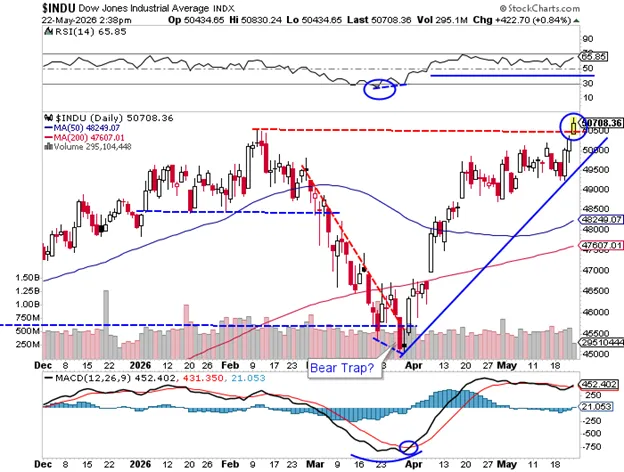
The Dow Jones Industrial Average staged a powerful rally this week on Wednesday and broke to new all-time highs Friday. Breakouts need a move of 1-3% past these points to be legitimate and they need to hold. A whipsaw back below 50,500 would be a bearish sign for stocks
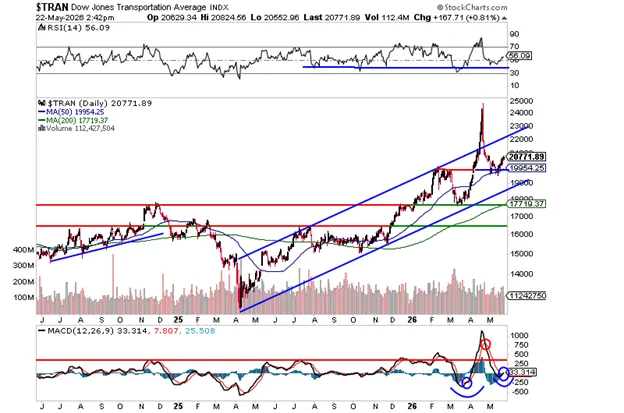
New highs should be confirmed by the Transport Index, but due to the wild rally in April, I think we’re far away from that possibility. A final resolution to the Iran conflict and a 10-20% drop in oil prices would help.
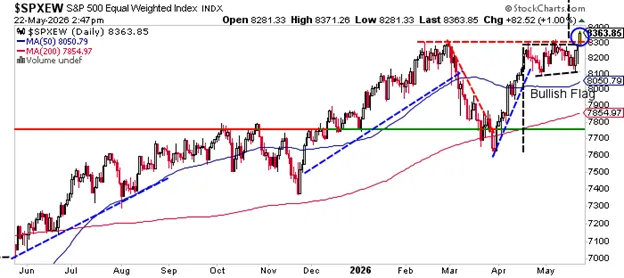
Additionally, the equal-weighted S&P 500 broke to new all-time highs Friday and broke resistance. What’s more, there’s a bullish flag development that points towards a move to 9000 for the index from 8300, approximately a 8.5% move higher as a target of the pattern. That’s a sign that the rally is broadening and not just in large-cap tech names benefiting from AI spending. I attribute the move on hopes for a sustainable resolution to the U.S. and Iran conflict.
Bottom Line
This week highlighted a market still heavily dependent on two forces: AI enthusiasm and geopolitical stability. NVIDIA’s earnings confirmed that AI spending remains extraordinarily strong, but the stock’s muted reaction showed investors are beginning to demand more than just “beat and raise” quarters from the market’s biggest winners. Expectations across semiconductors and AI infrastructure have become so elevated that even exceptional results may only sustain leadership rather than extend it.
At the same time, the market’s sensitivity to oil prices and Treasury yields remains a major concern. Every headline surrounding Iran negotiations triggered violent swings across equities, bonds, airlines, homebuilders, and energy stocks, reinforcing how fragile investor confidence becomes when inflation risks reaccelerate. The broader market appears increasingly caught between slowing economic momentum and stubborn inflation pressures, which complicates the Federal Reserve’s path forward just as rate expectations begin shifting higher again.
Still, there were constructive developments beneath the surface this week. The equal-weighted S&P 500 breaking to new highs alongside improving participation outside mega-cap technology suggests broadening market leadership may finally be developing. If oil prices stabilize and Treasury yields stop climbing aggressively, rotational opportunities across software, industrials, financials, and cyclical sectors could continue expanding beyond the narrow AI trade that has dominated market leadership over the past year.



Comments
Log in or sign up to join the conversation.