


Executive Summary
AI Ups and Downs: Investors rotated beyond Nvidia into networking, optics, servers, software, and infrastructure providers only to correct hard on Friday due to rising yields and profit-taking.
Oil Roars Back: Crude oil surged above $96 per barrel as U.S.-Iran tensions intensified, fueling inflation concerns and creating winners and losers across sectors.
Strong Data – Delayed Easing: Strong employment, manufacturing, and services data pushed Treasury yields higher and reduced expectations for near-term rate cuts, pressuring growth stocks late in the week.
AI Ups and Downs
For much of the past two years, artificial intelligence has largely been a semiconductor story. This week marked another important shift as investors broadened their focus from chipmakers to the companies supplying the infrastructure necessary to support the next phase of AI deployment.
The catalyst came early in the week at Computex, where NVIDIA unveiled its first-ever PC processor built on Arm architecture and announced a partnership with Microsoft focused on AI-enabled personal computing. The move represents Nvidia's most direct challenge yet to Intel and AMD in the PC market while reinforcing the growing importance of Arm-based computing architectures.
Nvidia CEO Jensen Huang continued to reinforce a theme that has become central to the AI investment case: compute equals revenue. Rather than focusing solely on chip costs, Huang argued that the ability to generate profitable AI tokens per watt of power consumed is becoming the primary metric for data center economics. That message helped ignite buying across multiple AI-related industries.
Some of the week's biggest winners reflected this broader infrastructure story. Marvell surged more than 30% Tuesday after Huang called the company the potential "next trillion-dollar company." Optical networking firms Coherent and Lumentum rallied sharply as investors embraced the growing need for faster data movement inside AI data centers. Corning also posted double-digit gains as demand expectations increased for fiber and optical connectivity.
Enterprise infrastructure spending provided another major boost. Hewlett Packard Enterprise delivered a blowout quarter, with shares jumping nearly 20% after management highlighted robust demand for AI servers and enterprise modernization projects. Dell continued its rally after analysts raised price targets following its own strong earnings report and improving supply-chain outlook.
The week also showcased the enormous capital requirements associated with the AI race. Alphabet surprised investors by announcing an $80 billion equity offering to fund AI infrastructure expansion. The stock initially sold off on dilution concerns, but the announcement reinforced just how aggressively major technology companies are investing to compete against OpenAI, Anthropic, and other emerging AI challengers.
Yet by Thursday and Friday, cracks began appearing. Broadcom fell more than 12% despite strong results as investors concluded expectations had simply become too high. Semiconductor stocks sold off aggressively, with AMD and Micron each falling roughly 10% Friday alone. The PHLX Semiconductor Index dropped nearly 8% on Friday as profit-taking accelerated.
Investment Implication: Leadership within the AI ecosystem continues to broaden beyond semiconductors. Additionally, the reaction to Broadcom’s earnings and rising rates also highlights how overextended expectations and valuations have become as of late in the AI space and a correction may be here.
Oil Roars Back
Just as investors appeared comfortable with moderating inflation trends, energy markets delivered a reminder that geopolitical risks remain capable of altering the economic outlook quickly.
Crude oil prices surged throughout the week as tensions between the United States, Iran, and Israel intensified. On Monday, reports that Iran had halted communications with the United States helped send West Texas Intermediate crude up 5.5% to $92.19 per barrel. By Wednesday, oil had climbed to $96.08 per barrel amid renewed reports of military strikes and uncertainty surrounding diplomatic negotiations.
The market reaction reflected growing concern about potential disruptions to global energy supplies. Investors remain highly sensitive to developments involving Iran because of the country's strategic position within global energy markets and the importance of regional shipping routes.
Energy stocks responded accordingly. The energy sector was among the market's strongest performers on Monday, Tuesday, and Wednesday as rising oil prices boosted earnings expectations for producers and service companies. Meanwhile, higher energy prices created headwinds for several consumer-oriented industries. Dollar General's earnings commentary illustrated this challenge, with management specifically noting that rising gasoline costs were reducing discretionary spending among lower-income consumers.
The impact extended beyond consumer spending. Rising oil prices also contributed to higher Treasury yields as investors reassessed inflation risks.
Notably, the market's leadership rotated throughout the week as investors balanced energy-driven inflation concerns against AI-driven growth optimism. Defensive sectors such as healthcare, consumer staples, and utilities attracted increased buying interest whenever oil prices spiked and Treasury yields moved higher.
Investment Implication: Sustained strength in oil prices could complicate the inflation outlook and create further rotation away from highly valued growth sectors toward industries that benefit from or are insulated from rising energy costs.
Strong Data – Delayed Easing
The economic story this week was straightforward: the U.S. economy continues to show resilience, but that resilience may delay the Federal Reserve's path toward easier monetary policy.
Several economic reports exceeded expectations. The ISM Manufacturing Index rose to 54.0 versus expectations of 53.1, while the ISM Services Index climbed to 54.5 versus consensus estimates of 53.6. Factory orders increased 4.8% compared with expectations of 3.5%, and JOLTS job openings jumped to 7.62 million from 6.89 million previously.
The week's most important report arrived Friday. Nonfarm payrolls increased by 172,000 in May, easily surpassing expectations for 96,000 jobs. Previous payroll figures were revised sharply higher as well. Average hourly earnings increased 0.3%, while unemployment remained at 4.3%.
Markets interpreted the data as evidence that the economy remains stronger than expected. Treasury yields rose sharply, with the 10-year Treasury reaching approximately 4.53%, its highest level in several weeks. Futures markets quickly adjusted expectations for monetary policy, with traders increasing the probability of another Federal Reserve rate hike later this year.
The resulting selloff was particularly severe among the market's highest-multiple growth stocks. Software, semiconductors, and mega-cap technology companies all came under pressure as investors reassessed valuations under a potentially higher-for-longer interest-rate environment.
Importantly, not all aspects of the economic data were uniformly strong. Real average hourly earnings remain negative year-over-year, long-term unemployment increased, and job losses occurred in financial services, information technology, and retail. Those details suggest that while growth remains positive, underlying conditions may not be as robust as headline payroll numbers imply.
Investment Implication: As economic data continues to exceed expectations, Treasury yields may remain a significant source of volatility for growth-oriented sectors whose valuations have become increasingly sensitive to changes in interest-rate expectations.
Chart of the Week
The Nasdaq Composite Index was overextended running into this week with a new price high and lower momentum readings through the RSI indicator – which is a warning of waning momentum. Given the largely uninterrupted run since the March lows, it’s possible that technology stocks have some mean reversion. Two tools that can help identify possible support levels are Fibonacci retracement levels for the advance as well as rising moving averages.
Fibonacci retracement levels show possible support targets are near the 38.2%, 50%, and 61.8% retracement of the March to June run. A bullish retracement would be a stop at the 38.2% level near 24,688. When something corrects towards the 61.8% retracement level, it often can signal a complete retest – which would test the March low. The 50-day moving average at 24,780 as of today and the 200-day moving average below are some additional support levels to watch.
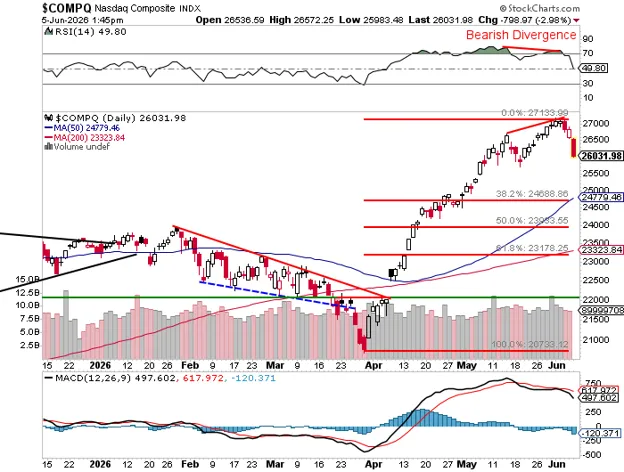
Source: StockCharts, Ryan Puplava, CMT® CTS™ CES™
Bottom Line
This week's market action revealed a tug-of-war between powerful AI-driven growth trends and emerging macroeconomic headwinds. The AI infrastructure boom continues to expand into new areas of the economy, but rising oil prices and stronger-than-expected economic data reminded investors that valuations ultimately remain sensitive to inflation and interest rates. With technology leadership showing signs of fatigue after an extended run and economic resilience keeping yields elevated, the next phase of the market may depend less on enthusiasm and more on whether earnings growth can continue to justify increasingly demanding expectations.



Comments
Log in or sign up to join the conversation.