


Executive Summary
AI’s Reality Check: Semiconductor stocks suffered another violent reversal despite strong results from Taiwan Semiconductor Manufacturing (TSM) and continued evidence of robust demand for computing infrastructure.
Earnings Draw the Line: Goldman Sachs (GS), Abbott Laboratories (ABT), UnitedHealth Group (UNH) and several other companies delivered strong results, but uneven stock reactions showed that investors were placing greater emphasis on guidance, margins and earnings quality.
Oil Bites Back: Renewed fighting between the United States and Iran pushed crude oil and refining margins sharply higher, threatening to reverse some of the improvement reported in June’s inflation data.
AI’s Reality Check
The artificial-intelligence trade remained the market’s biggest source of volatility, but this week’s selling increasingly resembled a reassessment of price and positioning rather than a collapse in underlying demand. The PHLX Semiconductor Index fell 4.8% Monday, rebounded 2.5% Tuesday, declined 2.1% Wednesday and dropped another 4.3% Thursday. Memory-related companies were hit especially hard, with Micron (MU), Sandisk, Seagate Technology (STX) and SK Hynix (HXSCL) frequently among the market’s largest decliners. The semiconductor benchmark entered Friday down more than 13% since the beginning of July.
Fundamental results remained impressive. Taiwan Semiconductor Manufacturing reported that second-quarter profit increased 77% from a year earlier, marking its fifth consecutive quarter of record earnings. Nevertheless, its shares came under sell-the-news pressure as investors focused on elevated capital spending and questioned how much future AI growth was already reflected in semiconductor valuations. The disconnect between operating results and stock performance demonstrated that even exceptional earnings may not be enough when expectations and investor positioning are equally exceptional.
Competition also became a larger part of the AI debate. Chinese companies continued developing lower-cost models and proprietary processors designed to reduce their dependence on Nvidia (NVDA) and other U.S. suppliers. Moonshot AI’s introduction of its Kimi K3 model renewed concerns that increasingly capable and inexpensive AI systems could eventually alter the level or composition of data-center spending. At the same time, Apple (AAPL) announced plans to spend more than $30 billion under an expanded chip-supply agreement with Broadcom (AVGO) through 2031, illustrating that semiconductor demand extends beyond AI accelerators into connectivity, consumer devices and domestic manufacturing.
The selling also highlighted the unusual concentration of the major indexes. On Monday, the capitalization-weighted S&P 500 fell 0.8%, while the equal-weighted index declined only 0.1%. A similar divergence appeared Thursday, when the equal-weighted S&P 500 rose 1.0% even though the standard index fell 0.5%. Weakness in a relatively small group of large technology companies therefore obscured much healthier performance across several other sectors.
Investment implication: Semiconductor leadership may increasingly depend on valuation discipline, competitive advantages and demonstrated returns on capital rather than broad exposure to the artificial-intelligence theme.
Earnings Draw the Line
Second-quarter earnings showed that investors were not broadly abandoning risk. Instead, they were distinguishing between companies delivering strong operating momentum and those facing weaker guidance, margin pressure or changing customer spending priorities.
Goldman Sachs produced one of the week’s strongest reports. The company generated second-quarter net revenue of $20.34 billion, net income of $6.63 billion and earnings of $20.98 per share. Its annualized return on common equity reached 23.5%, and the company increased its quarterly dividend to $5 per share. Goldman shares rose 9.0% following the announcement, while JPMorgan Chase (JPM) and Bank of America (BAC) gained 2.5% and 1.9%, respectively, after their reports.
The reactions within financials were far from uniform. Citigroup (C) and Wells Fargo (WFC) declined despite exceeding headline expectations, demonstrating that an earnings beat alone was insufficient. Investors scrutinized expenses, credit conditions, net interest income and forward profitability alongside the reported numbers. BlackRock (BLK) shares advanced 6.6%, while Morgan Stanley (MS) finished nearly unchanged after topping expectations, further illustrating that market reactions depended on how results compared with already elevated assumptions.
Health care offered another source of strength. UnitedHealth Group reported revenue of $112.0 billion, operating earnings of $8.0 billion and adjusted earnings of $6.38 per share. The company raised its full-year adjusted earnings outlook to between $19.50 and $20.00 per share. Abbott Laboratories reported $12.6 billion in sales and adjusted earnings of $1.31 per share, while increasing its full-year adjusted earnings guidance to between $5.45 and $5.60. Abbott shares rose 10.7%, helping the health care sector gain 2.2% Thursday.
Technology earnings produced a very different response. IBM (IBM) released preliminary figures showing second-quarter revenue of $17.2 billion, an increase of only 1%. Software revenue grew 5%, consulting was approximately flat and infrastructure revenue declined 7%. IBM shares plunged 25.2% as investors concluded that spending on chips, servers and AI infrastructure may be displacing portions of traditional software and consulting budgets.
Transportation results were similarly mixed. Delta Air Lines (DAL) reported adjusted revenue of $17.7 billion and adjusted earnings of $1.56 per share. It projected third-quarter revenue growth in the mid-teens and earnings of $2.00 to $2.50 per share while maintaining its full-year outlook. However, Delta shares declined as investors weighed strong travel demand against higher fuel costs and the profitability implications of the renewed oil shock.
Investment implication: As earnings season progresses, sector leadership may be determined less by whether companies beat consensus estimates and more by revenue quality, operating leverage, expense discipline and management’s outlook for the remainder of 2026.
Oil Bites Back
The week’s inflation reports initially provided relief. The Consumer Price Index fell 0.4% in June after rising 0.5% in May, marking its largest monthly decline since April 2020. Headline inflation slowed to 3.5% year over year, while energy prices declined 5.7%. Core CPI was unchanged for the month, and the Producer Price Index subsequently fell 0.3%, compared with expectations for an increase.
The problem was that the energy environment changed almost immediately. WTI crude surged $6.73, or 9.4%, Monday to $78.42 per barrel after the United States renewed its blockade of maritime traffic leaving Iranian ports. By Friday, WTI had climbed to approximately $81.43, putting it on pace for a weekly increase of roughly 14% as fighting expanded around the Strait of Hormuz and threatened other regional shipping routes. Energy stocks including Valero Energy (VLO) and Diamondback Energy (FANG) outperformed as the broader market absorbed the inflationary implications.
The key difference today compared with March is that inventories are now at historically low levels, leaving refiners with virtually no remaining cushion. Total U.S. crude inventories, including the Strategic Petroleum Reserve, have fallen to their lowest level since 1984. Gasoline inventories dropped to 210.5 million barrels, the lowest seasonal level since 2012, while U.S. refinery utilization reached 96.2%. Tight supplies pushed the benchmark 3-2-1 refining margin to a record $69.66 per barrel.
These conditions complicate the Federal Reserve’s decision-making. June’s inflation data supported keeping rates unchanged, but rising crude oil, gasoline and diesel prices could lift headline inflation, reduce consumer purchasing power and influence future inflation expectations. The 10-year Treasury yield tested 4.60% during the week before finishing Thursday near 4.57%, reflecting the tension between improving historical inflation figures and a potentially worsening forward energy outlook.
Investment implication: Persistent energy inflation could keep interest-rate volatility elevated while favoring companies with pricing power, lower energy sensitivity and sufficient margins to absorb higher transportation and input costs.
Chart of the Week
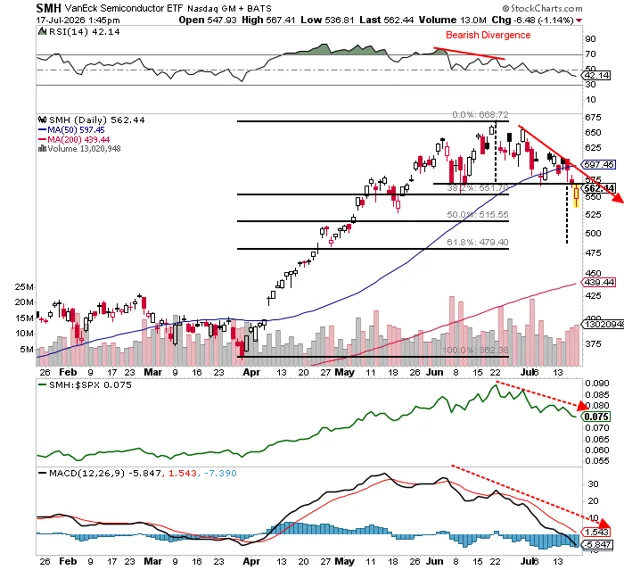
The VanEck Semiconductor ETF (SMH) (Ticker SMH) has experienced a meaningful technical breakdown after failing to confirm its late-June price high with stronger momentum. The Relative Strength Index (RSI) formed a bearish divergence and has fallen to roughly 42, while the Moving Average Convergence Divergence (MACD) has crossed lower and moved into negative territory. RSI is a momentum indicator that measures the speed and magnitude of price movements, while the MACD measures changes in trend and momentum. Performance versus the S&P 500 is also deteriorating, indicating that semiconductors are no longer providing the same degree of market leadership. Together, these indicators suggest weakening price momentum and a potential shift toward a more cautious market outlook. SMH is now trading below its declining 50-day moving average near $597 and remains beneath the short-term downtrend line connecting its recent highs.
Source: StockCharts, Ryan Puplava, CMT® CTS™ CES™
Friday’s sharp rebound from an intraday low near $537 produced a long lower shadow, suggesting buyers defended the 38.2% Fibonacci retracement and support zone around $552. That could support a short-term oversold bounce, but the intermediate trend remains damaged unless SMH can reclaim approximately $575–$600, including its 50-day moving average and descending trendline. A sustained break below $552 would increase the risk of a deeper retracement toward the 50% Fibonacci level near $516, followed by the 61.8% level around $479. The longer-term uptrend remains intact above the rising 200-day moving average near $439, but the chart currently favors consolidation and heightened volatility rather than an immediate return to semiconductor leadership. A move back above approximately $569 would represent a bullish short-term shift; however, given elevated valuations, a healthy correction could ultimately benefit the group over the longer term.
Bottom Line
This week was not simply a technology selloff or a return to defensive investing. It was a test of market leadership. Semiconductor stocks declined despite outstanding industry fundamentals, showing that valuation and positioning now matter as much as revenue growth. Earnings reports from Goldman Sachs, UnitedHealth and Abbott demonstrated that investors remained willing to reward strong execution, while the reactions to IBM, Citigroup and several transportation companies showed that guidance and earnings quality had become more important than headline beats.
At the same time, the oil shock threatened to undermine the week’s encouraging inflation data. The market enters the next phase of earnings season balancing durable AI investment, broader sector participation, historically tight energy inventories and a Federal Reserve that may have less flexibility than the June inflation reports initially suggested.



Comments
Log in or sign up to join the conversation.