

Summary
- The COVID-19 panic is reaching extreme levels.
- You never know when the bottom will come, so you need to keep some cash available in your portfolio.
- However, returns over the long term should be quite attractive from current market levels.
- The smart thing to do is slowly buying high-quality stocks that are strong enough to withstand any recession.
- This too shall pass, the world will overcome this crisis, and the best companies will emerge in stronger shape than ever.
The COVID-19 panic is reaching extreme proportions, and buying in times of panic tends to produce outstanding returns over the long term. The smart thing to do is to be hunting for bargains in this environment, but you also need to manage your overall portfolio risk. If you have cash and time on your side, this market panic scenario can offer outstanding opportunities.
This Too Shall Pass
The current market sell-off is remarkably sharp, the S&P 500 declined by nearly 30% from its highs, erasing 3 years of gains in only one month.
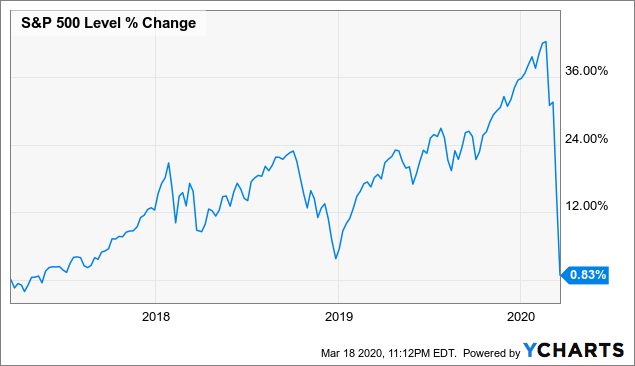
Data by YCharts
Investors are feeling panic and despair in these challenging times, which is perfectly understandable and even to be expected. However, successful investing is about doing the right thing under stressful and uncertain conditions.
Nobody knows what the economic impact of the COVID-19 will be or how low the market will go as a result. But the world is going to overcome this crisis sooner or later, and those who buy high-quality stocks in times of market panic will be well-rewarded for their temperament and strategic vision.
Since we don't know how low the market will go, it makes sense to conserve a sizable cash position and to consider hedging if the opportunity to do so arises. However, history proves that market meltdowns can be generational buying opportunities for those with a strategic long-term vision.
The table from A Wealth Of Common Sense shows the biggest drawdowns in the US stock market and forward-looking returns from the low over 1, 3 and 5 years. The evidence is quite clear, once the market is down by close to 30% from its highs, forward-looking returns tend to be quite attractive. Importantly, the larger the drawdown the larger the subsequent returns.
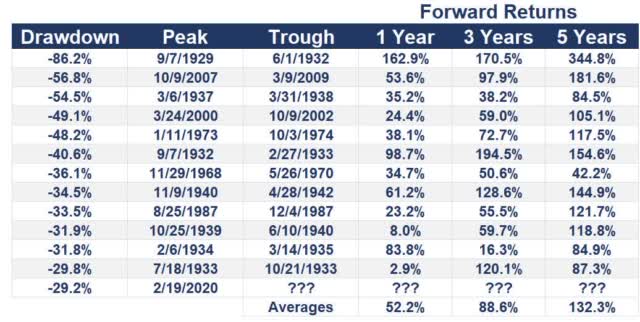
Source: A Wealth Of Common Sense
There are many things that we cannot know about this market crisis, we don't know how long it will last and how deep the social and economic impact will be. The stock market hates uncertainty, and stock prices will probably remain volatile until there is more visibility on the horizon.
But we do know a few things about the behavior of the stock market in the long term. When investors are fearful, they tend to be too pessimistic, and they typically sell high-quality stocks at attractive prices when they should instead be buying them.
The COVID-19 crisis is unique to some degree, and it is also quite scary. But we need to remember that the market crash of 1987, the terrorist attacks in 2011, and the Great Financial Crisis in 2008 were also unique and scary events at the time.
The world economy and the stock market recovered from all of those major drawdowns, and there is no reason to believe that we can't overcome the COVID-19 market panic in due time.
Not only that, but the recovery from this crisis could be particularly strong. When - not if - this is over, consumers and businesses are going to benefit from historically low interest rates, massive monetary and fiscal stimuli, and rock-bottom energy prices. This should be a powerful tailwind for the global economy in the second half of 2020.
How I Am Managing Risk In This Environment
In order to understand where we are right now, we also need to understand where we are coming from. In January of this year, the stock market reached excessive levels of complacency, and bad things tend to happen when investors are too optimistic and they ignore the risks.
In my January 13 market outlook assessment, I explained that investors should conserve cash and be patient with new purchases.
The market is overbought and investor sentiment is optimistic in the short term, so any correction in the coming weeks should be no surprise at all. If you are a long-term investor, meaning that you hold your positions for months and even years, patience is the best strategy. This is not a good time to be aggressively buying stocks, and the ones that are too extended should be particularly avoided. You need to be selective in your purchases and keep some cash at hand in case there are better entry prices in the near term.
I was expecting a correction, so I raised cash levels in the portfolio to 50%. This is obviously a very conservative allocation, but the violence and speed of the decline turned out to be much stronger than I was expecting.
I generally implement some hedges when markets are moving in the wrong direction, but the market didn't provide attractive rebounds to build hedges at good prices so far.
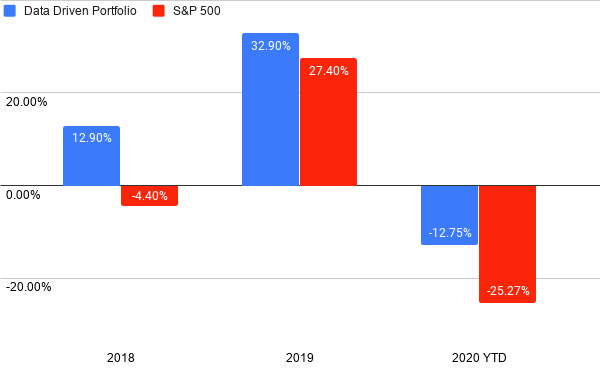
This strategy of raising cash when the market is expensive and hedging the portfolio when the trend is down generally produces solid returns in different environments. In 2018, for example, the portfolio gained 12.9% while the S&P 500 declined -4.4%.
This year so far, the portfolio is down by 12.7% versus a 25.27% decline for the S&P 500 based on closing prices as of March 19. Not having triggered the hedges has been a drag on performance, but a large cash position and a portfolio of stocks that performed better than the indexes have helped in a big way.
In the past few weeks, we have been slowly increasing exposure, and the portfolio is currently 70% in stocks and 30% in cash. We still have more than enough cash to continue buying, but we are not as protected as we were back in January.
When looking for entry prices, you need to acknowledge that you can never buy the whole position at the exact bottom, you will always be early or late to some degree. The plan is buying part of the positions on the way down and another percentage of the positions as markets start showing signs of improvement.
If we get a nice rebound, hedging the portfolio is still an option to consider. However, at current levels, I am more inclined to continue buying than to hedge the portfolio or sell any positions.
Defense Is The Best Offense
Holding a large share of cash in the portfolio can hurt performance in times when markets are rising non-stop. However, this cash also allows you to keep your head cool under pressing conditions and to capitalize on big buying opportunities when they come. In a sense, a defensive posture with cash in times of complacency allows you to be more aggressive with your purchases in times of market panic.
When it comes to hunting for opportunities, many investors tend to go for the most beaten-down names, focusing on sectors such as energy, financials, hotels, and airlines. But this strategy is too risky in my opinion, and it can easily backfire. Many of the companies in the sector can face serious financial trouble, and this can dilute shareholder value in a permanent way.
As opposed to that, I have been adding to positions in high-quality stocks that will come out of this crisis in a stronger than ever shape. Amazon (AMZN) is a great example to consider. The company is one of the strongest businesses in the world, and it has been facing booming demand as consumers stay at home during the social-distancing periods.
Amazon will face some operational and logistical challenges during the crisis, but management knows how to generate customer loyalty over the long term, and chances are that Amazon will be one of the main beneficiaries of changing consumer habits due to the pandemic. I was already holding a considerable position in Amazon stock before the recent market crash, and buying more at attractive prices looks like a winning proposition.
A more risky bet with bigger upside potential is The Trade Desk (TTD). The company is a market leader in programmatic advertising, providing software that allows advertisers to buy media digitally. The Trade Desk uses artificial intelligence to make advertising better targeted and more effective, and it's a major beneficiary from the digital media revolution.
The stock is down by over 48% from its highs of last year, but you wouldn't have guessed that by looking at the company's financial performance. On February 27, The Trade Desk announced a 34% increase in revenue, with earnings per share surpassing Wall Street expectations by 28.6%.
The business fundamentals remain intact, but due to generalized market panic, we can now buy The Trade Desk at a substantial discount of 48% from its highs. This looks like a good opportunity for long-term investors who are willing to tolerate the short-term volatility in the stock in exchange for attractive potential over the long term.
In simple terms, the plan is to continue slowly deploying cash over time, investing in high-quality stocks with enough strength to go through a recession and attractive potential for growth over the years ahead. This plan may not be perfect or ideal, but it is consistent and it fits with my needs, my time horizon, and my risk tolerance levels.
A subscription to The Data Driven Investor provides you with solid strategies to analyze the market environment, control portfolio risk, and select the best stocks and ETFs based on hard data. Our portfolios have outperformed the market by a considerable margin over time, and The Data Driven Investor has an average rating of 4.9 stars out of 5. Click here to get your free trial now, you have nothing to lose and a lot to win!
Performance as of March 19, 2020



Comments
Log in or sign up to join the conversation.