

Rising energy prices? BORING! The ECB looks like it will be tied up with more pressing issues next week, like France and the future of ECB President Christine Lagarde. Even markets are losing interest. Yet the sharp rise in natural gas prices still poses a serious headache for European inflation. James Smith looks at how it could top 5% this winter.
This is how bad European inflation could get this winter
It’s a sign of the times that energy prices are not the top talking point at next week’s European Central Bank meeting. They might not even be the second.
France, surging bond yields, and what the ECB might do about all that will take centre stage. Will Frankfurt curtail its rate hike cycle? Will it stop quantitative tightening?
Then there’s the game of musical chairs set to engulf the central bank next year. Will Lagarde step down early? Is she thinking of standing in the French presidential race? And how are her book sales going?
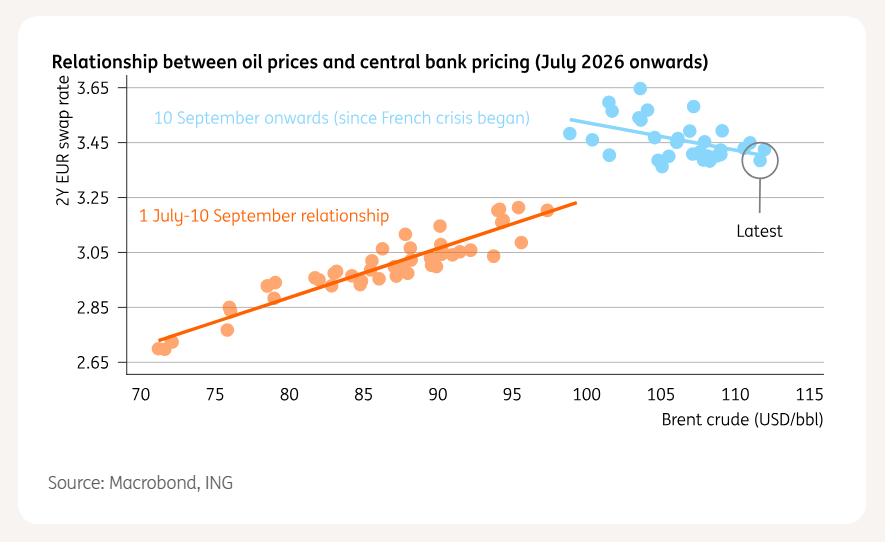
Even markets are losing interest in the energy story. The correlation between oil prices and two-year swap rates has broken down since the French shenanigans kicked off in mid-September.
The relationship between swap rates and oil has broken down
That’s all the more striking now that both oil and natural gas prices have eclipsed the ECB’s ‘adverse’ scenario from just six weeks ago.
What was just an oil crisis is rapidly becoming a natural gas crisis, too. European benchmark gas prices keep hitting new highs. And in that key respect, this is starting to look more like 2022 than it did earlier in the summer. Though less influential than four years ago, natural gas still sets the marginal electricity price much of the time across large parts of Europe.
Context matters, of course. Today’s scary-looking gas prices were fairly normal during the second half of 2021, months before the Ukraine invasion, and they eventually rose to several multiples of current levels.
But inflation is a rate-of-change game. And in percentage terms, the rise in gas prices is now a fair bit larger than it was at the equivalent point in the Ukraine shock.
Energy prices have topped the ECB's adverse scenario
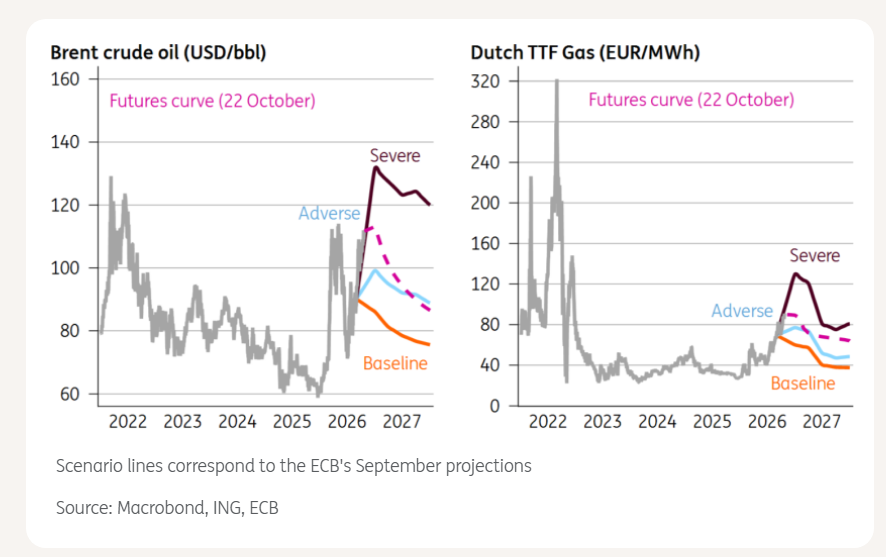
Scenario lines correspond to the ECB's September projections
The worst, in other words, is still to come on inflation.
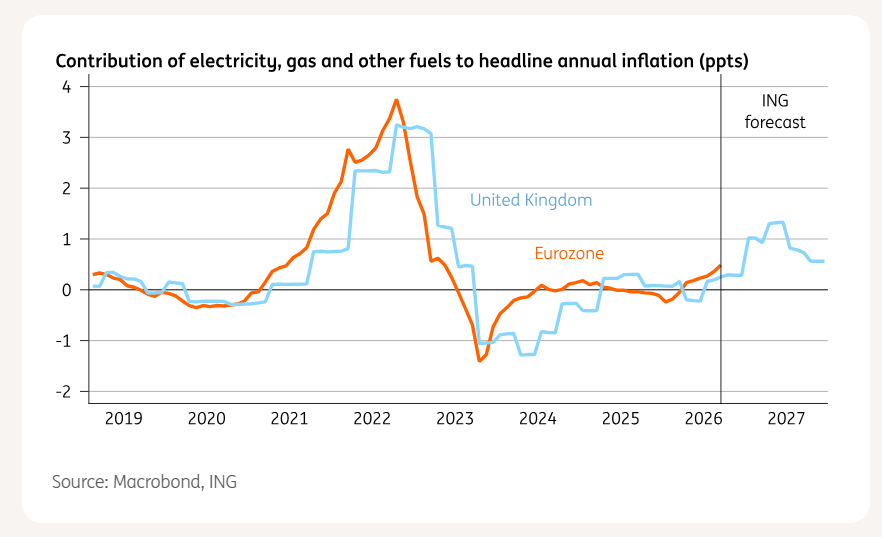
Here in the UK, the latest predictions for the household energy price cap, which is intrinsically linked to wholesale gas prices, suggest electricity and gas bills will rise a whopping 25% in January. By next summer, this category is likely to be adding roughly a percentage point more to inflation than it is today. My chart below shows that household energy prices in the eurozone tend to follow a similar pattern.
That doesn’t mean headline inflation has to rise by the same amount. From April, this year’s initial oil price spike will rapidly start dropping out of the annual comparison, offsetting some of the pain from gas.
But it probably won’t be enough to get inflation back to 2% by spring or early summer. And rising natural gas prices mean 4% inflation this winter increasingly looks baked in. We're already fairly close; the eurozone hit 3.8% in September and the UK reached 3.5%.
Household energy bills are unlikely to peak until after winter
So what gets eurozone inflation to 5%?
The obvious answer is another leg higher in energy. Oil at $130/bbl and gas staying where it is today would just about get us there, according to our team’s latest scenario analysis.
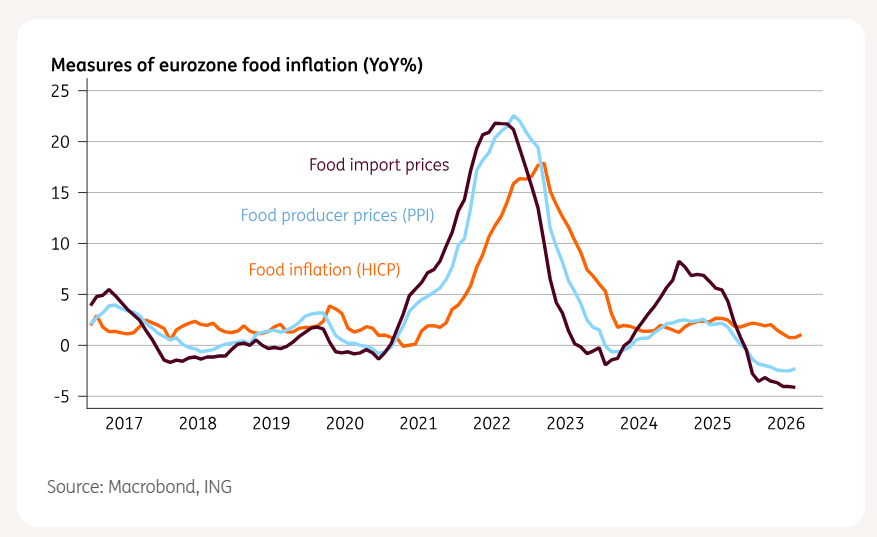
Then there’s food, which frankly remains a major headscratcher. This is the obvious place for higher energy costs to show up. They raise production, transport and supermarket heating costs. But so far, nothing. Consumer food inflation is just 1.1% in the eurozone, having peaked at almost 20% last time around.
Admittedly, fresh food inflation did pick up in September, which means the trough is probably behind us. But that was entirely down to “fruit-bearing vegetables”, whatever they are. All the while, import and producer output food prices are both still in deflation.
That will probably change – and this is probably the main thing to watch as we start to get October’s inflation data late next week. The ECB sees food inflation peaking at around 3.5% next summer. And with some agricultural commodity prices on the rise and this year’s drought and forthcoming El Nino yet to do their thing, food is a major uncertainty.
Food inflation, what food inflation?
The thing is, though, whether it's 4, 5 or 6%, we’re talking tenths of a percentage point here or there on overall inflation. This is not what’s going to move the needle.
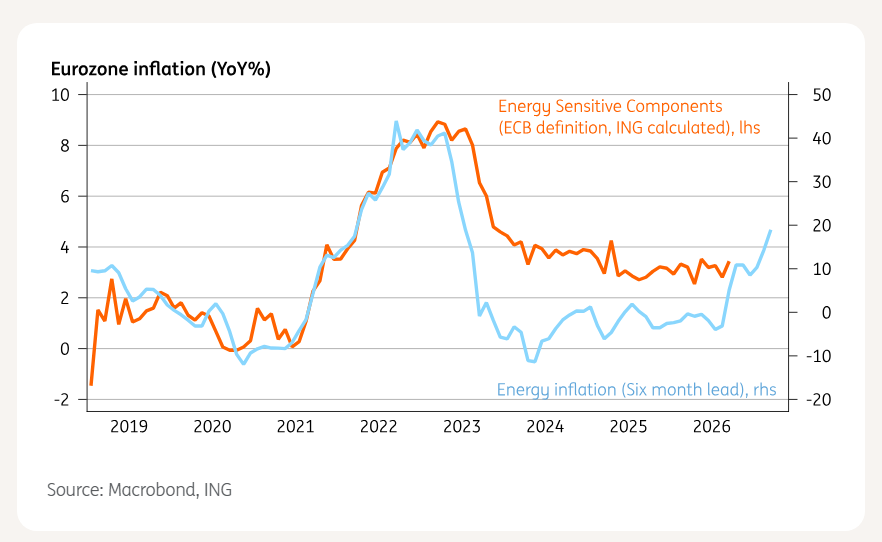
For that, we need second-round effects across the broader inflation basket. And here there is still little evidence of anything sinister. Long-suffering readers will be familiar with my chart below, which shows that ‘energy-intensive’ inflation categories still show no sign of pressure.
But, as the chart also shows, this tends to lag energy inflation by about six months. Only now should we start to see the effects come through. And if they do, this is where things could really start to get spicy. That’s especially true if you add in some other upside risks: AI investment bottlenecks, a surprise resurgence in the jobs market, and widespread energy support packages from governments.
Second-round effects have remained elusive so far
But none of that is our base case right now.
And this distinction between the first-round energy shock and the second-round inflation response is ultimately what matters for the ECB and other central banks in the region.
If, or when, the ECB hikes in December, it’s still unlikely to be acting on concrete evidence that the Iran war has unleashed broader inflationary pressure. It will still very much be a vibes-based thing – an insurance policy against a repeat of the 2022 nightmare.
But the calculus should look very different by spring. Headline inflation should clearly have peaked, even if it hasn’t fallen dramatically. More importantly, we should have a much better idea whether those much-feared second-round effects are materialising at scale.
Our view is that they won’t. That is why my colleagues aren’t currently forecasting further ECB hikes next year, and think we could get a rate cut by next Christmas.
By then, energy prices should hopefully be well down on the ECB’s list of talking points. But the way this year is going, who knows what we’ll be worrying about instead.
THINK Ahead in developed markets
United States (James Knightley)
Rate Decision (Wed): The Federal Reserve is the focus, but with heavy hitters, such as Philip Jefferson, Michelle Bowman and Chris Waller suggesting that while they are likely to hike again, there is no pressing need to do it quite yet, markets and economists are united in expecting an "on hold" decision. The fact that Fed Chair Kevin Warsh subsequently chose not to talk up the chances of action when he spoke at the IMF meetings in Bangkok, unlike at the Jackson Hole Conference before the September hike, further dampened the perceived chances of action. Nonetheless, the economy is growing strongly, unemployment is low and inflation is above target, so we do expect a December rate hike.
3Q GDP/Core PCE Price Index (Thu): 3Q GDP will be the data highlight, and we are expecting a robust figure of 3.4% annualised with consumer spending and tech investment continuing to propel the US economy forward. The core PCE deflator, the Fed's favoured inflation measure, is also likely to be hot, rising 0.3% month-on-month, hence our expectation of a December rate hike.
Canada (James Knightley)
Rate Decision (Wed): The Bank of Canada is a really close call. Much closer than for the Federal Reserve decision on the same day. We are leaning in the direction of a hold, for now, but a hike is certainly coming. Inflation was a little softer than anticipated last month, jobs were lost, and the unemployment rate remains elevated, so we think they will hold fire this time, especially given the current "risk off" environment.
Eurozone (Peter Vanden Houte/Carsten Brzeski)
ECB decision (Thur): After a surprisingly hawkish message in September, a severe fiscal and political crisis in France means the ECB is unlikely to repeat that tone at its October meeting. At face value, macro developments since the last meeting would still justify another rate hike. But higher bond yields mean the ECB is very likely to stay on hold next week and will delay any next rate hike decision to December. Read our full preview.
3Q GDP (Fri): With business sentiment strengthening slightly in 3Q, helped by the temporary decline in energy prices, eurozone growth was probably still close to 0.3% quarter-on-quarter, following the 0.6% expansion in 2Q, which was admittedly boosted by exceptionally strong Irish data. However, the renewed rise in oil and, especially, natural gas prices has likely weighed on economic sentiment in October, pointing to a weaker reading than in September.
France (Charlotte de Montpellier)
GDP (Fri): The French economy is unlikely to have regained momentum in the third quarter. We expect GDP to have stagnated, after zero growth in the second quarter and a 0.2% contraction in the first. Industrial production disappointed over the summer, with total output falling in both July and August. The modest rebound in manufacturing in August was too narrow to signal a genuine recovery, while order books remained weak and inventories high. On the demand side, household consumption of goods fell by 0.5% in August. Higher borrowing costs are already weighing on investment and reinforcing some wait-and-see behaviour among households and businesses. The outlook beyond the third quarter is even more worrying. Interest rates have continued to rise in October, while the recent violence and protests are adding to an already fragile confidence backdrop.
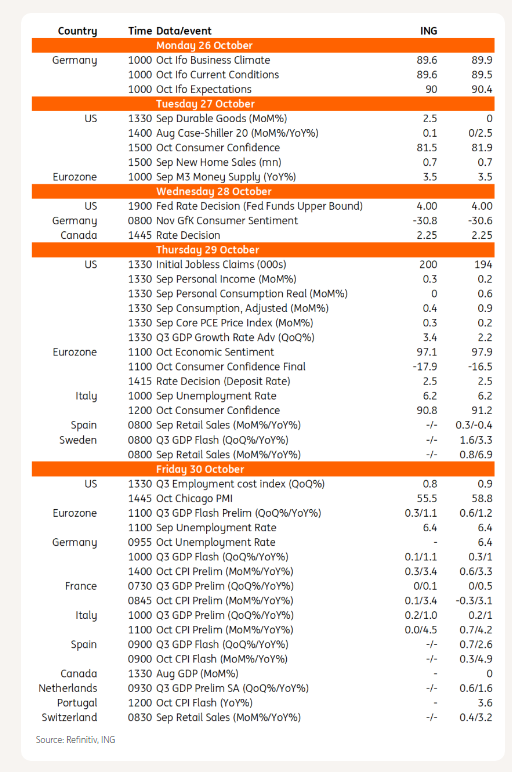
Key events in developed markets


Comments
Log in or sign up to join the conversation.