


Plenty of ink has been spilt on why the ECB is hiking rates. And whether it's right or wrong. But fewer are asking if any of this even matters, anyway? James Smith explores how the relationship between interest rates and the economy has changed – and not always as you'd expect
Are rate hikes pointless?
Long-suffering readers will know that, in my occasional bid to prove I’m still young – and definitely not edging towards a midlife crisis – I like to talk in memes.
And this week’s ECB meeting got me thinking about that one of a skeleton sat patiently on a park bench. Because that’s roughly how old I’ll be when this week’s rate hike fully feeds through to Europe’s economy.
Cue one of my favourite charts (I know, it’s a sad existence…). It shows that since 2021, average eurozone mortgage rates for existing homeowners have risen by less than one percentage point – despite 450bp of rate hikes. And while rates have since been cut, that average mortgage rate keeps on rising.
How average mortgage rates have changed since the rate hikes four years ago
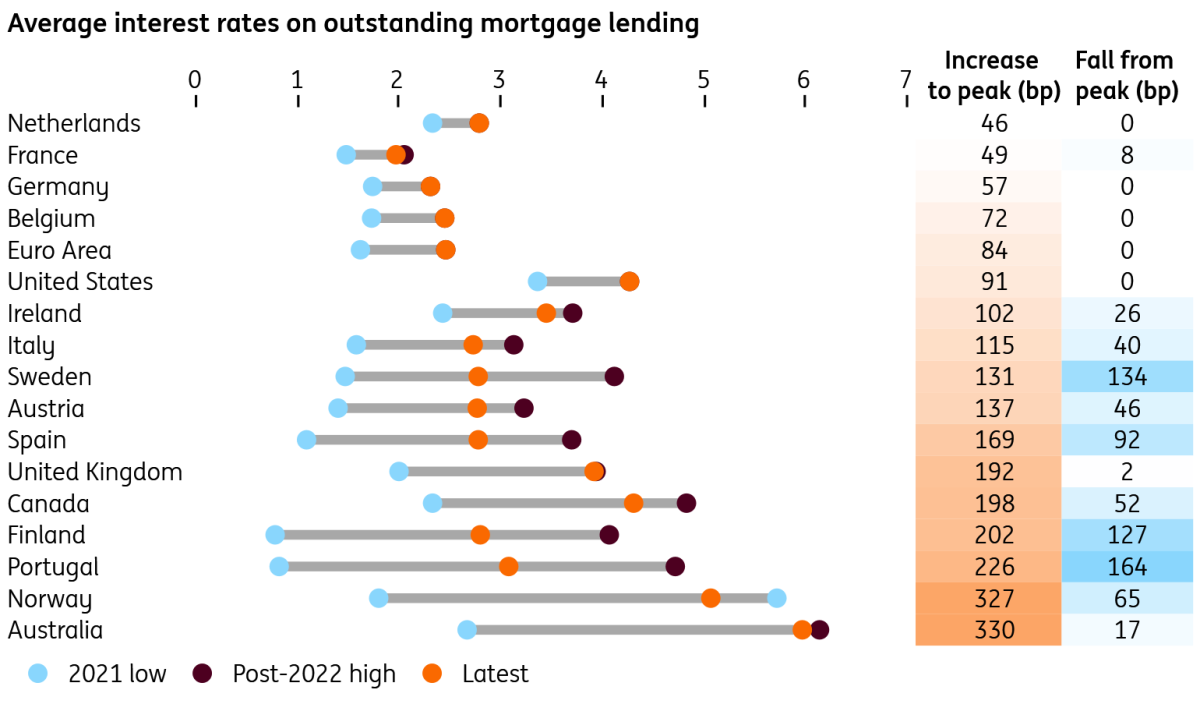
Admittedly, it depends on where you look; Dutch and French homeowners have been the most insulated from hikes, while Portuguese and Finns are the least.
But the big picture is simple. Around half of eurozone mortgages are fixed for more than 10 years. That means the rate hikes from four years ago are still working their way through – and will be for several years to come. And that's before we even think about this week’s extra 25bp.
One interesting consequence is that rate hikes can initially boost household incomes. Savings rates adjust quickly, whereas mortgage payments largely don’t. National accounts data shows net interest income for households actually rose as a share of disposable income in both the eurozone and UK after the last hiking cycle – a sharp contrast to when rates rose ahead of the financial crisis.
Rate hikes initially boost household cashflows these days
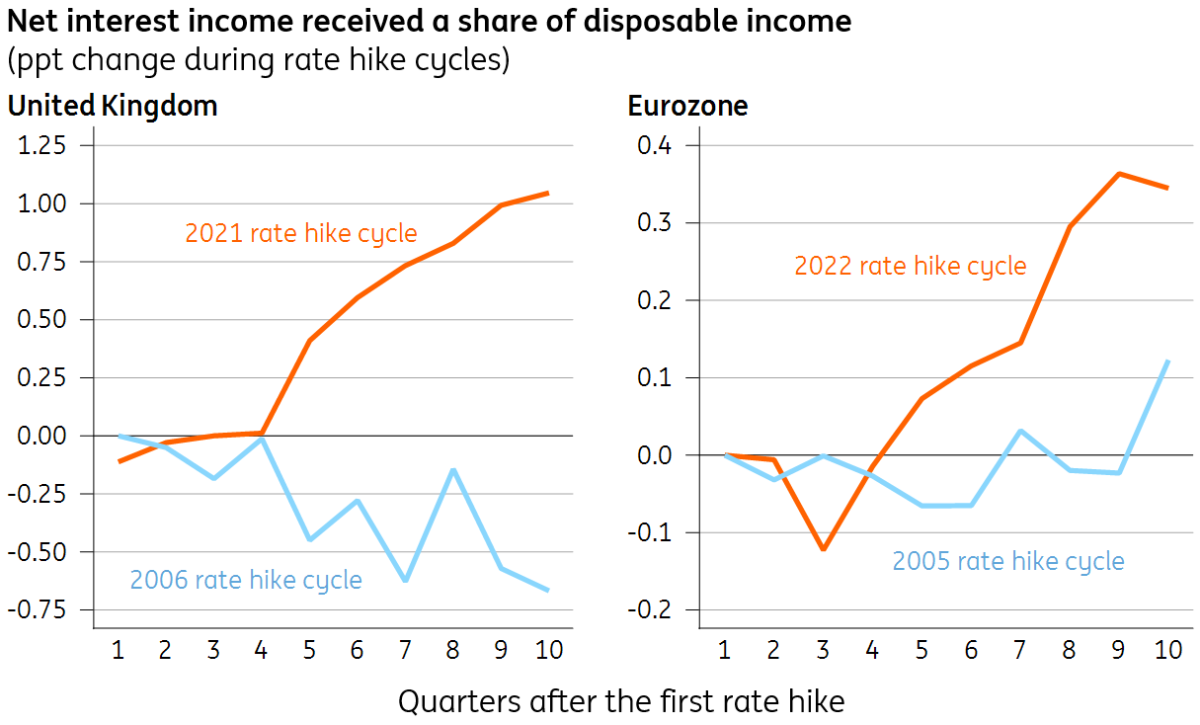
None of this means rate hikes are in some way stimulative, as some have occasionally argued. In the UK, for instance, shorter mortgage fixes mean consumers know any savings windfall today will give way to higher repayments in the future – and they tend to act accordingly. And those receiving higher interest income aren’t necessarily the same people facing higher repayments – and the latter are more likely to materially adjust consumption in response to rising interest rates.
Still, it does mean that rate hikes can have unexpected consequences.
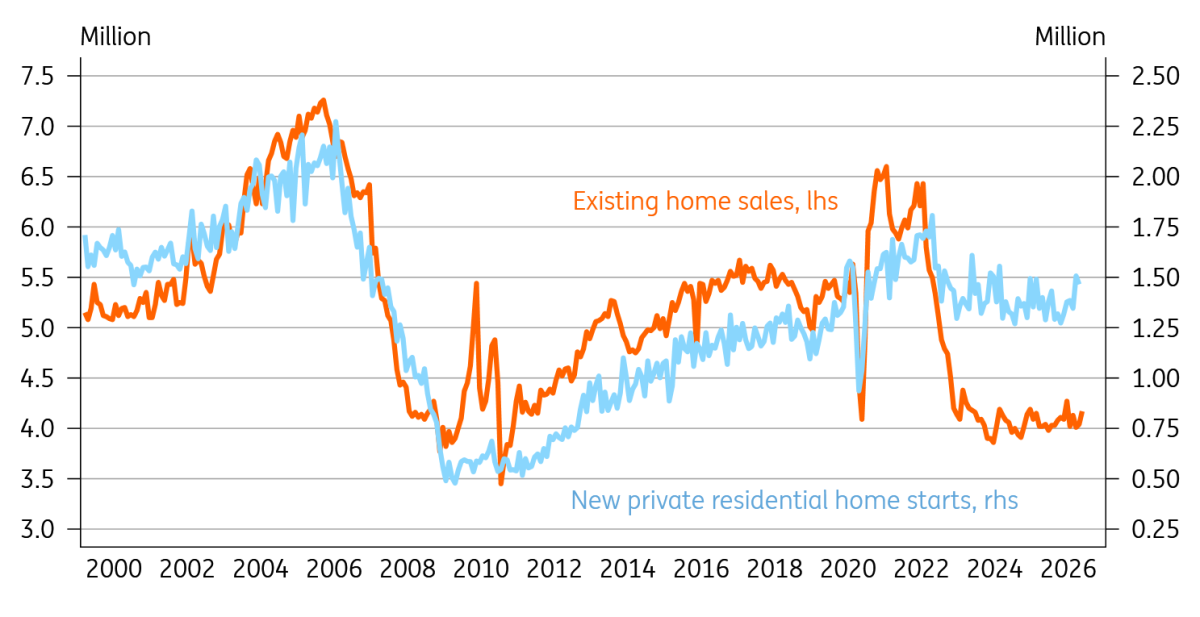
Take housebuilding. The textbooks say higher rates cool activity. Yet that isn’t what happened in the US after the aggressive rate hikes four years ago. Demand collapsed – and has stayed that way. But so did supply. Homeowners with ultra-low fixed rates stopped moving. Why trade up to a 7% mortgage? Listings plunged, meaning new-build demand and residential construction held up more than you might expect in a tightening cycle.
US homebuilding has held up as existing home availability has plunged
So if rate hikes take years to bite, what’s the point?
Well, they still do achieve something. Rate hikes have made consumer credit much more expensive, as US delinquency data shows. Corporate borrowing tends to be more sensitive to floating rates (even with increased hedging). Tighter credit standards have an impact, too.
But one or two rate hikes here and there won’t change much. So, above all, it's about signalling. With all this fixed-rate debt, what central banks say often matters more than what they do. That was ultimately the point of this week’s ECB hike.
ECB President Christine Lagarde insisted this wasn’t an “insurance” move. But the truth is that financial markets, by pricing a string of rate hikes this year, are doing the central bank’s dirty work for them. And officials are well aware that, four months into the energy crisis, if they don’t act now, investors may well start to see them as all bark and no bite. The fear is that inflation expectations in financial markets would otherwise start to pick up.
There’s plenty to debate there. But for central bankers still scarred by the inflation surge four years ago, I suspect credibility – and how markets perceive it – will continue to dominate decision-making this summer.
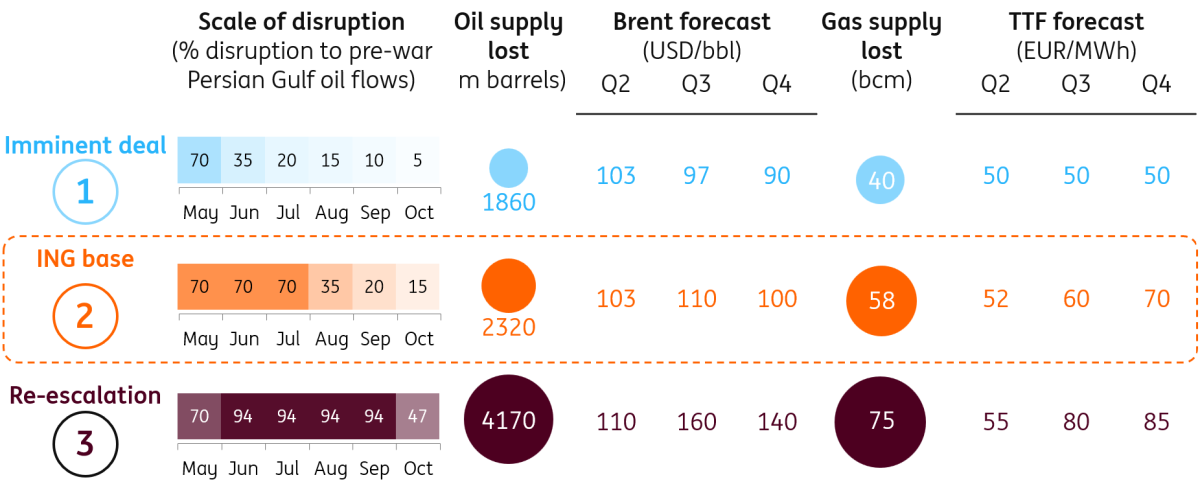
Maybe it won't matter. If we really are on the verge of a US-Iran deal – and if that really does reopen the Strait of Hormuz (two big ‘ifs’) – then the pressure eases. A second ECB hike might still happen, but a Bank of England rate rise would be taken off the table. But that’s not our base case.
Our commodities team still sees energy prices pushing higher into July, even if there’s a deal, as the support from inventories fades and production takes time to ramp up again. They continue to flag the risk of higher European gas prices as and when Asia has to compete more aggressively in the spot market for LNG cargoes.
If that happens, it’ll be very hard for central banks in Europe to resist further tightening this summer.
James Smith
Our three scenarios for energy prices
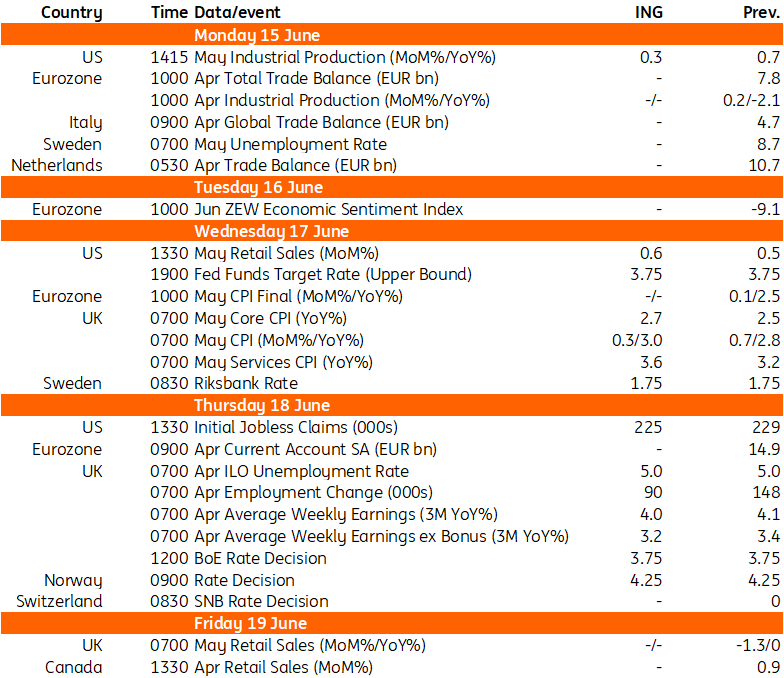
THINK Ahead in developed markets
United States (James Knightley)
The Federal Reserve is set to sound more hawkish this week in the wake of improved economic momentum and elevated inflation readings caused by the surge in fuel prices. The dot plot may show more Fed officials expect rates to be raised before the end of the year than those that expect cuts. This could create a tricky environment for the new Fed Chair, Kevin Warsh, who was recently appointed by President Trump – a keen advocate for lower borrowing costs. Nonetheless, our view is that there will be an extended pause and the next move remains more likely to be a rate cut, albeit not until well into 2027.
In terms of data, retail sales will be lifted by higher prices at gasoline stations due to it being a nominal dollar figure, but outside of this we expect the control group to remain fairly subdued. Meanwhile, manufacturing output should continue to be boosted by the ongoing data centre rollout and associated tech investment cycle.
United Kingdom (James Smith)
Inflation (Wed): Inflation is set to bounce back, having been artificially dampened in April by the timing of Easter. Still, it's too early to blame any of this on second-round effects of the Iran war. And too early to see the full impact of higher oil/natural gas prices; household energy bills are capped until July.
Jobs (Thu): Coming just hours ahead of the BoE decision, the question is whether last month's dreadful figures – which included a sharp drop in payroll employment – are revised up.
Bank of England (Thu): We expect the Bank to keep rates on hold, but the main question is how many dissent and vote for a hike. Chief Economist Huw Pill was the sole dissenter back in April, but a recent speech as good as confirmed that he'll be joined by Megan Greene. We expect a 7-2 vote, but the risk is that Pill and Greene are joined by Claire Lombardelli and/or Catherine Mann in advocating for higher rates.
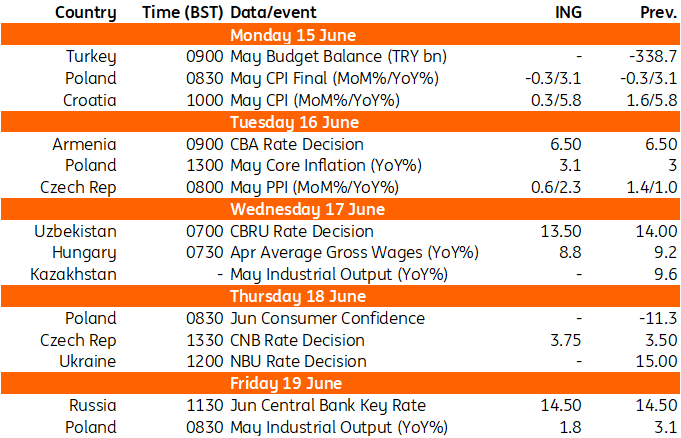
THINK Ahead in Central and Eastern Europe
Poland (Leszek Kasek)
CPI (Mon): Next week’s Polish data calendar is quite modest. The final CPI print for May on Monday should confirm that consumer inflation indeed slowed down to 3.1% YoY from 3.2% in April, while core inflation increased only slightly to 3.1% YoY from 3.0% a month before (NBP reading on Tuesday). The flash CPI reading two weeks ago indicated a surprising decline in food prices (unusual for May), but we will also search for confirmation that the second-round price effects remain contained in other price items as the government introduced a fuel price shield (lower excise tax and VAT rate on fuels).
Industrial Output (Fri): We project a modest 1.8% YoY growth in industrial production in May (publication on Friday), down from 3.2% in April. We believe that the slowdown is partly due to weak external demand, especially from Germany, given the uncertainty and volatility related to the Middle East conflict, but this also reflects a calendar effect (one working day less than in 2025).
Czech Republic (David Havrlant)
Rate Decision (Thu): The Czech National Bank will likely proceed with a rate hike next Thursday. We expect a split vote and would not be surprised if the base rate were to remain the same. However, we consider one hike in June as the most likely outcome at this stage. Producer prices likely increased in May, reflecting higher input prices of energy, basic chemicals, and metals.
CIS (Dmitry Dolgin)
Rate Decision (Tue): We expect the Central Bank of Armenia (CBA) to hold the policy rate at 6.50% at the upcoming meeting, as current CPI of 4.2% YoY as of May, above the long-term target of 3%, and growing external inflationary risks related to global food prices call for caution, in line with the tone of previous CBA communication.
Meanwhile, the persistent strength of the dram amid continued remittances and portfolio inflows and narrowing fiscal deficit may serve as an argument in favour of improvement in the perceived balance of inflationary risks for the medium-term.
Rate Decision (Wed): We believe the surprising drop of the CPI to 5.5% YoY (vs. 7.3% YoY at year-end 2025), closer to the longer-term target of 5%, amid continued fiscal consolidation and gold-reinforced UZS have made the current level of policy rate 14.00% too high and see room for a cut at the upcoming meeting or at least some further softening in CBRU rhetoric.
Key events in developed markets next week
Key events in Central and Eastern Europe next week

Comments
Log in or sign up to join the conversation.