

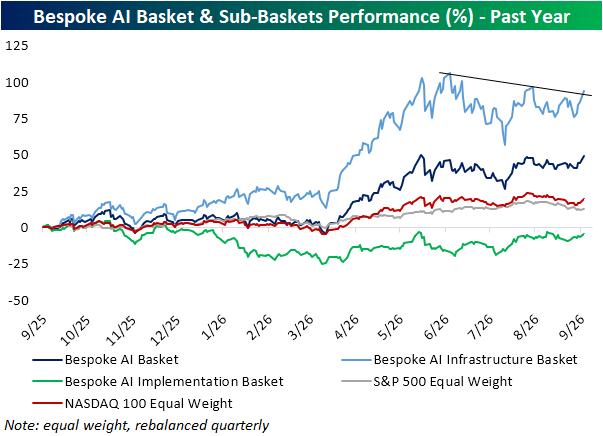
Advanced Micro Devices (AMD) joined the $1 trillion market cap club yesterday, a bright spot for an AI trade that has had a rough few months. We proxy the theme by using our AI baskets, and as shown below, the group is currently in a prolonged drawdown. However, the surge in equity prices yesterday saw solid participation from AI names. In particular, AI infrastructure stocks have broken out of their multi-month downtrend.
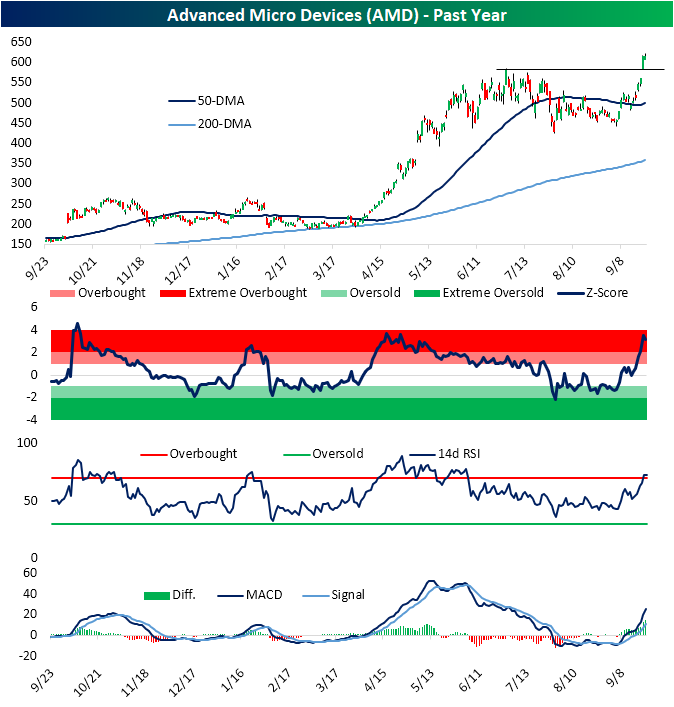
Among the AI infrastructure names, one of the most notable this week is AMD. The stock rose nearly 10% yesterday and, as shown below, has finally broken out to new highs. Further, AMD is not only a winner this week, but year-to-date the stock has risen 190% and is the ninth-best performer in the S&P 500.
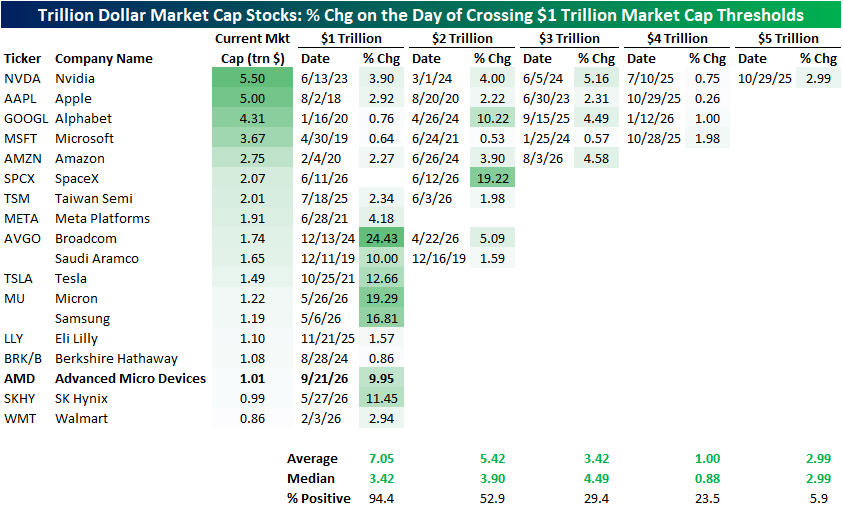
Those huge gains have, of course, massively lifted the stock's market cap too. Yesterday's 9.95% gain meant that for the first time in its history, it crossed the $1 trillion market cap threshold. That makes it the 18th stock to eclipse a $1 trillion market cap threshold, and as shown below, it was one of the more rapid one-year gains to get there.
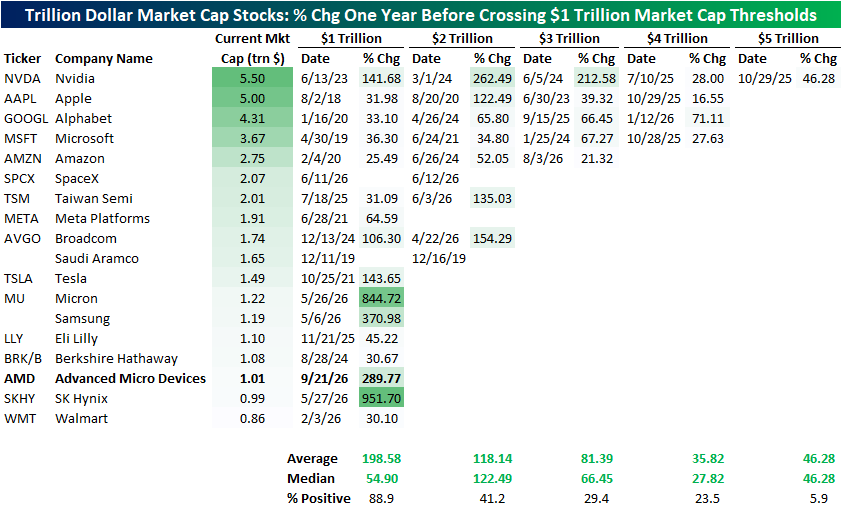
Further, the single-day move that brought it above the $1 trillion mark was also on the larger side of prior examples, whether that be for the first $1 trillion threshold or any subsequent one.
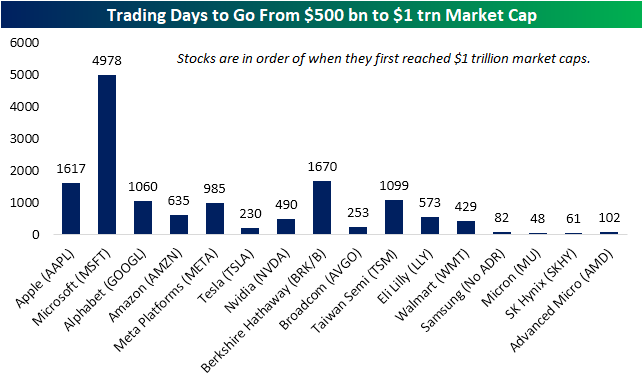
To put it into further perspective, below we show the number of trading days it has taken for mega-cap stocks to go from the first close with a $500 billion market cap to over $1 trillion. It only took AMD 102 days. The only faster trips came from memory chip makers Samsung (SSNLF), Micron (MU), and SK Hynix (HXSCL)) all of which occurred in the past year.
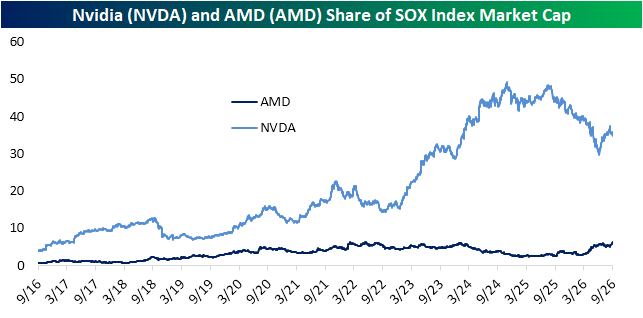
While AMD is now in the trillion-dollar market cap club, its share of market cap for major semiconductor indices is sizable but still well behind what has historically been its biggest rival, Nvidia (NVDA). AMD now accounts for 6.4% of the SOX's market cap. While that's a record for the company, it pales compared to NVDA's 34.7% share. NVDA's influence is also down significantly from last year's peak of around 49%.
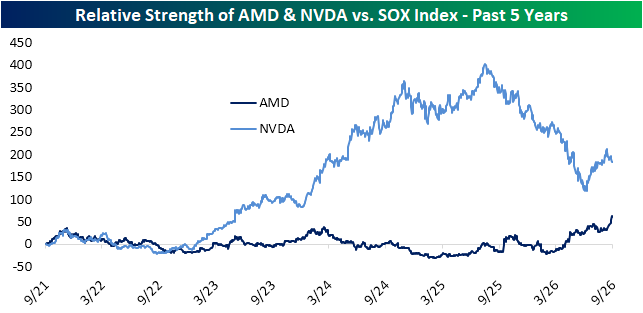
To put it differently, despite its enormous weighting, NVDA has lagged the broader semiconductor group for an extended period now. As a result, competitors like AMD have been able to catch up, and AMD's relative strength versus the SOX is now at a five-year high. If that rotation continues, it would be a sign that the AI infrastructure trade is broadening beyond its single biggest name, a healthier setup than one that depends on NVDA alone.



Comments
Log in or sign up to join the conversation.