

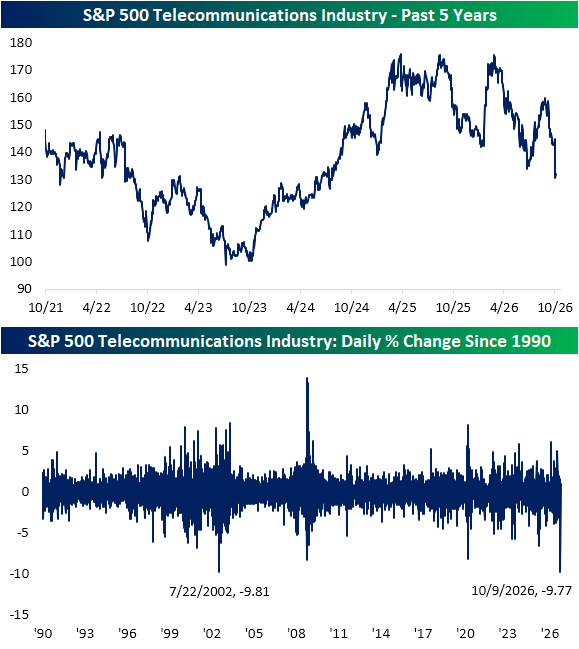
The S&P 500 Telecom industry group saw its second-biggest one-day drop last Friday due to the threat of major disruption from satellite cellular providers. As shown below, the Telecom group, which is home to three cellular network stocks: Verizon (VZ), T-Mobile (TMUS), and AT&T (T) in addition to Comcast (CMCSA), has basically been on shaky ground for a year and a half now. Its latest drop has left it at the lowest levels in over two years, and as shown in the second chart below, Friday was the second worst single day decline for the industry since at least 1990. The only bigger drop came in July 2002 on the day after Worldcom announced its bankruptcy.
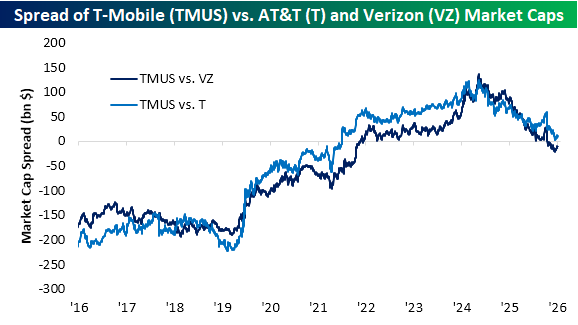
While the single-day drop in telecom stocks was a sight to behold last week, over the longer term, another interesting trend has been unraveling in the space. Throughout the 2010s, US cellular networks were dominated by companies like Verizon (VZ), AT&T (T), and Sprint. In the past decade, though, T-Mobile (TMUS) has made inroads to join the rest as one of the biggest players in the game, especially after its 2010 merger with Sprint.
As shown below, in the past decade, TMUS has gone from a company lagging in market cap by a tune of $200 bn to being the largest telecom provider in the first half of the 2020s. With that said, the past couple of years have seen the market caps of TMUS, T, and VZ essentially come back to parity of one another. In fact, it is now Verizon (VZ) that is back to ranking as the largest US telecom company.
For an alternative look at how the sizes of these companies have progressed over time, check out this interactive graphic we've made.



Comments
Log in or sign up to join the conversation.