


Keeps The Door Ajar
Last week, traders leaned into the belief that the worst had passed, that the theatre of conflict had rotated away from live fire and into closed-door bargaining, and that risk could begin to price a measured path back toward normality. That illusion is now beginning to fray, not in one decisive tear, but stitch by stitch, as each new development quietly unravels the narrative that had briefly held the market together.
What we have instead is not a breakdown, but something far more difficult to trade. A controlled escalation wrapped inside a negotiation framework. The kind of move that does not blow the market apart, but keeps it permanently off balance.
The Strait is no longer just a transit route. It is the central valve of global liquidity, and Trump has just put his hand firmly on the lever.
A naval blockade targeting Iranian flows is not about boots on the ground. It is about squeezing Iran’s primary revenue stream, but in doing so it is also constricting the market’s oxygen. Strip out roughly 1.5 to 2 million barrels a day from the system and you are not just tightening supply, you are rewriting the inflation script in real time. Oil is no longer trading as a commodity. It is acting as the market’s truth serum, forcing every asset class to reassess its assumptions through the lens of a higher cost of energy.
Brent pushing back above $100 is not just a price move. It is another in an endless series of mini-regime signals. It tells you that the idea of a clean return to pre-conflict pricing was always a fragile narrative built on hope rather than structure.
And yet, this is not panic.
Because the market can see what this really is. This is pressure with conditions. A blockade with rules. A squeeze designed not to trigger collapse, but to force compliance.
The red lines laid out are not incremental asks. They are maximalist demands dressed as a pathway to stability. End uranium enrichment. Dismantle nuclear infrastructure. Surrender material. Rewire regional behaviour. Open the Strait with no toll. It is not a negotiation in the traditional sense. It is a full-spectrum reset attempt.
But here is where the market hesitates before fully leaning into risk aversion.
The door has not been shut.
Iran has not walked away. The language remains deliberately elastic. There is just enough ambiguity left in the framework to keep the idea of diplomacy alive. And that changes everything. Because markets do not price outcomes, they price paths.
Right now, the path is not resolution. It is extension.
That is why the reaction, while sharp, is not disorderly. Oil surges, equities pull back, the dollar firms, high beta FX comes under pressure. The Australian dollar and rand feel the weight first, as they always do when the market rotates away from growth sensitivity. But the move lacks the kind of cascade that defines a true risk off event.
This is not capitulation. It is recalibration.
The sentiment heading into this was slightly skewed the wrong way. The ceasefire rally had pulled capital back into equities with some conviction. A 3.6% lift in the S&P and a 7.4% surge in emerging markets were not just relief; they were a re-risk positioning built on the assumption that the negotiation channel would hold.
Now that assumption is being poked in the side in real time.
And this is where the tape becomes more complex.
Because oil at these levels starts to bleed into everything else. It feeds directly into inflation expectations. It begins to challenge the narrative that central banks can ease into a soft landing cleanly. It forces bond yields higher, particularly at the front end, where policy sensitivity lives. The two-year yield drifting toward 3.8% is not just a number; it is the market quietly repricing the idea that the Fed will stay patient.
At the same time, growth signals are already showing strain. Consumer sentiment is softening. Earnings expectations are holding, but only just. A 12% growth projection for S&P profits is not weak, but it is the slowest pace in over a year. It leaves very little margin for error if input costs begin to rise again due to energy.
So the market finds itself in a narrowing corridor.
On one side, inflation risk is being reignited through the barrel. On the other hand, growth is already showing signs of fatigue. That is not a clean environment for risk assets to extend.
But again, this is not a market collapsing under the weight of uncertainty. It is a market being held in suspension by it.
Because the key detail sits beneath the headline.
The blockade is selective. It targets Iranian flows. It does not entirely shut the Strait. Freedom of navigation for non Iranian traffic remains intact. That distinction matters. It tells you this is not about detonating a global supply shock in one stroke. It is about isolating pressure, tightening the vice with precision rather than force. But in doing so, it introduces a different kind of risk. It quietly poses the question of whether Iran chooses to absorb the squeeze or test the resolve behind it, probing the edges of US military credibility, where any misstep or overreach risks crossing a line that drags the situation back toward a worst-case scenario.
The real fault line sits in the grey zone, where a rogue faction or proxy miscalculation could spark escalation without clear intent, turning a controlled pressure campaign into something far less predictable. That tension now sits just beneath the surface, not fully priced, but impossible to ignore.
The market, however, understands that the blockade is part of a broader negotiation strategy, a visible tightening designed to force movement at the table rather than an irreversible step into full-scale conflict.
Which leaves us in a familiar but uncomfortable place.
The market is not trading at a resolution. It is trading on the continuation of talks under tension.
And that creates a very specific kind of price action. One where every headline has the potential to shift the narrative, but none are definitive enough to anchor it. A market that zig zags quickly but struggles to trend cleanly. Where conviction fades as quickly as it builds.
This is no longer about pricing a ceasefire. It is about pricing the terms under which one might eventually emerge.
And until those terms become clearer, the Strait remains the switch that controls everything.
Japan Yields Break The Silence As The Global Rate Complex Reprices The Barrel
The move in Japan is not happening in isolation. It is the echo of a deeper shift running through the global rates complex, where the cost of energy is once again rewriting the script for inflation and forcing bond markets out of their comfort zone.
The 10 year JGB pushing to levels not seen since 1997 is not just a domestic story. It is a signal that the world’s most anchored yield curve is starting to feel the pressure of a rising tide. For decades Japan has been the quiet corner of global fixed income, a place where volatility went to die and policy acted as a permanent shock absorber. That anchor is now beginning to lift.
And the catalyst, once again, sits in the Strait.
Oil moving higher on the back of the blockade narrative is not just tightening supply expectations, it is feeding directly into Japan’s most vulnerable channel. Imported inflation. Japan does not produce its own energy in meaningful scale, it imports it, pays for it in dollars, and absorbs it through the currency. So when the barrel rises and the yen weakens at the same time, it is not a double hit, it is a compounding loop.
The yen drifting back toward 160 is not just a currency story. It is a transmission mechanism. Every tick weaker feeds straight into higher import costs, which feeds into inflation expectations, which forces yields higher as the bond market begins to question how long the Bank of Japan can remain behind the curve.
And that is the tension now building.
Because Japan has spent years conditioning markets to believe that yields would remain capped, that policy would absorb shocks, that volatility would be managed rather than expressed. But inflation driven by energy is not easily controlled through domestic tools. It leaks in from the outside, and once it does, it forces a repricing that even the most patient central bank cannot fully suppress.
The rise to 2.49% in the 10 year is not explosive, but it is symbolic. It tells you that the ceiling is no longer fixed in the minds of investors. That matters more than the level itself.
At the same time, the global backdrop is not offering relief. Higher oil feeds global inflation, keeps front end yields elevated, and reinforces the idea that central banks cannot pivot cleanly toward easing. That pressure transmits across curves, and Japan, despite its uniqueness, cannot remain fully insulated.
There is also a second layer building beneath the surface.
Intervention risk.
As the yen weakens toward 160, the language from Tokyo is becoming more deliberate. Not reactionary, but preparatory. When officials begin to talk about acting on all fronts, it is not just about optics. It is about drawing a line in the sand without yet stepping over it.
That creates a familiar tension in FX: Momentum versus intervention.
On one side you have the macro drivers, yield differentials, energy driven inflation, dollar strength. On the other side you have the risk that authorities step in to disrupt the trend. That tension rarely resolves cleanly. It tends to produce sharp, disorderly reversals when the line is finally tested.
And this is where the cross asset picture tightens.
Higher yields in Japan are not just a domestic adjustment. They ripple outward. Japanese investors have long been exporters of capital, seeking yield abroad. As domestic yields rise, even modestly, that incentive begins to shift at the margin. It does not trigger an immediate reversal, but it changes the calculus.
Slowly at first. Then all at once.
So what you are seeing is a market that is beginning to reprice multiple layers at the same time. Energy risk feeding inflation. Inflation feeding yields. Yields feeding currency dynamics. Currency dynamics feeding policy risk.
All of it looping back to the same source.
The barrel.
And just like that, a market that believed it had found stability is being reminded that the foundation was always more fragile than it appeared.
Gold Gets Sold To Fund The Shock As The Barrel Rewrites The Playbook
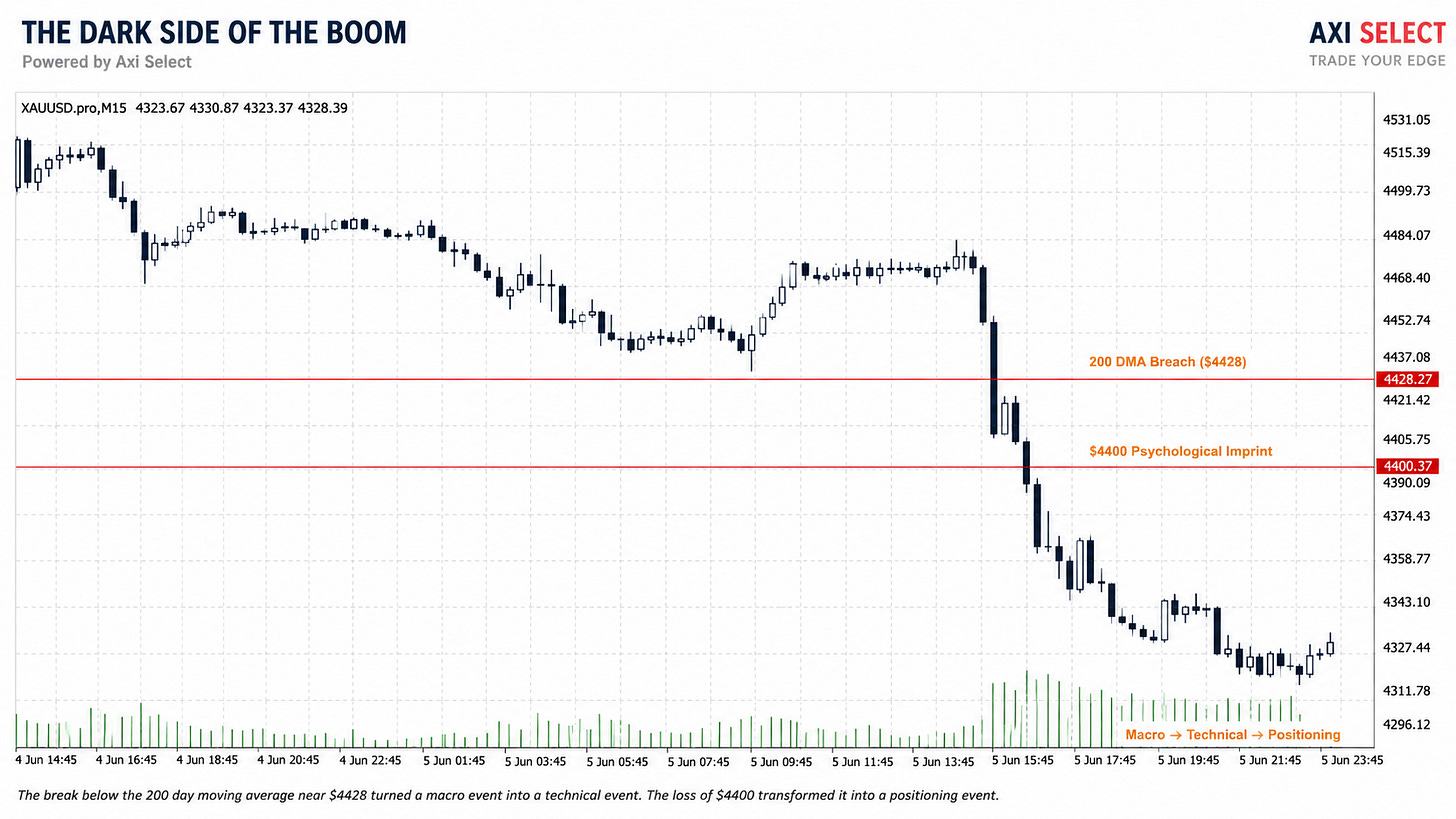
Gold is not falling because its story is broken. It is falling because the market has been forced to change the lens through which that story is viewed.
The blockade has shifted the narrative away from fear and into inflation, and that distinction matters more than the move itself.
When oil surges, it does not just lift energy markets, it ripples through the entire macro structure, feeding inflation expectations, lifting yields, and strengthening the dollar. That combination is toxic for gold in the short term. Not because gold loses relevance, but because it stops being the first call in a world where the cost of money is moving higher.
This is the classic paradox the market keeps relearning.
Gold thrives on instability, but not all instability is created equal.
If the shock is growth negative and rates are falling, gold becomes the safe harbor. But when the shock is inflationary and rates are rising, gold gets treated like inventory. It gets sold, not because traders no longer believe in it, but because they need to fund the adjustment elsewhere.
That is exactly what is happening here.
The move lower is not a rejection of the gold thesis. It is a collateral call.
The market is being forced to reprice the path of central banks. The idea that policymakers could ease into a soft landing is being challenged by the resurgence in energy driven inflation. Suddenly the question is no longer when cuts arrive, but whether they get delayed or even reversed.
And gold, which pays no yield, feels that shift immediately.
At the same time, the dollar is firming. Not aggressively, but enough. A stronger dollar tightens financial conditions globally and adds another layer of pressure on bullion. It is not just one headwind, it is a convergence.
Higher oil. Higher yields. Firmer dollar.
That trio does not just weigh on gold, it forces positioning to unwind.
And positioning matters here.
Gold had been bid into the ceasefire narrative. It was holding ground as a hedge against uncertainty, but also benefiting from the belief that rates would eventually move lower. That dual support is now being questioned. The inflation channel has taken over, and the market is rotating accordingly.
But there is a deeper layer to this that should not be ignored.
Gold is down roughly 11% since the conflict began, yet the geopolitical backdrop has not improved. If anything, it has become more complex. That divergence tells you the market is not trading the headline risk directly. It is trading the policy response to that risk.
And policy, right now, is being driven by the barrel.
So what you are seeing is not a breakdown in gold’s role. It is a sequencing issue.
Energy shocks hit inflation first. Inflation hits rates. Rates hit gold.
Only later, if the shock begins to weigh on growth and financial conditions tighten enough, does gold reassert itself as the hedge of last resort.
We are not there yet.
For now, gold is being liquidated to make room for a world where inflation risk has been reawakened and central banks are no longer seen as easing into the background.
It is not a loss of faith.
It is a reshuffling of priorities.
And in this phase of the cycle, the barrel still sets the terms.


Comments
Log in or sign up to join the conversation.