

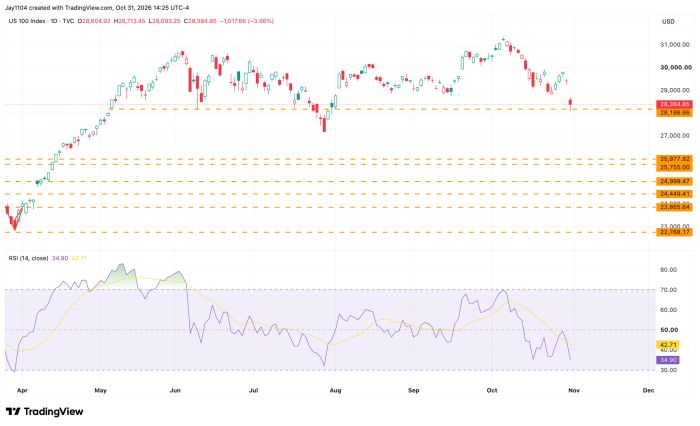
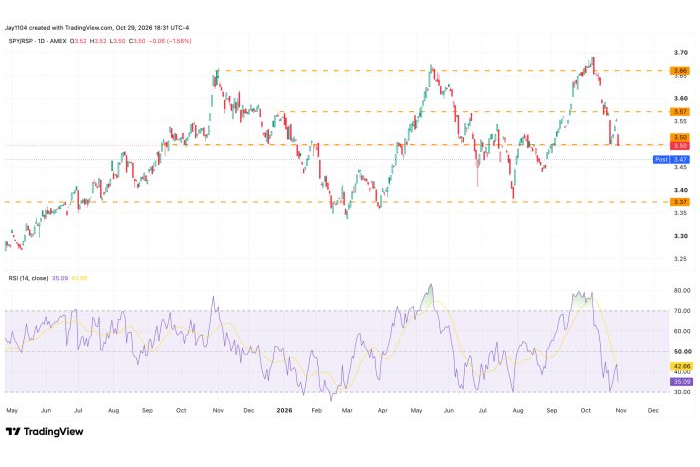
The stock markets had a pretty hard sell-off Friday afternoon, with the S&P 500 down over 1.8% and the Nasdaq down almost 3.5%. The Nasdaq broke a key support level, and the S&P 500 broke below a mild support area. Other levels still sit beneath both that could keep things together into Monday, and the SMH found support and bounced.
The 1-day VIX finished sharply higher, so there is an opportunity for the kind of Monday vol-crush bounce we have seen a couple of times now. What stands out this time is that the VIX model shows a VIX around 19 is pretty much where it should be, given where single-stock volatility and 1-month implied correlations are. If anything, it finished Friday slightly too low relative to implied correlation and dispersion.
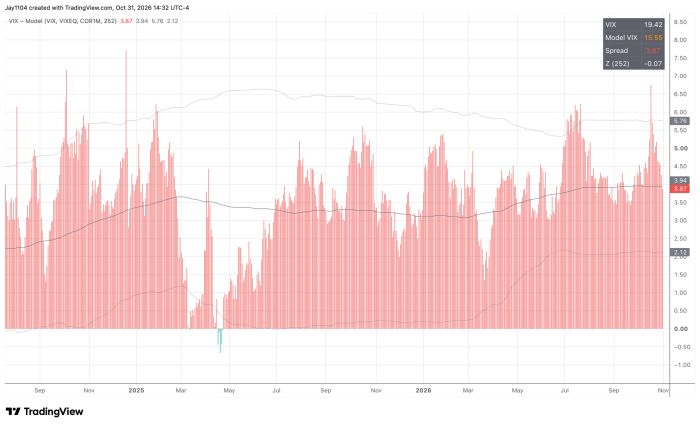
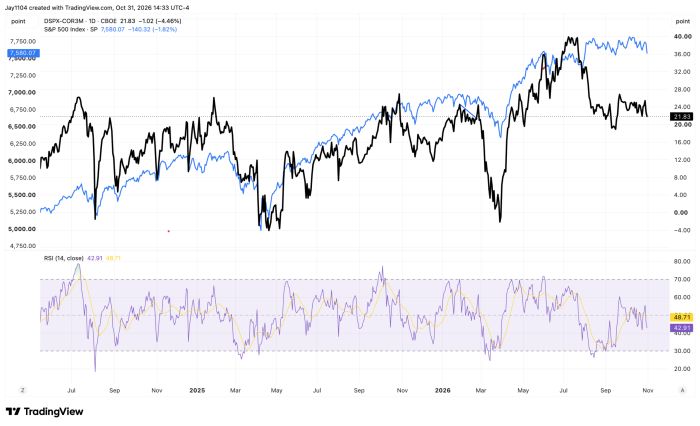
We are also at the point in the year when implied volatility and dispersion should start coming down. Once earnings season passes, single-stock implied volatility typically falls, correlations rise relative to dispersion, and the spread between the two narrows. That is not a supportive season from a volatility standpoint. That doesn’t mean the market can’t rise, but I think it is unlikely the VIX will melt back to the low 14s we saw in mid-September and early October. The model says 19 is about what to expect, and with the election on Tuesday, implied volatility may rise right through it as hedges go on.
In individual names, Nvidia (nvda) fell over 4% on Friday, AMD over 10%, and the SMH about 7%. I think the equity market is starting to catch up to what the credit market has been telling us for nearly a year. Broadcom’s (avgo) forward earnings yield (the inverse of the P/E ratio) has moved right along with its 5-year credit default swap. As the CDS has widened, the multiple has sunk, a direct result of the market repricing the credit risk that comes with this AI spending.
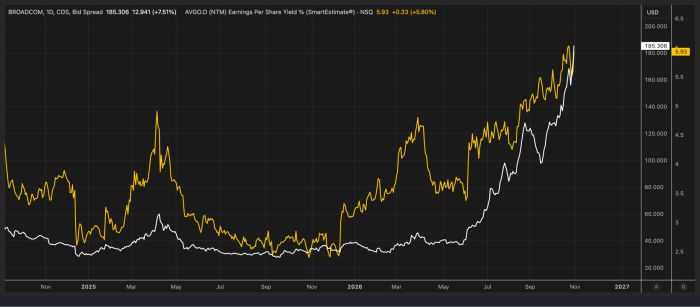
The question is whether the repricing continues or eventually stops. From what I can see, credit is repricing these names faster than earnings growth is changing, so the offset is no longer in equilibrium. If that continues, or growth slows even a little, I think stock prices could keep contracting, especially in the more vulnerable sectors.
I think there is a broad misunderstanding of how to think about the CDS market. This is not about these companies going out of business. It is a reassigning of credit risk, and S&P put Meta on negative credit watch Friday after the close. These stocks could ignore credit while forward earnings growth was solid. Now capex is eroding free cash flow, which could mean new equity issuance that dilutes earnings per share and lowers earnings growth over time. This is not like 2008, and a lot of it is self-inflicted. If one of these companies stopped spending, my guess is its CDS would narrow, which wouldn’t be good for its stock or for the semiconductor names that depend on that spending. I have watched this market for over a year with a lot of respect, and it has been easy to track the whole time.


Comments
Log in or sign up to join the conversation.