

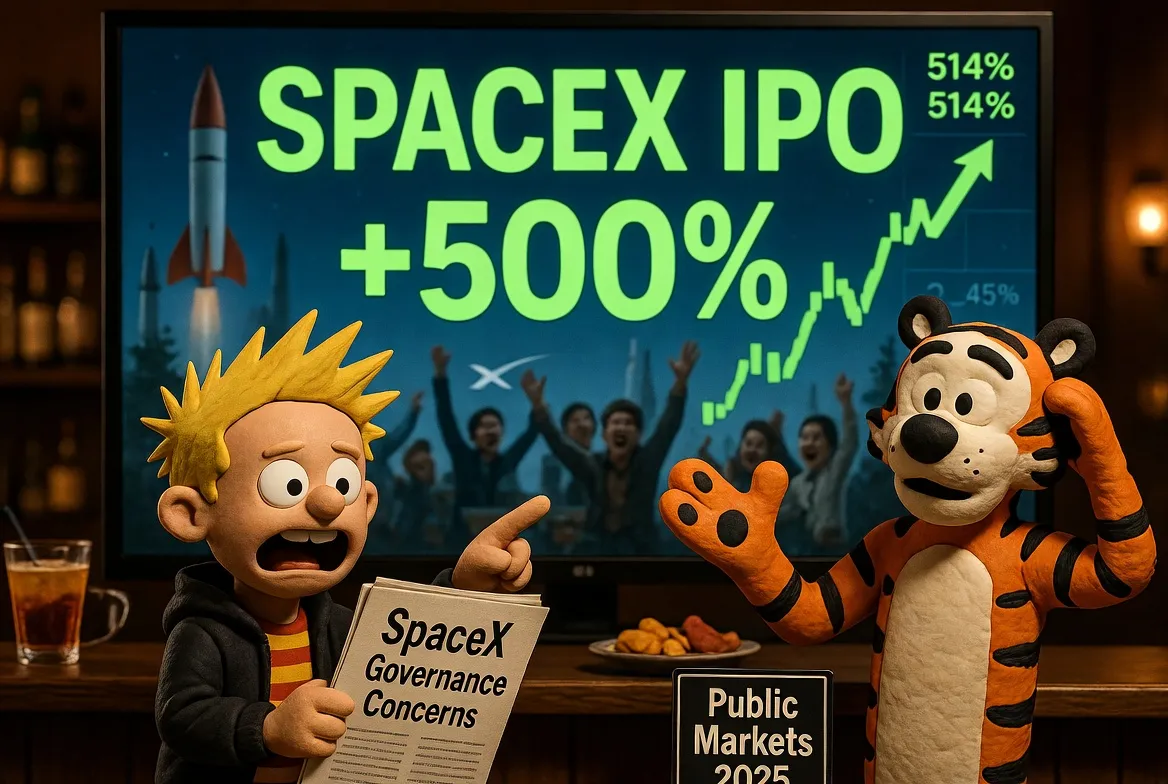
The upcoming SpaceX IPO bothers me.
And I want to be explicit and unapologetic about it.
I view it as one of the greatest sources of hypocrisy in today’s market environment.
The company is preparing to go public at a valuation somewhere between $1.75 trillion and $2 trillion.
The proposed governance structure would give Elon Musk 42.5% of equity and roughly 84% of voting control through dual-class shares that carry 10 votes each.
Reports indicate the Nasdaq (NDAQ) modified its fast-track inclusion rules to allow mega-cap IPOs into the Nasdaq-100 after 15 days rather than 3 months.
S&P (SPGI) has proposed removing its profitability requirement for large offerings.
Nine thematic “SPACE” ETFs have launched or filed over the past three months, another effort by the growing passive-funds industry to clip a few percentage points off returns for investors in the name of democratization...
The American Federation of Teachers, representing 1.8 million workers with retirement assets in the trillions, has publicly warned that its members would be effectively forced to buy into the company at a valuation that “defies financial logic.”
Let me tell you…
If I’m agreeing about ANYTHING with AFT President Randi Weingarten, a person who essentially demands a government monopoly on children’s education and zero competition in her industry, you know something’s off…
Whether the final numbers land exactly at the valuation doesn’t change the argument.
This is a structural analysis, not a price target… and a history lesson.
What’s being constructed… whether it’s SpaceX or whoever comes next… is the logical endpoint of a 40-year evolution in how public markets stopped functioning on the backbone of “capitalism,” accountability, and everything we were told about markets in the 20th century.
It’s worth understanding, without emotion, what has changed and who benefits from the change.
Further, I think this IPO is a masterclass in hypocrisy… all set against the ever-evolving landscape of what it means to have money and power in this nation.
It’s not a right-or-left issue…
This is an up-or-down one.
What Public Markets Used to Mean
Back in my father’s day, when people walked up hill both ways to get to Wall Street, going public had real significance.
If a company wanted capital, it had to follow the… what I’ll call… ‘Rules of the Exchange.’
I stress the word “Exchange” - because it’s not just a term that defines the trade between buyers and sellers. I’m not talking about the rules of the NYSE…
I’m talking about the well-established trade between companies and the infrastructure of public markets.
In exchange for access to the deepest, most liquid investor base on earth, the founders accepted a set of conditions.
They diluted their ownership.
Shareholders received voting rights in relation to their financial stake.
Courts remained accessible for disputes between shareholders and directors.
Activist investors could challenge management and buy shares with voting rights, and press for changes that benefit all shareholders.
Boards answered to the people whose money they were managing.
Price discovery happened because buyers used math to decide whether the company was worth the ask, and sometimes the answer was… “No.”
This was the trade… the bargain… the exchange.
It behaved this way for centuries. There was a transfer of capital in exchange for accountability, transparency, and public governance.
The last four decades have given us something much different - a gradual, systematic unbundling of those rules and traditions.
Economic exposure, governance power, legal recourse, access to liquidity, and downside responsibility came as a package deal.
When you bought a share, you got all five.
Today, they are increasingly separated, and the separation is the point…
This now follows a pattern.
Instead of those five pillars, today’s “public market” increasingly provides liquidity, valuation support, retirement capital, a passive bid floor, and exit liquidity for early investors.
This is the reality.
Now, under current accommodations, the insiders retain voting control, board authority, information advantages, legal insulation, float scarcity, and compensation structures tied to the stock price that the public mechanically supports.
The media, advocates, and everyone else who isn’t really paying attention (or lacks the fortitude) still call all of this “investing.”
More and more, only one side really participates in ownership in any classical sense.
How did we get here?
We can start in 1993 with the first ETF on the passive side.
But the real disconnect began in 2004 with Google (GOOGL).
The company went public with dual-class shares in 2004. No one blinked. It was believed that founders should be able to maintain control and make decisions around their companies. But they could have stayed private if they wanted to…
The argument is that more people would benefit from the company’s growth if it went public. And that has worked out for a lot of investors - but it was the first break in the tradition - and the first domino to fall.
Facebook (META) followed in 2012, and that’s worked out well for the public, too, financially...
But then Snap (SNAP) went public in 2017 with no voting rights at all for outside shareholders, and the market barely flinched. Snapchat is down 77% since its IPO, and I remember talking to CalPERS at the time about how they were adamantly opposed to having to own this thing under the rules of the passive investing flows.
Next came Lyft (LYFT), Pinterest (PINS), Zoom (ZM), and Palantir (PLTR)… and the erosion continued.
We also had the explosion of SPACs in 2020, which enabled concentrated ownership to enjoy borderline-exploitative tax benefits at the expense of public investors.
Each listing pushed the governance boundary slightly further, and each time the market accepted it because the companies were growing and the stocks were going up.
As we know, this is America, and when stocks go up, structural objections tend to get filed in the drawer marked “Things we’ll worry about later.”
The SpaceX structure, if it proceeds as reported, would combine all of the concessions at once and at a scale that makes the precedent permanent…
This is the future… companies of the future will get all the benefits of public markets without the associated risks.
The SpaceX IPO demands dual-class voting, mandatory arbitration, class-action waivers, CEO/CTO/chairman concentration, Texas incorporation thresholds, a 5% float, and prearranged fast-track index inclusion at a valuation above 100x revenue.
Every previous listing was a step.
This will be the final destination.
The Passive Plumbing
To understand the statement around passive bids, you have to understand how money really moves through the American retirement system.
Most people don’t understand capital structures, and the people who built the system aren’t in a hurry to explain it.
Three firms… BlackRock (BLK), Vanguard, and State Street (STT) collectively manage roughly $25 trillion in assets and control the voting power associated with an enormous share of American corporate equity.
Passive index funds now account for more than half of all U.S. equity fund assets.
The majority of 401(k) contributions flow into target-date funds that automatically allocate to index products.
Most of this happens without a single person deciding if any individual company deserves the capital it receives.
Americans believe they are “investing.”
They are technically… but through an at-scale automated capital-routing process.
Money enters the retirement system through payroll deduction, flows into target-date funds selected by plan administrators, gets allocated to index products managed by a handful of firms, and lands in whatever companies the index committee has decided belong in the basket.
The ordinary investor chose none of this.
That person was told to “set it and forget it,” and that was presented as wisdom rather than surrender.
This creates a buyer that is 100% different from anything that existed in classical capital markets.
A passive index fund does not ask, “Is this company worth the current price?”
Instead, it asks, “Is this company in the index?”
Those are different questions.
The difference between them is where the entire thesis lives.
Old-school, discretionary investors would look at fundamentals, consider valuation, weigh risk, and sometimes walk away.
A passive fund buys when the index says to buy, at whatever price the market is offering, and in whatever quantity the weighting demands.
It is a price-insensitive, mechanically obligated buyer.
And when tens of trillions of dollars operate on that basis, the market begins to reward index eligibility over fundamental quality…
That’s because the capital doesn’t care about quality.
It cares about inclusion.
Float Scarcity is Now a Weapon
Let’s talk about the real weapon in this IPO.
If you’re a company going public, and you know that tens of billions in passive capital will be forced to buy your stock the moment it enters a major index, you have an incentive to keep the float small.
When a stock has a thin float, buying becomes concentrated in fewer available shares.
That compressed buying amplifies price impact, fuels rising market capitalization and index weight, and forces more buying during the next rebalance.
This is a reflexive loop, not a bug in the system.
It is a feature that can be designed to benefit the people at the very top of the food chain… in this case… Elon Musk.
Tesla (TSLA) proved this in December 2020 when its S&P 500 inclusion triggered a self-reinforcing rally that added roughly $200 billion to its market cap in the weeks surrounding the event.
The passive bid created the price increase, which raised the index weight…
The mechanics of the market pushed the weight higher, which forced more buying.
Tesla had a larger float and a lower starting valuation than what’s being discussed for SpaceX.
The index rules weren’t reportedly modified in advance at the company’s request.
Well, right now, let’s consider what a 5% float means.
At a $2 trillion valuation, this is about $100 billion in tradable shares.
Even at a conservative free-float adjusted index weight, you are looking at billions in forced demand compressed into an artificially scarce supply.
The structural parallel is closer to luxury scarcity mechanics…
Not a public stock market for companies.
This looks more like a private market for limited-edition sneaker drops, fine art markets, and crypto token supply caps…
None of this looks anything like classical equity investing.
The supply is constrained by design.
The demand is automated by structure.
And the stock’s price will emerge from the collision of it all…
The Rebalance Math
I remind everyone that index funds don’t hold cash reserves.
These funds are ALWAYS fully invested.
So, when a new stock enters the index, the fund raises capital by selling proportionally across every other name in the basket.
At full-cap weighting, a $2 trillion entry would represent approximately 7.4% of the Nasdaq-100.
Doing some back-of-the-envelope math, a name like Apple (AAPL) would compress from roughly 9% to about 8.3%.
Across $500 billion in capital, that implies billions in Apple sold… not because of anything related to Apple’s business, but because the index math demanded a reallocation.
The same will go for Microsoft (MSFT), Nvidia (NVDA), Amazon (AMZN), Meta, Broadcom (AVGO), and Tesla…
All of them will be trimmed.
We’ll see tens of billions of dollars pulled from companies with decades of proven cash flow, redirected into a company at 100x revenue that has never traded a single day on a public exchange in… likely… the first 15 days of trading.
Watch as everyone in the media marvels at what happens, with people suggesting that investors are very optimistic about the company and the future.
In reality, they’re not explaining the actual mechanics driving this IPO.
The float-adjusted scenario is less dramatic but structurally identical.
The capital still comes from somewhere.
The selling is still forced.
Recall that the stocks that will experience selling didn’t do anything except exist in the same index as a new entrant with a governance structure that ensures the public capital flowing in has no meaningful influence over how it gets used.
One Person’s Retirement
Now, let me go back to the point about Randy Weingarten and the AFT.
I want to remind you of a situation where a public school teacher in Maryland, with a state pension and a supplemental 403(b) plan set up by her HR department through a target-date fund.
She contributes automatically from every paycheck.
She picked the fund because the enrollment form said it was “age-appropriate” and “professionally managed.” She likely didn’t read the paperwork and just trusted whoever manages the funds… because that’s how it works in this country.
This teacher doesn’t know what’s in the fund. She has never looked at the underlying holdings. She was told she didn’t need to.
Imagine her fund holds an allocation to the Nasdaq-100 index.
When SpaceX enters the index, her fund will sell a proportional slice of every company she currently owns to buy SpaceX at a valuation above 100x revenue…
This will happen under a governance structure that offers no voting power, restricts her access to the courts through mandatory arbitration, prevents her from joining a class action, and requires either $1 million in stock or 3% of the company to even force a vote on a proposal.
This teacher didn’t choose this.
The money she earned was allocated to her retirement account.
She can’t refuse this scenario, and most people who work in education or contribute to a pension system won’t even know it happened.
If something goes wrong, she has very few legal remedies.
In fact, that process would be almost unrecognizable to the generation of regulators who built the public market framework that she was previously told to trust.
The old way of thinking is that… well… she and retirees “own the market.”
In reality, she owns little more than an increasingly concentrated basket of mega-cap momentum stocks. All of these names were selected by index committees and float mechanics that she likely doesn’t know exist.
This is all governed by people she can’t vote out, under terms she never agreed to, and funded by contributions she was told were safe.
All while central banks print money to support the underlying infrastructure, and the Treasury Department considers direct intervention in the repo markets that fuel the leverage in those mega-cap momentum names.
And this is what we’re calling capitalism?
What Is This?
I want to be clear about this because the imprecise version of this argument is “capitalism is broken,” and that framing is lazy and wrong.
Classical capitalism, at least in theory, featured price discovery, dispersed ownership, competition, accountability, risk of failure, and shareholder rights.
It also assumed that credit creation was constrained by something… gold, reserve requirements, political accountability, at minimum the pretense that someone in a position of authority had to justify the expansion of the money supply to the people whose purchasing power it diluted.
What is evolving in the public markets is something different.
It’s become a system of centrally planned credit creation through monetary and fiscal expansion that aims to perpetually protect the borrowing power and the political power of the central planners. And it creates massive incentives for free-riding.
This is all a system that no one voted for, amplified by incentives over time...
This whole thing funds state-backed retirement plumbing that feeds quasi-automated capital allocation into concentrated governance structures.
And it does so through engineered scarcity, legal asymmetry, and institutional dependency loops.
As a result, capital remains sticky (and close to permanent) regardless of company performance.
Meanwhile, the Fed’s balance sheet actions and the Treasury’s increasingly active management were never put to a referendum, but acted as massive support mechanisms for this experiment.
None of it was debated in terms that would allow an ordinary citizen to understand that the money in their retirement account was being devalued to fund the liquidity environment that makes the SpaceX structure possible in the first place.
The credit creation happens at the top, and the passive plumbing then distributes it downward.
The public markets increasingly function as liquidity infrastructure for private power rather than mechanisms for shared market ownership and accountability.
Again, the money is public, but the credit creation is centrally planned.
The control is private, but the risk is socialized through retirement systems.
All of the upside is privatized through governance structures.
And the connective tissue… the indexes, the inclusion rules, the passive mandates, the float engineering, the monetary expansion that made all of it possible… was all built in plain sight…
It’s been happening, one mechanism at a time, for 40 years, and not a single piece of it has been voted on by the people whose savings depend on it.
The historical parallel here is probably the Nifty Fifty era of the early 1970s.
Back then, this was a small group of “one-decision” stocks that institutional investors bought because they were considered permanently safe.
These actions drove valuations to 50x, 60x, and 80x earnings regardless of fundamentals.
When the regime broke in 1973, the same concentration that had amplified the rally amplified the collapse, and the stocks that had been “must-own” dropped 70-90% over two years.
The difference between then and now is that the buying in the 1970s was driven by human conviction.
Today, buying is driven by index math, meaning flows don’t gradually weaken as conviction fades… and it’s sustained by persistent efforts by central banks and political appointees to rescue the bond market through active management…
The Hypocrisy of Now
Here’s where I speak candidly.
There exists a large group of financial media, politicians, investors, and casual market participants who regularly call themselves “free market capitalists.”
They always talk at length about the beauty of competition, the wisdom of markets, the discipline of price discovery, the moral superiority of letting capital flow to its highest and best use…
Now, watch as many of them turn around and defend this structure as “a great business” and an opportunity for average Americans to get wealthy on SpaceX.
They will tell you that SpaceX is an incredible company, which it probably is…
I recognize that Starlink is transformative…
But the real hook here is this argument that everyone is going to make money, and, for a while, they probably will.
These voices will act like “everyone made money” settles the question.
It does not settle the question.
“Everyone is making money” is not a defense of a corrupted market structure.
Everyone was making money in 2006.
Everyone was making money in 1999.
Everyone was making money in every single bubble in the history of financial markets right up until the moment they weren’t…
The people who said “but the company is great” were never the ones who absorbed the losses when the structure broke.
The question was never whether the rocket works.
The question is whether a system that forces price-insensitive public capital into governance structures designed to eliminate public accountability… funded by centrally planned credit expansion that no one voted for… is something a free-market capitalist should be defending with a straight face.
Because that is not free market capitalism.
That is, whatever the opposite of free-market capitalism… but just wearing its skinsuit.
The danger is not just overvaluation.
The danger is that price-insensitive capital stops distinguishing between innovation and financial engineering….
That we’re eventually no longer able to distinguish between companies that deserve our investment capital and companies that have been structured to capture it.
Because what ACTUALLY makes markets functional?
Friction… skepticism… and consequences.
When markets don’t have these?
What are they?
The grand irony is that Americans were told that passive investing would remove emotion, speculation, and Wall Street games from the system.
That it would democratize ownership and give ordinary people a fair shot at building wealth without being taken advantage of by those with better information and faster connections.
What happened instead is that the system automated the games.
The speculation didn’t disappear.
It moved into index construction, float engineering, governance design, and inclusion eligibility.
The ordinary people still provide the capital.
They just no longer have any mechanism to influence how it gets allocated, who it benefits, or what happens when the structure breaks.
They were told to buy the index.
So, they bought the index.
The index is now a source of exit liquidity…



Comments
Log in or sign up to join the conversation.